
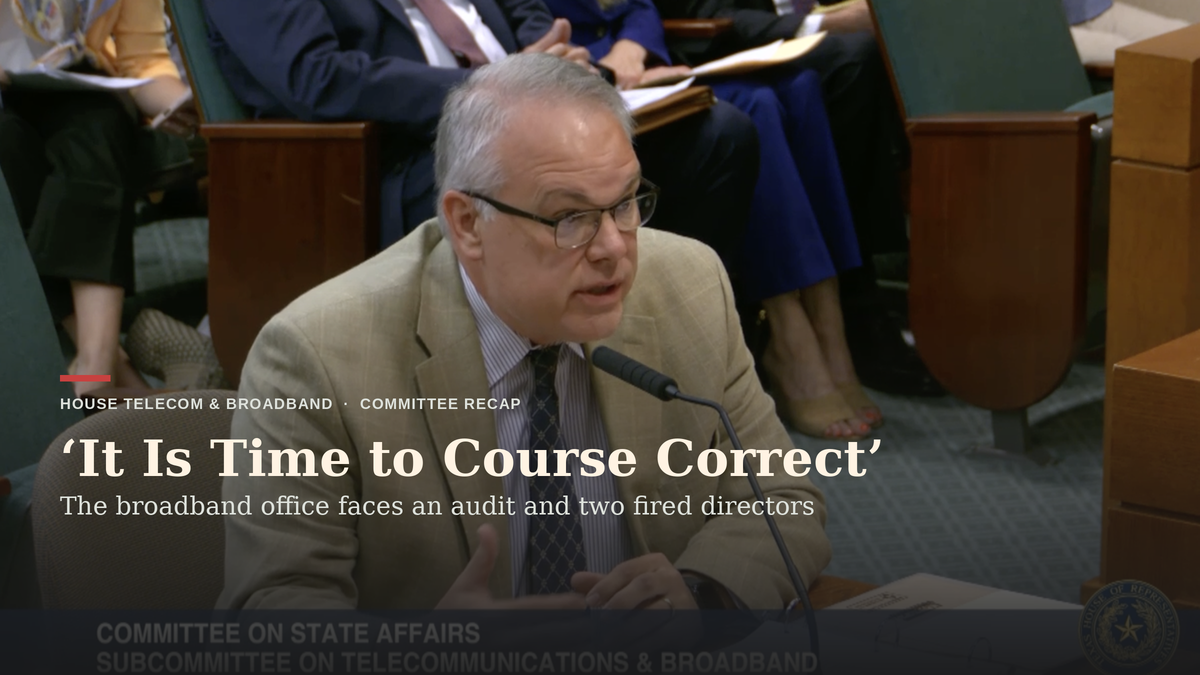
The state office distributing more than $5 billion in broadband money arrived at the Capitol on Aug. 18 with two fired directors behind it, a state auditor’s investigation ahead of it and a new manager who did not defend the record. “The previous administration went astray, and it is time to course correct,” Will Counihan told the House Subcommittee on Telecommunications & Broadband. Counihan, a 26-year veteran of the comptroller’s office, said he had taken over the division housing the Broadband Development Office on Aug. 7 — 11 days before the hearing.
Chair Rafael Anchía, D–Dallas, set the stakes in his opening. “Our appointed comptroller has dismissed the head of the BDO and the prior head of the BDO,” he said. Counihan confirmed the reasoning came from above: the comptroller “shares the concerns that were raised” in Senate testimony, he said, and “feels that the program was not being run in the most efficient and transparent way possible.”
The audit is narrower than the shake-up. “It related to the awards for the low earth orbit satellite program — and irregularities in that award,” Anchía said. “It is the subject of a state auditor’s audit and inspection.” Counihan said the office is cooperating: “We have been contacted by the SAO. We intend to fully participate in that audit.” As The Texas Dispatch previously reported, Lt. Gov. Dan Patrick and Speaker Dustin Burrows called for the review in July.
Counihan brought one concrete reversal. The office has “rescinded awards to two projects within the middle mile program, one in Central Texas and one in North Texas,” totaling “about $53 million,” he said — money that had not moved: “No money had been awarded, no work had been done.” He ruled out reviving them: “We do not have an intention to do a middle mile project west of Fort Worth or in central Texas.”
Anchía spent much of the charge documenting what the office does not track. Its public dashboard has gone stale, and Counihan could not commit to a fix: “We do not have a due date right now.” Asked about staffing, he said, “Right now I believe there are 20 FTEs,” with an organizational chart still being drawn. Asked whether awarded providers face any speed-test or completion incentive, Counihan answered, “I really had not given any thought to that.” Asked whether the office keeps a watch list of at-risk grantees, he said, “If we do, I have not been briefed on that.”
The chair drew the conclusion himself. “The private sector has had to develop their own coverage maps because the BDO — despite it being one of the core competencies of the office — did not have a map that was satisfactory to the marketplace,” Anchía said.
The satellite awards at the center of the audit have a second problem: the locations may not need service. Wes Robinson, regulatory affairs director for East Texas Telephone Cooperative, told members federal officials have asked states to re-examine the addresses assigned to low earth orbit providers, and the early result is stark. Analysts are “reporting 43% of the LEO locations are now served,” he said. “And so they may no longer be eligible for funding.” Anchía noted the policy change that put satellites in the running: “The Trump administration also permitted low earth orbit satellites to qualify for bid, whereas previously they had not.”
Communities found out too late to object, a philanthropy witness said. Texas Rural Funders’ executive director told members that “many communities who thought they would be eligible for BEAD dollars to build fiber have been selected for satellite service, but only found out once the eligible service locations were announced — when it was too late to make any changes.”
The most detailed complaint came from a cooperative that lost a bid. Charlie Conway, chief executive of Etex Telephone Cooperative, described a Marion County award in which his co-op was told it had missed a term for the program’s low-cost service option — a term the solicitation itself defined twice. “The NOFA contained two conflicting periods in separate sections,” he said. He also said the process moved after bids were in: “The winning bidder, an out-of-state company with no prior presence in Marion County, was allowed to lower its bid price to match what Etex had submitted after the initial bids.” His summary was the phrase members returned to: “the same pattern — lack of transparency, moving the goalposts.”
The scale under review is large and, so far, largely unspent. Texas drew “$3.3 billion” from the federal program, Counihan said, against a total identified need he put at roughly $10 billion, with about $1.3 billion awarded and roughly $2 billion of non-deployment money still uncommitted. Voters approved the $1.5 billion state Broadband Infrastructure Fund as Proposition 8 “with 74%,” he said; roughly $700 million to $800 million of it remains after transfers including $75 million for pole replacement and $155 million for next-generation 911. He said the office now judges 97.6 percent of Texas locations sufficiently served.
Delivery is the weaker column. Under an earlier state grant round, the office awarded $11.2 million against a $120 million budget and $180 million in applications, Counihan said. In the current round, budgeted at $701 million across two funding sources, he reported 21 projects with 15 extension requests, more than 42,000 locations less than half complete, roughly 39,000 more than half complete — and none finished.
Because this was an interim hearing, the subcommittee took no votes; the chair noted there was no bill before it. Findings flow into the House State Affairs Committee’s interim report and any broadband legislation filed in the 90th Legislature, which convenes in January 2027 — when Patrick and Burrows have said they intend to act on the audit’s results.
Also heard
The subcommittee worked two charges over 4 hours and 27 minutes, with a recess between them. The afternoon block — about 134 minutes, the longer of the two — took up pole attachment fees, where electric cooperatives and broadband providers gave members competing rates for the same pole and split over whether the Legislature should set a single statewide formula. A third charge on public-private partnerships for wireless first responder networks was dropped from the revised notice and did not come up.
Fact box
Issue
Interim charge monitoring the Broadband Development Office, federal BEAD awards and the state Broadband Infrastructure Fund (~111 minutes, ~42% of the hearing — second-largest charge by time, led here on news judgment because the office’s leadership turnover and pending state audit are the larger story)
What happened
The comptroller’s new division director told members the office’s prior leadership “went astray,” confirmed the state auditor has opened an inspection of low earth orbit satellite awards, and disclosed that two middle-mile awards worth about $53 million had been rescinded; he could not answer questions on staffing, dashboard updates, completion incentives or a grantee watch list; a cooperative alleged an out-of-state bidder was allowed to revise its price after bids were in; no vote (interim hearing)
WhenTuesday, Aug. 18, 2026, 11:00 AM CT · run time 4:27:24
WhereRoom E2.030, Capitol Extension, Austin (revised notice — room change)
Chair
Rep. Rafael Anchía, D–Dallas (HD-103)
Archived video
house.texas.gov, video 22745