
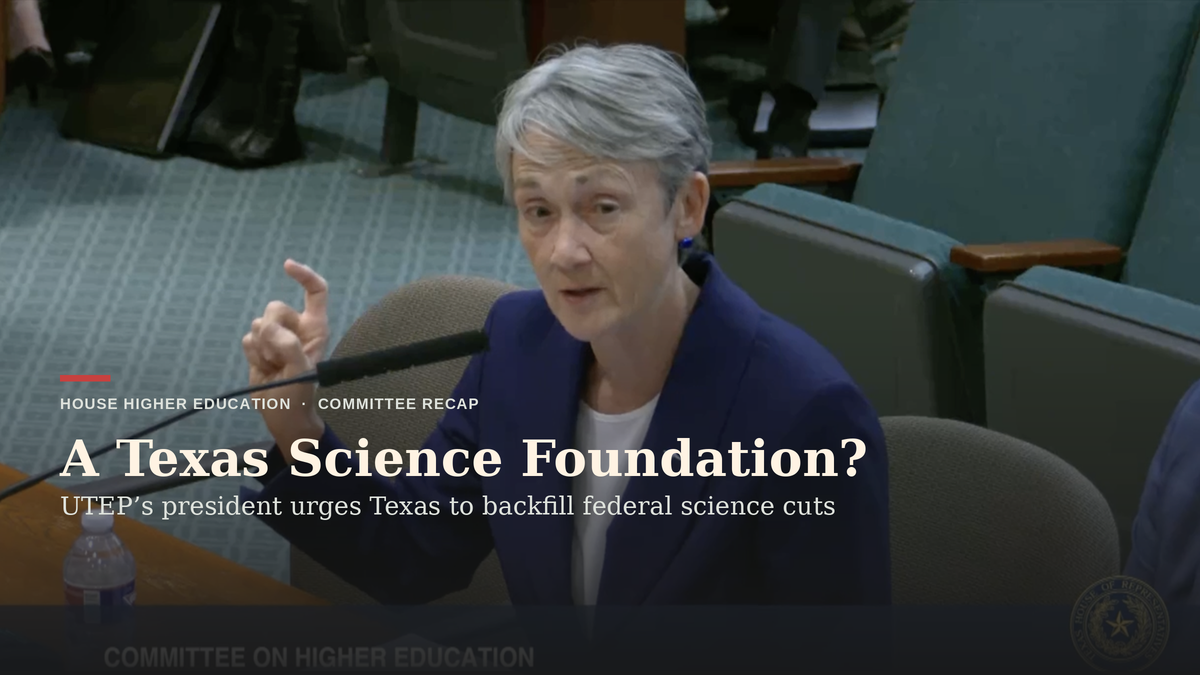
Washington is pulling back from basic science, and a Texas university president told House members Aug. 18 that the state should be prepared to take the field. “Maybe it is time to establish the Texas Science Foundation to step in, step up, and lead,” said Heather Wilson, president of the University of Texas at El Paso, in the longest stretch of a House Higher Education Committee hearing that ran more than eight hours.
The proposal — floated by a former member of Congress who once sat on the National Science Foundation board — landed as the committee’s central idea for the 90th Legislature.
Wilson laid out the position Texas is defending. “In 2024, $2.81 billion in federal research went to Texas to 71 different universities in the state of Texas. Texas is fourth in the nation,” she said. Then she rejected the ranking: “Honestly, per capita, it should be higher. We shouldn’t be fourth, we should be higher than that.”
Congress approved roughly $48 billion for the National Institutes of Health and about $9 billion for the National Science Foundation last year, she said, and “again this year, the Office of Management and Budget proposed a 50% cut” to both.
Her case for a state foundation rested on money Texas already spends. The state is “the number one funder of cancer research in the United States of America, to the National Institutes of Health. Number two is the state of Texas, over $9 billion over the last decade, and pretty soon will be probably number two when it comes to dementia research as well,” she said. “American research prowess was not handed to us.”
The sharpest technical fight of the day was over indirect costs — the overhead the federal government pays universities on top of a grant. Rep. Vincent Perez, D–El Paso, opened it. “There’s been an attempt to reduce those to 15% and that would adversely affect universities,” he said. “Could you explain to the committee what the indirect costs go to?”
Wilson answered with a restaurant. “If you go to a restaurant and you order a plate of enchiladas off the menu, and then you get the bill and you say, well, I’m really only going to pay for the food on the plate and the time of the waiter,” she said. “The feds have said 15%. Well, somehow that restaurant has got to pay for the chef’s time. They’ve got to pay for the plates and the pots and the oven and the electricity bill and the bookkeeper and the general manager.”
The rules are not the universities’ to write, she added: “The feds decide what direct and indirect is, what goes in each pot. And then they come to every university and they audit us.” So far, she said, “the federal courts and the Congress have not gone along with this 15% indirect approach.” If the cap survives, the bill moves: “The second way is to shift the costs to the states, because these are real costs.”
The Army offered the opposite view from the same numbers. Lt. Gen. Miles Brown, acting commanding general of U.S. Army Transformation and Training Command, told members overhead at some universities “can approach 85 to 90%. So if I have a $10 project, it’s going to cost me $18.”
He said the Department of War has directed contracting officers “to really push down the facilities and overhead to try to shoot for 35% and below,” and dismissed the current arrangement as “a 20th century model around university affiliated research centers and things like that.” Brown also said he watches how fast money moves: “You would be very surprised, people that over time do not spend or obligate the money.”
Chair Terry M. Wilson, R–Georgetown, used Brown’s testimony to reframe the charge itself. “Our charge, examine the ability of Texas public higher education institutions to compete for and secure federal grant funding. It kind of sounds as if it’s in terms of Texas lens,” he said. “But frankly, it’s not about Texas. It’s first about national security and our national defense.” He later described the state’s problem as a matching exercise: pairing university capability with the state’s agencies and boards “so that we can put our limited taxpayer dollars best to use.”
A witness from the National Security Innovation Council supplied the comparison that stuck. Texas has “about 17 national security demand signatures” inside the state, he said, across the Air Force, the National Geospatial-Intelligence Agency and several intelligence branches — and yet “we’re still at about half of where California is today. New York has about a third more.” He proposed a companion body to Wilson’s idea: “a Texas Federal Intelligence Research Council, something that is looking at where the Congress, where the administration might deploy the next $100 billion or the next trillion dollars.”
Wilson offered a cheaper move as well. The National Science Foundation underfunds its graduate research fellowships, she said, so Texas could take “the ones that are highly qualified but below the federal funding line and fund more of those. The evaluation has already been done.”
Lance McMahon of Texas Tech University Health Sciences Center argued the state’s rural footprint is an asset federal funders will pay for, since West Texas communities “experience higher rates of chronic disease provider shortages” and thin access to clinical trials. Vice Chair Donna Howard, D–Austin, pressed the limits of that pitch. “Obviously you’re not going to be able to just put a bunch of more people into the rural communities that would change everything,” she said. “But I guess this is a big challenge for us obviously, to look at.”
Because this was an interim hearing, the committee took no votes. Members will carry the record into the interim report and the bills filed in the 90th Legislature, which convenes in January 2027 — with a state science foundation now on the list.
Also heard
The committee worked four interim charges over 8 hours and 17 minutes, taking them out of numerical order. A 115-minute block on foreign adversarial influence and research security produced the day’s other news: Michael Lucci of State Armor testified that the Department of War had notified 30 American universities the previous day of an expedited foreign-infiltration audit due at month’s end, and said the University of Texas at Austin was reportedly among them. Asked to score Texas out of 100 on research security, he said “maybe like a 35 — and that’s the best in the United States.” A shorter closing charge on affordability produced the hearing’s biggest number: the Texas Higher Education Coordinating Board said funding every eligible student in the state’s three main aid programs would cost $714 million above base.
Fact box
Issue
Interim charge on the ability of Texas public institutions to compete for federal research funding (~153 minutes, ~31% of the hearing — the largest charge by time)
What happened
UTEP’s president proposed a state-run Texas Science Foundation to backfill federal science cuts; witnesses and members clashed over the federal push to cap indirect cost recovery at 15 percent, with the Army arguing university overhead of 85 to 90 percent is unsustainable; no vote (interim hearing)
When
Tuesday, Aug. 18, 2026, 9:00 AM CT · run time 8:16:48
Where
Room E2.036, Capitol Extension, Austin
Chair
Rep. Terry M. Wilson, R–Georgetown (HD-20)
Archived video
house.texas.gov, video 22750