
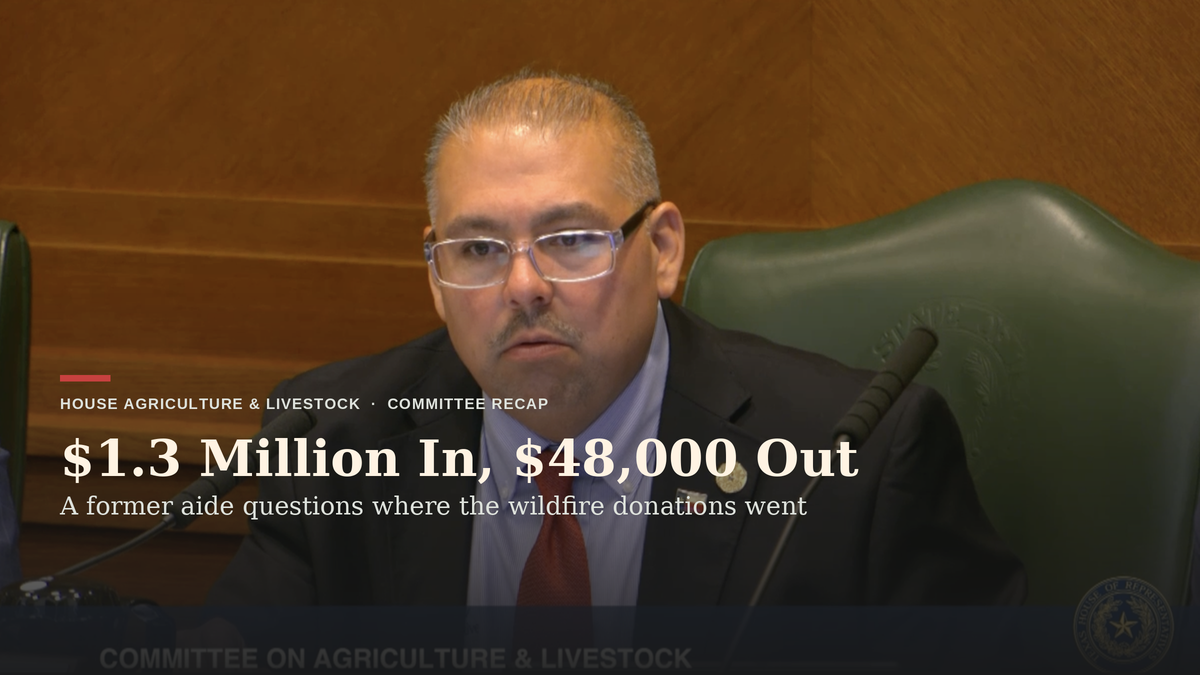
A woman who once worked in Agriculture Commissioner Sid Miller’s office walked into a Texas House hearing Aug. 18 with a dollar figure for the state’s disaster relief fund and asked members why so little of it reached ranchers. “Between February 26th and December 31st, 2024, $1,325,234.88 was raised and deposited into the Texas STAR Fund in connection with that very fire,” Bonnie Cudlipp told the House Agriculture & Livestock Committee, referring to the 2024 Panhandle wildfires. “During that same period, only $48,000 was distributed to ranchers within that fire zone.”
Her question was the plainest one asked all day: “If more than $1.3 million was raised to help these ranchers, why did only $48,000 reach ranchers in that fire zone?”
Cudlipp, who identified herself as a former executive assistant to Miller, tied the accounting to the committee’s other business — the state’s new $100 million farm lending program. “As House Bill 43 expands agriculture assistance, I believe we need to ask an equally important question: do we have the right people with the right agriculture knowledge, experience and judgment administering these programs?” she said. She closed on why she left: “I didn’t leave because I didn’t love our farmers and ranchers. I left because I knew we weren’t actually helping them.”
Miller returned to the room hours later in public testimony to answer. “There was some testimony earlier that I’d like to correct. It was very inaccurate, delivered by a disgruntled employee, unfortunately,” he said. He put the fund’s lifetime totals at roughly $2.4 million collected and $2 million disbursed over his 12 years in office, with about $400,000 on hand, and said the Panhandle fires drew “about $1 million for that fire alone. H-E-B actually gave us $500,000.”
Then Miller conceded the point that makes Cudlipp’s figures difficult to rebut. Asked whether the agency can trace donations back to the disaster that generated them, he answered: “No, so we don’t have a mechanism to do that.” He also described a rising award cap: “When I first started 12 years ago, our cap was $4,000 with a 1 to 1 match. Right now we’re up to $15,000 limit.”
The oversight charge covering the committee’s 14 agencies ran about 133 minutes, the second-longest block of a nearly seven-hour hearing, and Miller used his own turn to register objections to how the Legislature reshaped his authority. Under HB 43, he said, “appointments now belong to the governor, six of the nine. So I really don’t have control over the board.” He said his advice on the largest grant program was overruled: “I recommended that we make no interest loans to these gins so that money would come back in. We’d have an evergreen fund.” Instead the state made grants, and demand swamped supply.
The AgLink program drew “169 applications” and “$68 million worth of requests. We were able to fund 22 million,” he said, and a producer program drew “1100 applicants.” As The Texas Dispatch previously reported, the department opened the AgLink continuity grants earlier this year.
The screwworm response took the largest single share of the oversight charge. The Texas Animal Health Commission‘s executive director told members that “since Texas confirmed its first case of New World screwworm on June the 3rd, we have identified only 45 cases across 16 counties,” against “more than 38,000 cases in 29 of its 31 states” in Mexico since November 2024. He put the containment in historical context: a 1972 reemergence “caused more than 90,000 animals in Texas to be infested.” As The Texas Dispatch previously reported, the state’s case count has slowed through August.
“The fact that Texas has limited this outbreak to 45 cases is not the result of chance,” he said. “It is a result of preparation, partnership and an aggressive response strategy.” The agency has run “more than 46,300 animal inspections within the infested zones and issued over 1700 movement certificates.” Sterile fly production is the federal lever: partners “were able to buy us some time with the 100 million flies that they produced a week ago in Panama,” with “80% of the flies over Texas, and then the other 20% into Mexico.” He credited a tool the 1970s response lacked: “What’s helped this time is being able to control the animal movement.”
His forecast was the charge’s most consequential line for budget writers. “Unfortunately, we’ll be dealing with screwworm probably for 10 to 15 more years, as long as it remains present in Mexico,” he said, adding that the agency’s plan is to redirect the response toward cattle fever tick eradication and that “we will definitely be asking for some funding.”
TAHC general counsel Janine Coggeshall put the ask on the record: the agency operates with 227 people against an approved 228.2 positions and “we’re going to be requesting 118 FTEs” for screwworm and cattle fever tick work. “We have come to almost the limit of what our agency is able to do with the current resources for cattle fever tick,” she said.
Other agencies reported shortfalls of a different kind. Zach Brady, outside counsel for the Texas Boll Weevil Eradication Foundation, said the program has spent “$1.8 billion eradicating the boll weevil from our state” and retired more than $200 million in debt to zero.
Kendra Ray, executive director of the Texas State Soil and Water Conservation Board, described her agency as hands-on — “We move dirt, plant grass, establish good stewardship” — on $144.4 million a biennium. Her request grew out of the past two years of flooding: roughly “2000 flood control dams in the state are lacking adequate emergency action plans,” and she asked for $5 million one time to fix it. The dam program’s backlog dwarfs its budget: $50 million a biennium against “the $4 billion backlog of estimated costs.”
Because this was an interim hearing, the committee took no votes. Members will carry the record into the interim report and the agency budget fights of the 90th Legislature, which convenes in January 2027.
Also heard
The committee ran three charges over 6 hours and 56 minutes, out of numerical order. The largest, about 230 minutes, took up the resiliency of Texas agriculture, where commodity groups told members corn now sells for roughly its 1996 price against production costs up 150 to 200 percent and that the state loses up to 2,000 acres of working land a day. A closing 51-minute charge reviewed implementation of House Bill 43, the Texas Agricultural Finance Authority overhaul, where the Texas Farm Bureau said applications under the improved programs “requested more than 335 million in assistance, so demand far exceeded the available funding by more than 3 to 1,” and witnesses asked lawmakers to let the authority’s board meet virtually and to restructure an interest-rate-reduction program that ties up a full $1 million of budget to deliver a producer $20,000 to $30,000 a year in savings.
Fact box
Issue
Interim charge on oversight of the committee’s 14 agencies under Section 301.014 of the Government Code (~133 minutes, ~32% of the hearing — second-largest charge by time)
What happened
A former aide to Agriculture Commissioner Sid Miller testified that $1,325,234.88 was raised for the STAR Fund in connection with the 2024 Panhandle wildfires while $48,000 reached ranchers in the fire zone; Miller called the testimony inaccurate but conceded the agency has no mechanism to track donations to the disaster that generated them; the Texas Animal Health Commission reported 45 screwworm cases, forecast 10 to 15 more years of response and said it will request 118 additional positions; no vote (interim hearing)
When
Tuesday, Aug. 18, 2026, 11:00 AM CT · run time 6:56:27
Where
Room E1.026, Capitol Extension, Austin
Chair
Rep. Ryan Guillen, R–Rio Grande City (HD-31)
Archived video
house.texas.gov, video 22781