
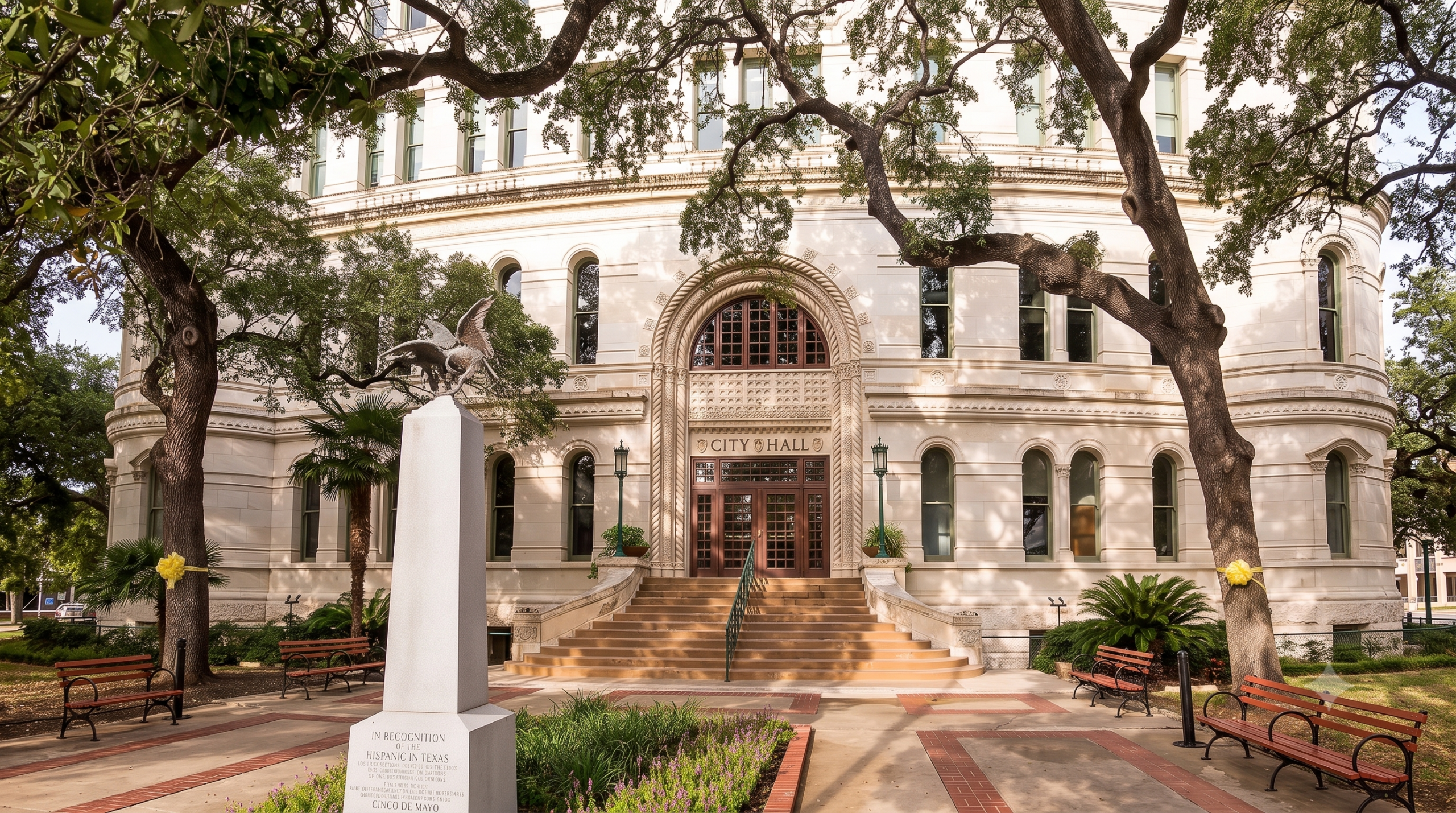
San Antonio City Manager Erik Walsh presents his formal 2027 budget to the City Council today, and it is expected to carry something no city budget there has carried since the early 1990s: a property-tax rate increase. The rollout of the proposed budget was announced in an August 3 city news release — town-hall meetings across the city August 17-28, public hearings on the tax rate and budget September 2 and September 10, and a final council vote September 17, ahead of a fiscal year that begins October 1.
For the owner of an average San Antonio home, the stakes were priced in the city’s June “trial budget” — the early draft staff showed the council — at about $81 more per year, or $6.75 a month, according to the San Antonio Report, a nonprofit newsroom that has tracked the budget process. Today’s document is the first since the county’s appraisal rolls settled enough to put a number on the actual rate.
The city faces a $158 million budget shortfall over the next two years. Its base taxable values — the value of property already on the rolls, not counting new construction — fell 2.1 percent this year, a hit to the property taxes that supply about 30 percent of the city’s general fund. “At the end of the day, our expenses are growing faster than our revenue,” Walsh told reporters at the June presentation, per the San Antonio Report. “So we’re going to have to approach it from both sides.”
The June trial budget called for raising the rate as high as state law allows without an election. Under the 2019 property-tax law, a city can collect up to 3.5 percent more property-tax revenue than the year before — new construction aside — before it must ask voters. San Antonio staff proposed maxing that out, worth roughly $66.6 million, and stacking on what the law calls the “unused increment” — in plain terms, tax capacity the city banked in years it stayed under the cap — worth another $58.2 million over two years.
The rate increase is one line in a longer column of costs. A San Antonio Report tally in June put the combined increases the average homeowner faces at about $167 a year so far — before any school-district elections. Alamo Colleges has approved a budget hinging on its first rate increase in more than a decade, about $33.84 a year on a median homestead. San Antonio Water System wants $3.91 more a month in year one. CPS Energy has floated a possible 4 percent electric increase. Northside, San Antonio and South San Antonio ISDs are all weighing November tax-rate elections. Bexar County, by contrast, says it will close its gap with cuts, not a rate increase.
San Antonio’s math is the same mechanism now playing out across Texas: when values fall, the tax-rate arithmetic pushes rates up to hold revenue steady, as The Texas Dispatch reported when the state’s rate-posting deadline arrived last week. El Paso’s council has already advanced the highest rate it can adopt without an election; taxing units statewide had to post their calculated rates by August 7.
Council members have signaled resistance, and Mayor Gina Ortiz Jones has pushed staff toward deeper cuts instead, singling out city contributions to nonprofits. Walsh’s answer in June was to show them the alternative: “Some of the council members [said] … ‘How do we cut our way out of it?'” he said, per the San Antonio Report. “We’re going to walk them through what that looks like.” From today, the council has five weeks — two public hearings and a string of town halls — to decide whether San Antonio homeowners get their first city rate increase since 1993, and it would take six of eleven votes to force a different answer.