
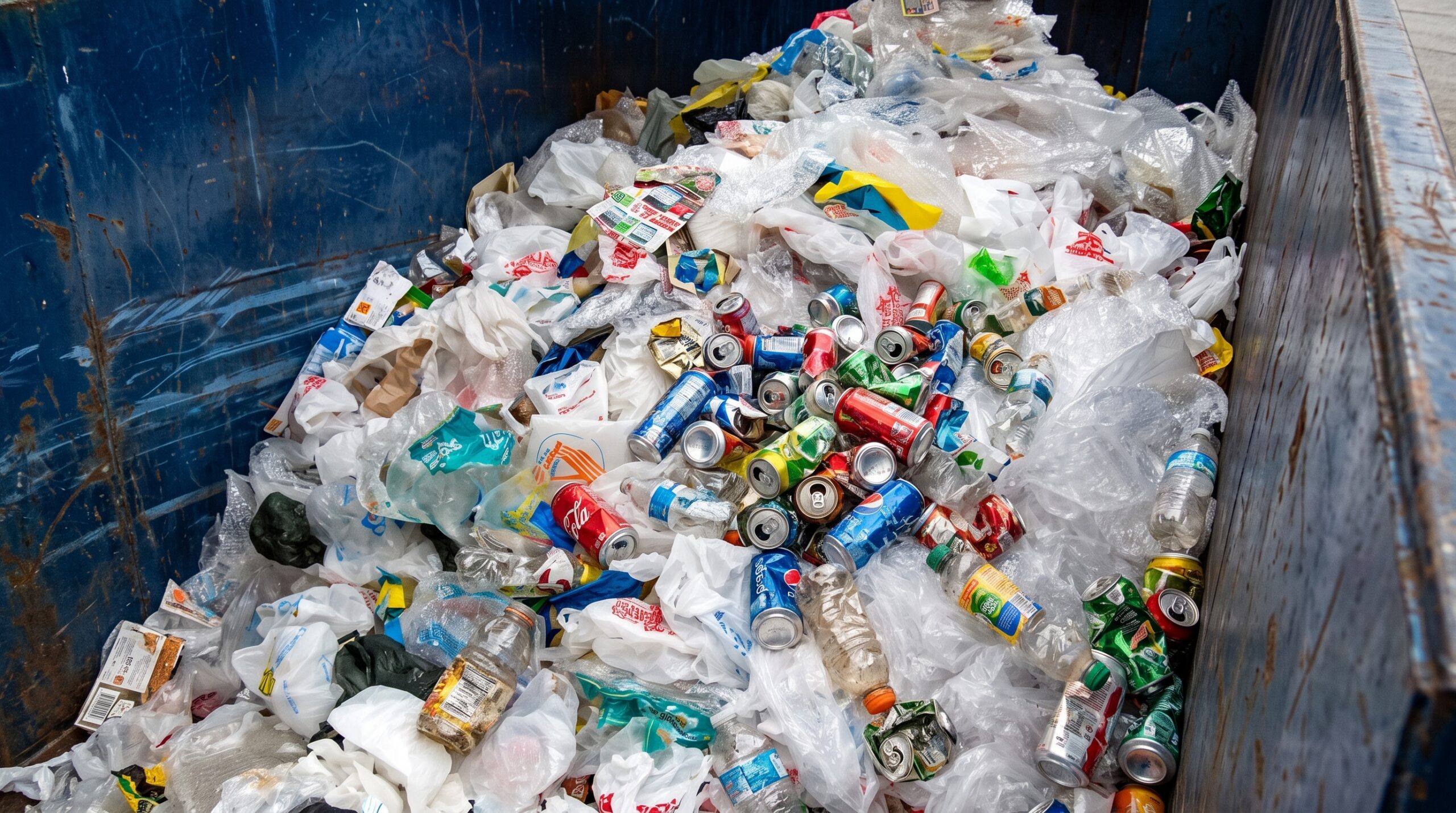
McLennan and Nueces counties landfill or litter roughly 390 million beverage containers a year, by a Texas Dispatch estimate, and at the scrap prices Texas A&M researchers used that material was worth about $7.9 million. That is more than the Texas Dispatch estimates the Waco and Corpus Christi areas spend picking up litter in the first place.
For three weeks this series has followed the cost of litter: what cities and counties cannot say they spend, who ends up paying and the cleanups that repeat every month. This week the question turns around. What is the trash in the ditch worth, and who wants it?
The starting point is a February 2025 brief from the Mosbacher Institute at Texas A&M’s Bush School of Government. According to the university’s summary, Texans bought 23.7 billion beverage containers in 2021 and recycled 5.2 billion. The other 18.5 billion were “buried in landfills or strewn across the state’s landscapes.” The state missed out on $372.6 million in scrap value that year, a figure the university’s summary describes as scrap metal.
The Dispatch divided those statewide totals by the 2021 Texas population, about 29.5 million, which works out to roughly 630 containers per resident a year, or about 12 a week. Applied to the Census Bureau’s 2025 estimates of 272,020 people in McLennan County and 352,992 in Nueces County, that comes to about 170 million containers worth $3.4 million in McLennan and about 221 million worth $4.5 million in Nueces. These are population shares of a statewide estimate, not counts, and the values are at 2021 prices.
Set beside the Dispatch’s earlier cleanup estimate, built from a 2017 nine-city engineering study adjusted for inflation plus state, county and nonprofit spending, the material is worth more than the pickup. In the Waco area the Dispatch put cleanup at $1.8 million to $2.2 million a year, so the containers thrown away are worth 1.6 to 1.9 times that. In the Corpus Christi area cleanup runs $3.0 million to $4.4 million, and the containers are worth 1.0 to 1.5 times as much. Both figures are rough. The point is the scale: these counties discard about as much value as they spend to clean up, and likely more.
Scrap value is not money a city could simply collect. Gathering, sorting and hauling cost money, which is why curbside programs rarely recover what the material is worth. Prices have also moved sharply since 2021. As the Dispatch reported in July, the national price for used plastic bottle bales fell to 1.74 cents a pound in March 2026, a collapse recyclers blamed on cheap new resin and imports. Aluminum cans have held their value far better, so the metal share of the figure is worth more today and the plastic share less.
The price swings already show up in city budgets. Corpus Christi is paying $48.72 for each blue recycling cart this year, up from $44.57, a 9 percent increase that city staff attributed to “fluctuation in the cost of plastic resin.”
The plastic Texas does not collect is the raw material for a plant on its own coast that has never run. Corpus Christi Polymers, a joint venture of Alpek, Indorama Ventures and Far Eastern New Century, was built to make the PET resin used in beverage bottles. Alpek paused construction on Sept. 27, 2023, saying “high inflationary rates, construction and labor costs have surpassed original expectations,” and the site has not restarted. The pause was about building costs, not litter. But the plant illustrates the supply question: NAPCOR, the PET plastics industry’s trade association, says more than 30 PET recycling and manufacturing facilities in Texas struggle to get enough recycled plastic locally and import it from overseas.
“We are importing trash that is completely unnecessary,” Raymond Robertson, the Mosbacher Institute’s director, said when the brief was released. The researchers found that 46 percent of plastic water bottles are recycled in states with a system to collect them and 10 percent in states without one. In Texas, fewer than one in five are recycled.
What does not get collected ends up on the coast. In May, 53 volunteers removed an estimated 4,600 plastic bottles from San José Island in two hours, about 95 percent of the 1,430 pounds they hauled off, according to KRIS 6.
Until Texas has a way to catch those cans and bottles before they end up in public places or the landfill, McLennan and Nueces counties will keep paying to pick up a supply that, by the Dispatch’s estimate, is worth more than the cleanup.