
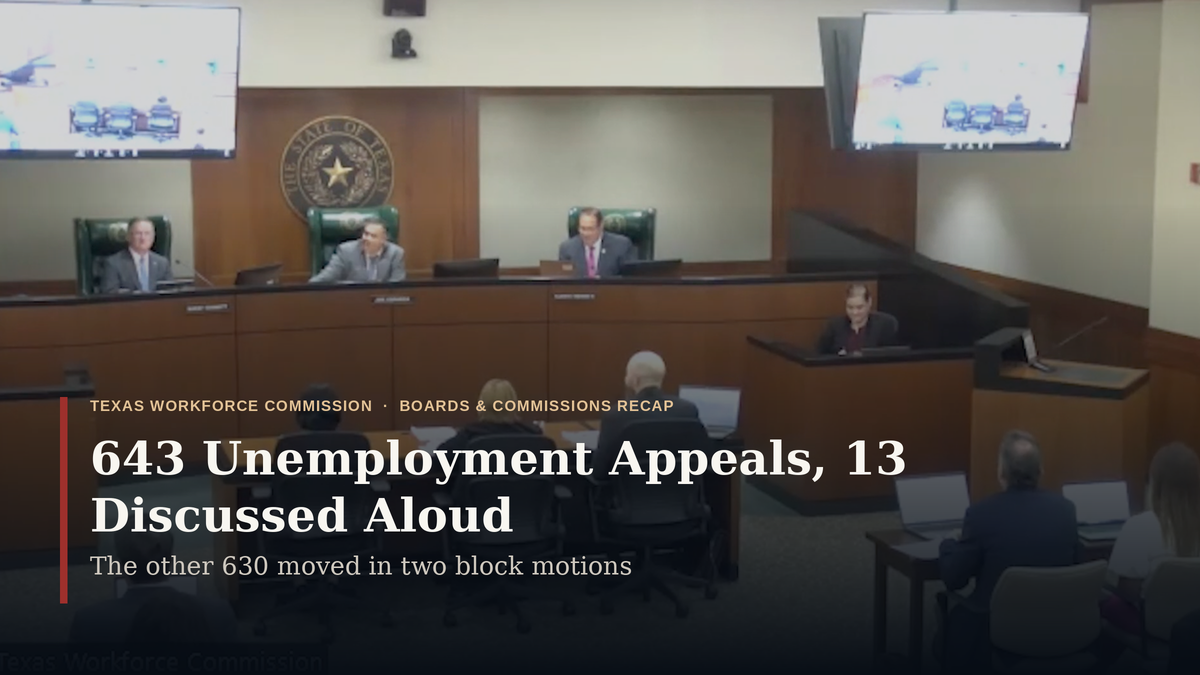
The last word on a Texas unemployment claim belongs to three people in a room in Austin, and on Oct. 20 they got through 643 of them. Thirteen were discussed aloud. The other 630 moved in two motions.
For the people in those files this was the end of the road inside the agency. Each of the 643 had already been through a hearing officer and then an appeal tribunal. Once the commissioners vote, the only route left is a suit in state district court — a lawyer, or going it alone against a former employer. The notice announcing the meeting listed case numbers and nothing else: no names, no employers, no amounts, no hint of which way staff had recommended.
The thirteen that got airtime are a catalogue of how Texans lose work. A caregiver at an assisted living facility was fired after missing mandatory hourly checks, leaving a resident, by one account read into the record, “in distress for over 4 hours”. A man quit after a supervisor cursed and threatened him and his wife; the trouble had started, on another account, when a supervisor gave him a pill he took for Tylenol and he blacked out. A worker was discharged over diesel that escaped a tote valve. Another was fired over “What the heck?” in a private conversation with a co-worker. Two more turned on whether a temp had reported back for reassignment in exactly the manner her staffing agency required.
On twelve of the thirteen, at least one commissioner dissented. Three opinions were read on every case and they often reached three different results. On the caregiver’s file, one would have reversed and found misconduct, one would have affirmed that there was none, and one would have reversed on different reasoning. On the temp who missed the reporting step, one found she had effectively made herself available and was “laid off for lack of work”; another found she had “effectively quit her role”.
They agreed outright once, and what they agreed was to send the case back. A bank employee fired for changing a member’s information said a manager had authorized the change; the commissioners remanded for that manager’s first-hand testimony and for the employer’s late evidence to be entered properly.
The other 630 moved on a formula the meeting repeated four times. One commissioner moves to “accept staff recommendations on the remaining UI cases”; a second seconds it “except for those cases which I am dissenting as reflected on UI short form dissent list”; a third concurs with the same reservation. Then: “And the motion passes with the exceptions noted.” What is on those dissent lists is never said aloud, and nothing in the notice or on the video tells a claimant where one could be read. Not one of the 18 wage claim cases was pulled for discussion at all.
None of this means the work was not done. The video runs 28 minutes, but that is the length of the public meeting, not of the deliberation: the commissioners read the files beforehand, every case already carries a hearing record and a tribunal decision, and a dissent noted on a short-form list is a real dissent by a real commissioner. High-volume appeal bodies everywhere decide most matters on the papers, and a system that argued all 643 out loud would move slower for everyone waiting in it. What the meeting shows is not that the deciding does not happen. It is where it happens — out of sight of the people it is about.
How the 643 came out is not on the record either. Nobody said how many went to claimants and how many to employers, the notice carries no totals, and the commission gave no breakdown. No trade association, legal aid organization, employer group or legislator has taken a public position on how these dockets are handled.
Two items with wider reach sat on the same agenda — statewide programs paid for with federal workforce, welfare, adult education and child care money, and a standing review of what Washington has changed since the last meeting. Neither appears on the video, which covers the dockets and then stops, with a commissioner wishing an absent assistant a happy birthday. The commission meets again Oct. 27.
One tax case, no argument. A single tax liability case sat on the second docket and none on the first. All three commissioners agreed with staff and it took under a minute. Nothing to reconsider. Three separate agenda items for cases the commission might revisit were each confirmed empty on the record. A quorum two hours earlier. The same three commissioners were separately noticed to appear at 8 a.m. at the agency’s fifth annual GRACE conference — its event on persuading employers to hire people leaving the justice system — a filing that exists because three commissioners in one room is a meeting under state law. Nothing from it appears on this video and nothing is reported about it here. No public comment. The chairman asked and nobody had signed up.