

Early voting opened Monday on a question Texas has spent a decade engineering its way toward. The state’s bond database says voters will decide $62.9 billion in local borrowing on Nov. 3. While that number is massive, the number smaller number is sharper: at least 35 school districts, one county and two cities are asking permission to tax above the cap the Legislature set, and the operating revenue at stake — about $273 million a year on the ballots that state a figure — is the money that pays teachers, deputies and the people who keep the parks open.
That is the trade-off Texas has been circling since 2019, now stated on a ballot. The state limited how much local governments can raise without asking. Property values stopped rising as fast. Federal pandemic money ran out. Insurance, housing and groceries kept climbing. And the ten largest school districts in Texas are all in a deficit. Something was always going to give. Nov. 3 is where voters say what.
Three bills hiding in one number
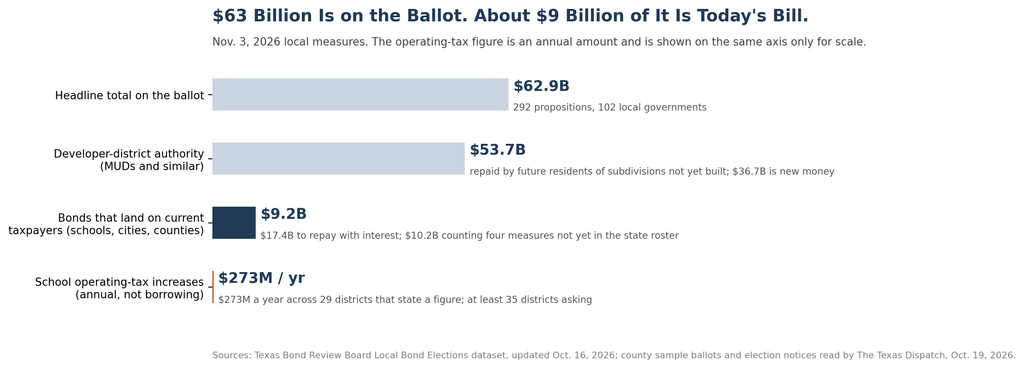
The $62.9 billion headline is real and mostly irrelevant to anyone who already pays Texas property taxes.
A Texas Dispatch reconciliation of the Bond Review Board’s dataset — 292 propositions across 102 local governments, queried Oct. 19 — separates it into three very different asks.
$53.7 billion is developer-district authority. Sixty-four municipal utility districts, management districts and similar entities are seeking permission to borrow for water, sewer and roads in subdivisions that largely do not exist yet. The debt is repaid by future homeowners; the voters in a brand-new district are often a handful of early residents or the landowner’s designees. The single largest item on any Texas ballot this fall is Denton County MUD 7, at $8.29 billion. Roughly $17 billion across all districts is “refunding” authority — permission to refinance later, not new borrowing.
$9.2 billion lands on existing taxpayers. Strip the developer districts out and the school, city and county bonds that current property owners will repay total $9.23 billion in principal, $17.37 billion with interest by the issuers’ own estimates. Add four measures the Dispatch found on official ballots but not yet in the state roster — Austin’s $295 million parks and libraries package, Collin College’s $600 million, Anna’s $60 million and Rice CISD’s $55 million — and it is about $10.2 billion.
$273 million a year is the operating question. At least 35 school districts are asking voters to ratify a maintenance-and-operations rate above the state’s compressed ceiling, alongside Dallas County, Garland, University Park and Austin Community College. No state agency tracks these elections; TEA, the comptroller and the Bond Review Board do not keep a list, and the school boards association’s tracker is members-only. The Dispatch’s count comes from reading sample ballots in 19 counties. For the 29 districts whose ballot language states a dollar figure, the added annual revenue is $273.4 million.
The first bill is a story about exurban growth. The second is a story about buildings. The third is the one that decides whether a district can make payroll, and it is the one nobody counts.
What the operating asks are for
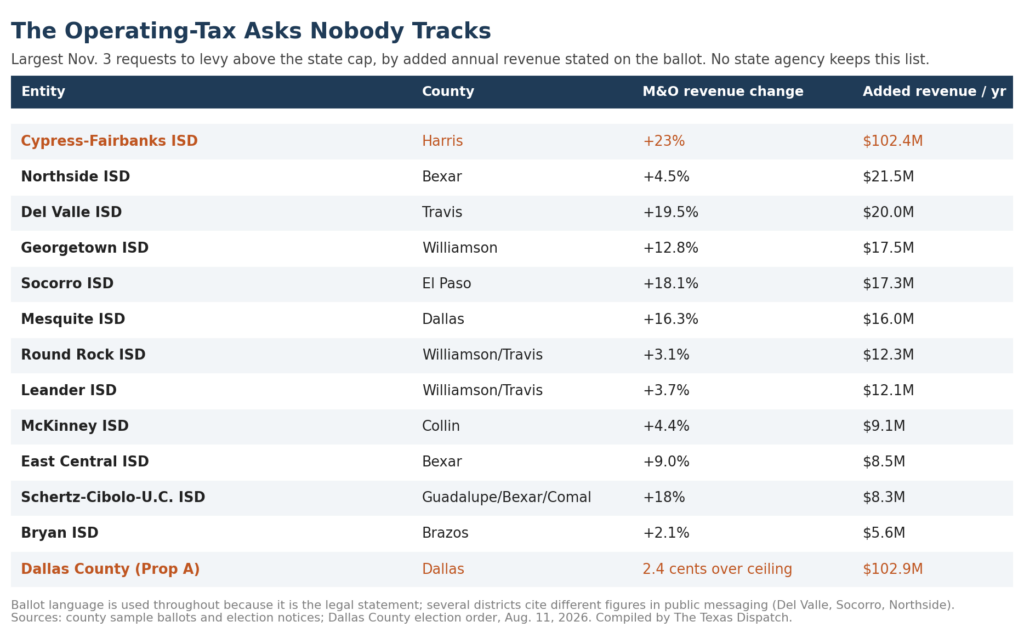
Cypress-Fairbanks ISD is the whole tension in one district. It is asking for a $1.636 billion bond across four propositions — $1.3 billion for buildings, $256 million for technology, $61 million for stadiums, $20 million for pools — with an estimated $3.23 billion repayment. On the same ballot it is asking for a 23 percent increase in operating revenue, $102.4 million a year, 37 percent of every operating-tax dollar requested statewide. The district approved a $1.2 billion budget in June with an $80.9 million projected deficit, after roughly $94 million in cuts, citing enrollment decline, utility and fuel costs, and state funding that has not kept pace with inflation.
The pattern repeats at smaller scale. Del Valle, Socorro, Mesquite, Georgetown and Schertz-Cibolo are each asking for operating increases between 12 and 20 percent. Districts cite teacher pay and deficits almost uniformly. Several — Navasota, Poth, Spring, Bay City — are “penny swaps” that move rate from debt service to operations without changing the total, a sign the constraint is the operating cap specifically, not the total rate.
Dallas County’s Proposition A is the only county-level tax increase the Dispatch found anywhere in Texas. The election order ties $102.9 million to homelessness and mental-health programs; the county puts the cost at $116.03 a year on a $350,000 home. Collin County’s $817.5 million bond is the largest county request — $296.5 million for courts and jail space, $475 million for roads, $40 million for an elections building, $6 million for parks. The City of Dallas’s $443 million public safety bond prints its $629.6 million repayment figure on the ballot itself.
Those are the services. Courts, jails, roads, mental health, teachers, classrooms. The asks are not exotic.
Why now
The squeeze is structural, and the Dispatch has reported each piece of it separately this year.
The revenue side is capped. Senate Bill 2 in 2019 limited cities and counties to 3.5 percent annual revenue growth without an election; House Bill 3 that year compressed school district rates and pinned the operating rate to a state formula. Both were built for a world of rising values. This year values flattened or fell — Bexar County’s base shrank 1.3 percent, Fort Worth’s average home lost 5.5 percent — and the cap that was meant to restrain growth began binding on governments whose revenue was already declining.
The cost side is not. The state’s $8.5 billion school finance package last session raised the basic allotment by $55 — less than one percent — while directing the rest to teacher pay and targeted allotments. Districts told lawmakers in June it was not enough; one expert put the gap at $19.6 billion “just to have the same purchasing power as they did back in 2019.” A TASB survey found 44 percent of districts in deficit midway through the fiscal year and 70 percent planning cuts for next year. In San Antonio, three of twelve districts are balanced. Austin ISD’s deficit is $105 million and it plans to borrow $140 million this fall to make payroll while it waits for tax revenue.
Cities are in the same place. Dallas is laying off more than 100 employees and cutting library hours. Fort Worth is eliminating vacant positions and cutting back on civilian raises. Bexar County’s manager called this the worst year for property tax revenue in 30 budgets.
And the economy is cooling rather than collapsing, which matters for how this reads. The Dallas Fed cut its 2026 Texas job growth forecast to 1.2 percent in September, below the state’s two percent long-run average, after a flat 2025, citing constrained labor supply, low oil prices and weak housing. Unemployment is 4.4 percent. That is a slowdown, not a crisis — but it is a slowdown arriving at the moment the cost of living has already outrun wages. Homeowners insurance is up 79 percent in six years. The Tribune has described Texas as a state once considered one of the most affordable in the country where affordability is now the defining issue.
The taxpayer gave first
Before any of this reached a ballot, the people paying the bills had already absorbed more than the cap was designed to prevent.
The Legislature’s 3.5 percent limit restrained the growth of local revenue. It did not reverse the base. Total Texas property tax levies rose from $73.5 billion in 2021 to $89.4 billion in 2025, 22 percent in four years, and over the longer run have grown far faster than population and inflation combined. Texas homeowners carry the seventh-highest effective property tax rate in the country, with a median bill above $4,200 — in a state with no income tax, where the property bill is the tax most people feel. Layer on homeowners insurance up 79 percent in six years, and the fixed cost of simply keeping a house has outrun most household budgets even where the rate stayed flat.
The relief the state has delivered went overwhelmingly to one group. Homestead exemptions rose to $140,000 last November; 40 percent of Texas homeowners now pay no school property tax at all, and roughly 61 percent of those over 65 or disabled pay none. Those are real reductions for the people who qualify.
But only 63 percent of Texans own their homes. The other 37 percent rent, and a renter gets no homestead exemption, no senior freeze and no 10 percent appraisal cap. The property tax on an apartment complex is a line in the owner’s operating costs, and it is passed through in rent. Multifamily and commercial property were given a 20 percent appraisal circuit-breaker in 2023, a looser limit than homesteads, and no exemption. The same is true of the small business in a strip center: under the net leases that dominate Texas commercial real estate, the tenant pays a proportionate share of the property tax directly, typically alongside insurance and maintenance, and that share rises with every reappraisal. When Harris County goes to its ceiling or Cy-Fair wins its 23 percent, the restaurant owner and the renter pay it without ever seeing a tax bill with their name on it.
That is why the demand for relief is not a preference held at the margins. A University of Texas poll found 75 percent of Texans rated property tax reduction extremely or very important for the Legislature to accomplish. Texas 2036’s August survey found 77 percent more likely to back a candidate who supports reducing them. In the latest UT poll, costs of living and the economy together drew 36 percent of open-ended responses on the most important issue facing the state, more than any other category. Some of that is ideology. Much of it is arithmetic: a household whose insurance, rent and groceries rose faster than its wages does not experience a 3.5 percent cap as restraint.
So when a district asks voters for 23 percent more, it is asking people who have already given. The question on Nov. 3 is not whether taxpayers will start absorbing the squeeze. It is whether they will absorb more of it, and for what.
The state, for its part, is not short of money. The Economic Stabilization Fund hit its $26.9 billion cap in late 2025, the comptroller expects it to exceed the cap for the first time in history this year, and state leaders in July ordered agencies to cut spending by three percent — exempting public education and the new education savings account program. The contrast between a full state reserve and local governments borrowing to make payroll is the political fact underneath every one of these ballots.
What voters did last time
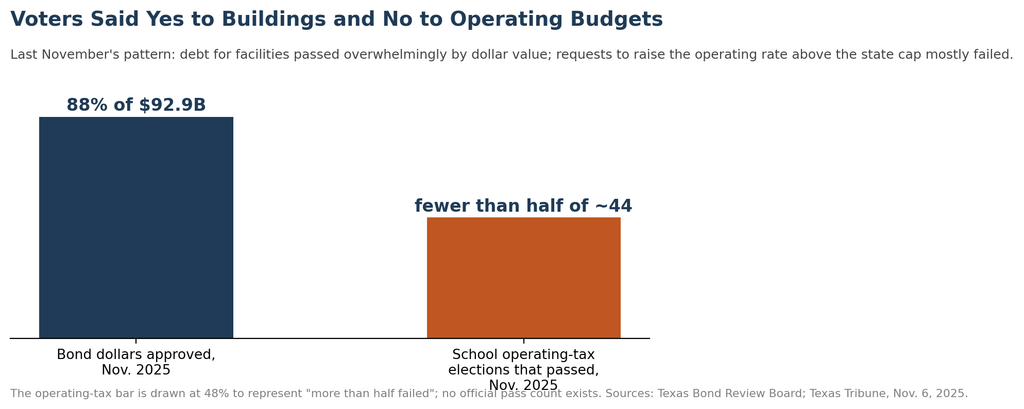
This is not the first time the question has been asked, and the answer so far has a shape.
Last November, Texas voters approved $82.3 billion of the $92.9 billion in local debt put before them — 88 percent by dollar value. The year before, they approved $28.8 billion of $36.8 billion. Bonds pass. Buildings are tangible, the bill is spread over decades, and a new high school is easy to picture.
Operating-tax elections are another matter. The Texas Tribune counted about 44 school district rate elections last fall and reported that more than half failed. A 2023 tally found a higher pass rate, but the trend since the state compressed rates has run against operating increases. The reason is not hard to see: an operating increase shows up on the next bill, in full, and buys something — a teacher who stays, a bus route that keeps running — that does not photograph well.
That asymmetry is the finding. The system Texas built channels local pressure toward borrowing for capital and away from paying for operations, which is the inverse of what districts say they need. Cy-Fair can likely get its buildings. Whether it can get the 23 percent is the open question — and the one that decides whether the $94 million in cuts was the floor or the beginning.
Does something have to give?
The honest answer is that it already has, on both sides of the ledger, and the ballot is where the next round is decided.
Taxpayers gave first and have given longest: a levy that grew 22 percent in four years, bills that rank among the highest in the country, and a pass-through to renters and small businesses that no exemption reaches. Services gave next. The layoffs in Dallas, the cuts in Cy-Fair, the three balanced budgets out of twelve in San Antonio, the Austin ISD borrowing — those are the adjustments local governments made before asking. Reserves gave after that; Austin ISD’s are at half what its own policy requires. Capital plans gave too; this is the lightest school bond slate in at least four Novembers, 28 districts and $7.4 billion against 67 districts and $10.4 billion last fall, which means districts that would normally be building are not asking.
What remains is the operating rate, and that is the one thing the Legislature deliberately put in voters’ hands — the same voters who have told every pollster for three years that they want their property taxes lower. The Dispatch has argued that guardrails on local revenue are the state’s appropriate role, and that position does not change here. But a guardrail has a logic: it assumes the body being restrained can still function inside it. The November ballots are the first large-scale test of whether that assumption holds when values are flat, federal money is gone and the state’s own reserve is full.
If voters approve the operating asks, the cap worked as designed — it forced the question into the open, and the public answered. If they reject them, as they mostly did last year, the next round of cuts lands on the services the asks were meant to protect, and the question returns to Austin in January with a $27 billion reserve sitting beside it.
What to watch
Nov. 3: Cy-Fair’s Proposition A is the bellwether. A 23 percent operating increase in the state’s third-largest district, following $94 million in cuts, is the clearest version of the question anywhere on the ballot.
Nov. 4–18: Results post to the Bond Review Board’s database within about two weeks. The Dispatch will re-run the reconciliation: pass rates by dollar for bonds, pass rates by district for operating measures, and whether the bond-yes, operating-no pattern held.
Nov. 30 onward: Districts whose operating measures fail have budgets already adopted on the assumption of passage. Watch for mid-year amendments, hiring freezes and the campus-closure lists that follow.
Jan. 12, 2027: The 90th Legislature convenes with a full reserve, a governor proposing to eliminate school property taxes for homeowners and a two-thirds voter-approval threshold, and districts carrying deficits into their third year. The results of Nov. 3 will be the most current evidence on whether Texans, given the choice directly, want lower bills or the services — and the Legislature will have to decide what to do with the answer.
Sources
The Texas Dispatch
- Dallas County and Eight School Districts Ask Texas Voters to Approve Higher Tax Rates Nov. 3 (Oct. 16, 2026)
- In Texas Budget Season, the Tax Rate Is the Last Number Decided, Not the First (Sept. 2026)
- Texas Homeowner Premiums Up 79% in Six Years as Lawmakers Press Regulators on Rate Review (Oct. 6, 2026)
- Internal data report, What Texas Taxpayers Are Being Asked to Cover Nov. 3 (Oct. 19, 2026) — reconciliation of the Bond Review Board dataset and 19-county ballot sweep
Government and primary documents
- Texas Bond Review Board — Local Bond Elections database; Texas Open Data dataset kbmc-qmvg, updated Oct. 16, 2026; 2025 Local Annual Report
- Dallas County election order, Aug. 11, 2026
- Cypress-Fairbanks ISD election site and Proposition A detail
- County sample ballots: Harris, Dallas, Bexar, Travis, Collin, Williamson, Montgomery, Hays, Denton, El Paso, Lubbock, Jefferson, Galveston
- Federal Reserve Bank of Dallas — Texas employment forecast softens further (Sept. 21, 2026); Texas Economic Indicators
- Texas Association of School Business Officials — Third Annual School Finance Survey
Outside reporting
- Texas Observer — A Texas Austerity Crisis Is Playing Out City by City, School by School
- The Texas Tribune — Texas schools say $8.5 billion boost didn’t solve budget crunch (June 1, 2026); Texas GOP leaders order state agencies to cut spending by 3% (July 15, 2026); Property tax cuts election 2025 (Nov. 6, 2025); Voters squeezed by high costs (Sept. 3, 2026)
- San Antonio Report — Which San Antonio school districts are strapped for cash? All but 3.; Bexar County forecasts its ‘worst year for property tax revenue’
- Austin Current — Austin ISD’s budget deficit grows to $105 million (Aug. 28, 2026)
- Click2Houston — Cypress-Fairbanks ISD approves $1.2 billion budget amid $80.9 million projected deficit (June 24, 2026)
- The Texan — Here’s a Look at Texas’ ‘Rainy Day Fund’
- Every Texan — 2026-27 Biennial Revenue Estimate
- TASB — Districts use tax rate election for people, programs (May 2024)
- The Texas Dispatch — Analysis: The Fiscal Crossroads — Abbott’s Property Tax Blueprint (July 2026; levy growth, WalletHub ranking)
- The Dallas Morning News — The Price of School Tax Cuts (Sept. 8, 2026; homeownership rate, share paying no school tax)
- University of Texas / Texas Politics Project — Texans feel the weight of property taxes; Latest poll finds historic levels of competition (2026)
- Texas 2036 — 10th Texas Voter Poll, August 2026
- FWD Commercial Real Estate — NNN lease explained for Texas commercial tenants