
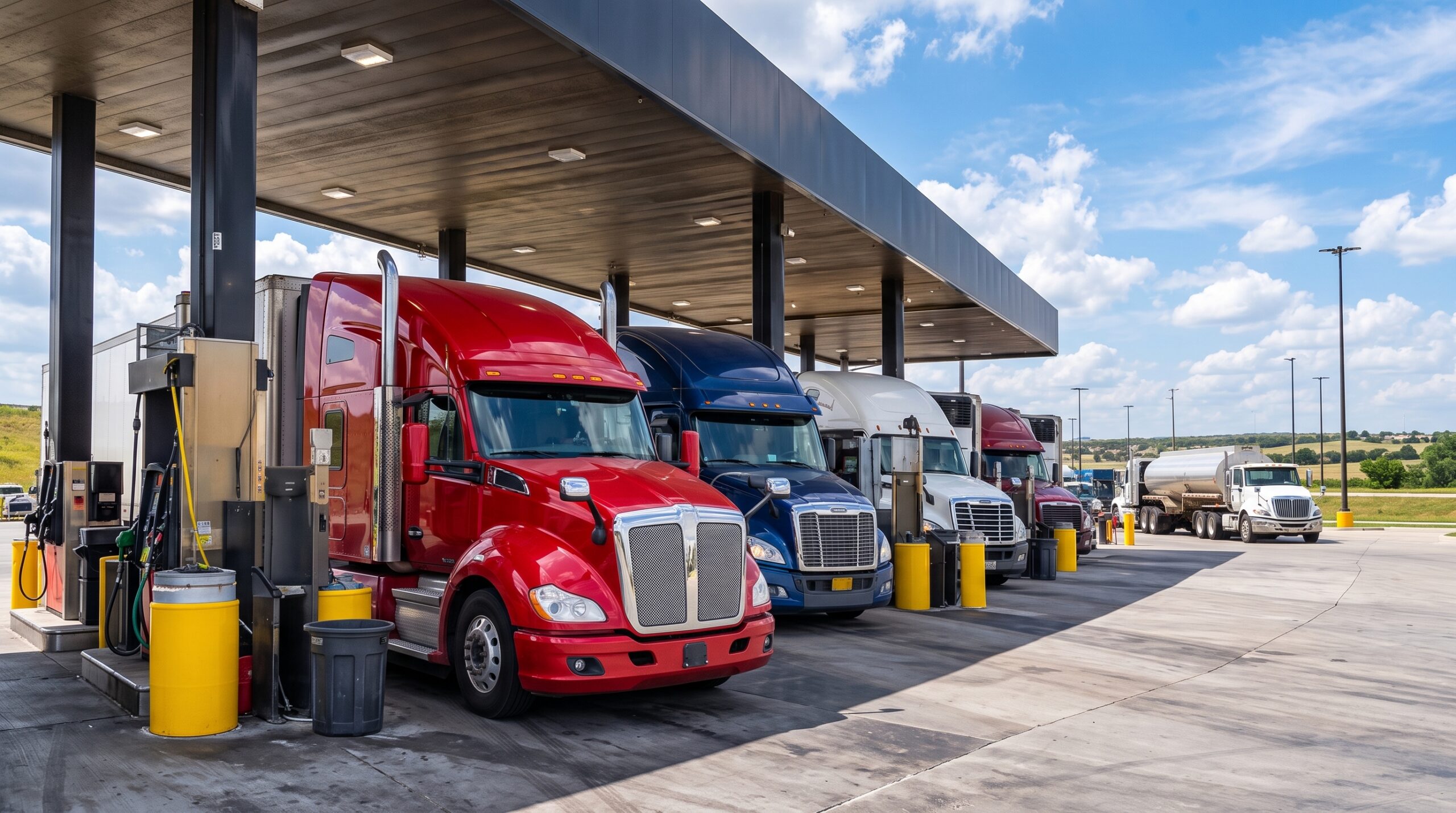
Most Texans never buy a gallon of diesel, but almost everything in their grocery cart has ridden on one. Diesel runs the tractors that plant crops, the trucks that haul cattle and produce, and the fleets that restock store shelves. And at the corner station where Texans do buy fuel, the 20 cents the state collects on each gallon is often more than the owner keeps.
Texas diesel averaged $5.77 a gallon on Oct. 19, according to AAA, $2.66 more than a year earlier. On Sept. 28, Gov. Greg Abbott declared a statewide disaster over diesel prices and supply. The order let farmers and truckers run dyed diesel, normally limited to off-road equipment, on public roads and allowed heavier fuel, farm and timber loads. It did not waive the state’s 20-cent tax, the Texas Tribune reported; the governor’s office has said he cannot waive taxes on his own.
This is the fourth installment of The Texas Dispatch’s series on the state gas tax, after looks at where the money goes, what it costs a household and who pays the most.
Diesel is taxed like gasoline. Texas charges 20 cents a gallon on highway diesel, the same as gasoline, and the federal government adds 24.4 cents. Texas vehicles used about 6.5 billion gallons of diesel and other special fuels on public roads in 2024, according to the Federal Highway Administration. At 20 cents, that is about $1.3 billion a year, a Dispatch calculation. Farmers and ranchers with a state agricultural exemption number can buy dyed diesel tax-free for off-road equipment, but fuel burned on highways is taxed.
At current prices the state tax is about 3.5 percent of a gallon of diesel. The rest of this year’s increase is far larger. If diesel stayed $2.66 above last year’s price for 12 months, Texas highway diesel would cost about $17 billion more, by the Dispatch’s estimate, roughly $1,500 for each of the state’s 11.4 million households. Not all of it would land on Texans, and prices move, so the figure shows scale rather than a bill.
The grocery bill lags the pump. In September, U.S. prices for food eaten at home were up 1.8 percent from a year earlier, while gasoline was up 34.2 percent and fuel oil 74.2 percent, according to the Bureau of Labor Statistics. That gap is typical early in a fuel spike. “Early on, much of the cost increase gets absorbed along the supply chain through existing freight contracts,” David Ortega, a food economist at Michigan State University, told the Associated Press in September. “But as contracts reprice and fuel surcharges take hold, more of that cost makes its way to the grocery store.” Produce, meat and dairy, which need frequent refrigerated hauling, tend to feel it first.
Estimates of fuel’s share of food costs vary. The Independent Grocers Alliance, an industry group, told the AP that fuel accounts for roughly 15 to 30 percent of the total cost of food. Farmers receive about 18.5 cents of each dollar spent on food eaten at home, according to the U.S. Department of Agriculture; the rest goes to processing, packaging, transportation, wholesaling and retail.
For trucking companies, fuel was about 48 cents of the $2.34 it cost to run a truck a mile in 2025, roughly a fifth of all costs and before this year’s spike, according to the American Transportation Research Institute. A typical heavy truck uses fuel equal to about 9,750 gallons of gasoline a year, federal data show, or roughly 8,600 gallons of diesel. At Texas’s rate that is about $1,700 a year in state tax; at this year’s prices, the same truck’s fuel bill is up about $23,000, a Dispatch calculation. Carriers pass much of that along through fuel surcharges that adjust weekly.
Behind the counter. When pump prices rise, the corner station gets the blame. But most of the price is someone else’s money. In 2025, convenience stores, which sell about 80 percent of the nation’s motor fuel, made an average gross margin of 39.7 cents a gallon, according to NACS, the convenience store industry’s trade association. The association says retailers spend about 20 to 25 cents a gallon to sell fuel, including about 8 cents in card fees. Subtracting those costs leaves roughly 15 to 20 cents a gallon before income taxes, a Dispatch calculation. Texas takes 20 cents; with the 18.4-cent federal gasoline tax, government collects about twice what a typical station keeps.
Stations do not remit the tax themselves; the licensed supplier pays it when fuel leaves the terminal, and it is built into the wholesale price. The average store sells about 2,700 gallons a day, based on NACS figures, which means it pays about $16,000 a month in Texas gas tax, and about $31,000 in state and federal tax combined, as it buys each load. Retailers then pay card fees on the full price, taxes included. The industry paid $21.3 billion in swipe fees in 2025, NACS reported, $4.6 billion of it on taxes collected.
Rising wholesale prices can squeeze stations rather than enrich them. Retailers price fuel on the cost of their next delivery, and NACS says increases are often passed to drivers over as long as eight weeks. Fuel was 65 percent of convenience store sales in 2025 but only 39 percent of gross profit.
Texas has 16,504 convenience stores, more than any other state. Nationally, 54.8 percent of stores that sell fuel are single-store businesses.
The diesel tax is a small, fixed slice of a much larger price increase, 20 cents of $5.77. Unlike the price of crude, it is the part Texas sets for itself. Only the Legislature can change it, and lawmakers return in January.