
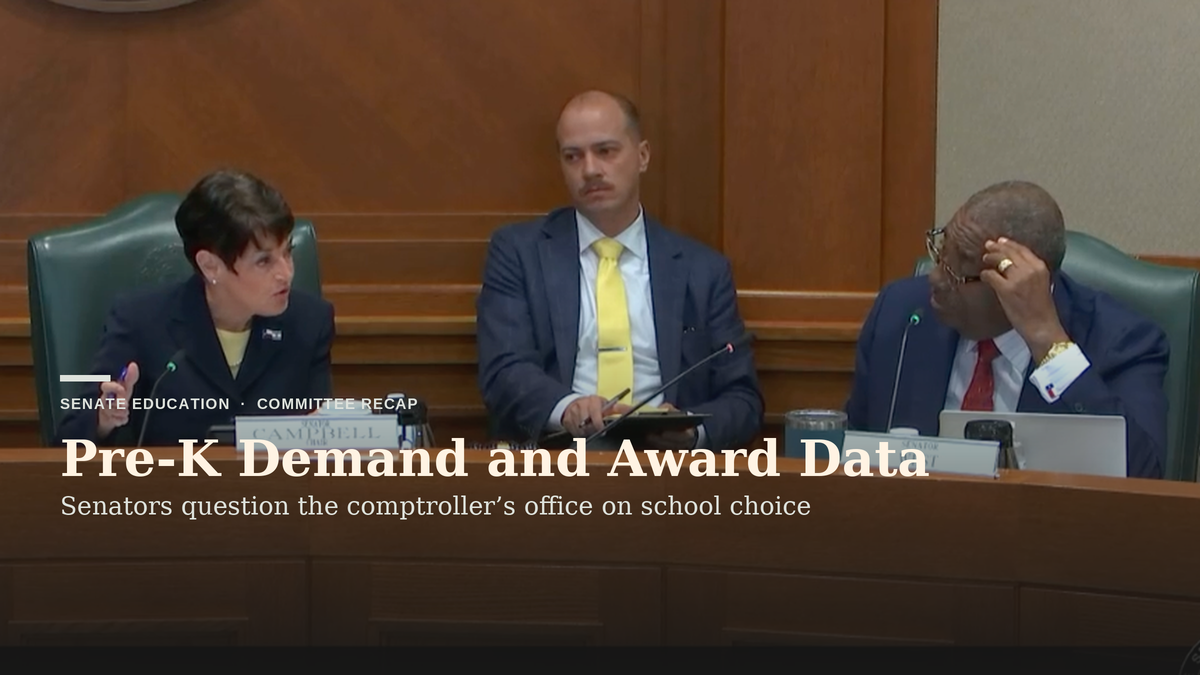
The Texas Comptroller’s Office told the Senate Education Committee on Oct. 7 that the state’s new school choice program runs on parent-approved payments and two layers of audit. Senators questioned who is applying and why.
Travis Pillow, interim program director of the Texas Education Freedom Accounts program in the Comptroller’s Office, was the first witness on Senate Bill 2, the 2025 law that created the accounts, a charge listed in the hearing notice. Every payment must be approved and started by a parent through a secure online system, he said. The program is audited by an outside auditor his office is hiring and by the State Auditor’s Office.
As of Oct. 5, he said, “the vast majority of our program expenditures more than $224 million have been for private school tuition and fees.” The top category by transaction volume was textbooks and instructional materials. About 62% of participants live in households below 200% of the federal poverty level, he said, roughly $66,000 for a family of four. The Texas Dispatch previously reported on the 274,000-application first round and the awards near 96,000 students.
Sen. Brent Hagenbuch, R-Denton, asked whether the office had found misuse. “This is such a great program, and I’m so proud that we’ve implemented it,” he said. “We want to be careful about this program.” Pillow said the office studied other states’ programs and built in safeguards so each transaction is for an approved education expense. Schools verify enrollment, and “parents have to initiate that transaction,” he said, so money does not flow to schools automatically. Lee Weedman, executive director of Green Oaks Education and Support in Arlington, told the panel 28 of her 40 students received awards, most about $16,000.
Sen. Royce West, D-Dallas, focused on the age of recipients. About 37,000 applicants were for pre-K, he said, and about 10,000 awards went to that grade level. Pillow said kindergarten leads participation, followed by pre-K and first grade. West asked whether that points to a child care problem. “This program is intended to pay for academic instruction and education,” Pillow said. “Child care is still an issue in the state of Texas,” West replied.
Sen. Angela Paxton, R-McKinney, noted that pre-K applicants must qualify for public pre-K. “Yes. The requirements for our program for pre-K students mirror the requirements for state public,” Pillow said. Paxton said those families chose this option for their children. She agreed child care matters. “It’s an important family issue. It’s an important workforce issue,” she said, and she offered to work with West on it in the Economic Development Committee.
West also asked about complaints that private schools collected the first payment and then expelled students. Pillow said parents sometimes leave a participating school early. “We process refunds back to the program so that the parent can find another school,” he said. Refunds are required where services were not rendered, he said.
Sen. José Menéndez, D-San Antonio, worked from the office’s Aug. 1 demographic report, which Pillow confirmed. Pre-K and kindergarten applicants total 43,229, Menéndez said. Households between 200% and 500% of poverty, up to about $165,000, produced 87,000 applicants and 17,300 funded students. Pillow agreed that fewer than 30 students from families above that line received funds. “67,000 of them applied, but 30 got,” Menéndez said. He said he opposes expanding the program and asked how it would interact with the federal tax credit scholarship program. Pillow said that program has not launched and raises policy questions about how the two “interact and complement each other.”
Menéndez also cited a Dallas Morning News report that 7,400 of roughly 29,400 eligible students with disabilities returned their awards. “We do not know definitively,” Pillow said of the reason, adding that the office plans to survey those families. Asked about a fifth tier beyond the law’s four, Pillow called it “a semantic issue”: the top income tier splits between students with prior public school enrollment and those without.
No vote was taken. The charge asks for recommendations to enhance and expand the program. Child care, income targeting, returned awards and the federal tax credit are likely to shape that debate in the 90th Legislature, which convenes in January 2027. The Texas Dispatch previewed this hearing.
The committee spent about 44 minutes on how schools handle hostile foreign influence; see the companion recap, “Senate Panel Weighs Foreign-Funding Claims in Schools and State Board’s Curriculum Changes.” It also took up monitoring of three 2025 laws: about 30 minutes on Senate Bill 12 on parental rights, about 23 minutes on Senate Bill 13 on school libraries, and about 31 minutes on House Bill 6 on discipline and telehealth mental health. Public testimony, roughly three hours, followed.
Fact box
- Issue
- Interim charge on the school choice rollout under Senate Bill 2 (approx. 81 minutes, about 20 percent of the hearing)
- What happened
- The Comptroller’s Office described the education freedom account program, its payment controls and audits; Sens. West and Menéndez questioned pre-K demand, award data by income and returned awards; Sens. Paxton and Hagenbuch supported the program. No vote — interim hearing.
- When
- Wednesday, Oct. 7, 2026 · run time about 6:43 (4,023 caption segments)
- Where
- Room E1.028, Capitol Extension, Austin
- Chair
- Sen. Donna Campbell, R–New Braunfels (SD-25); Vice Chair Sen. Paul Bettencourt, R–Houston (SD-7)
- Key witnesses
- Travis Pillow, interim program director, Texas Education Freedom Accounts, Comptroller’s Office; Lee Weedman, Green Oaks Education and Support (Arlington)
- Archived video
- senate.texas.gov video 22859