
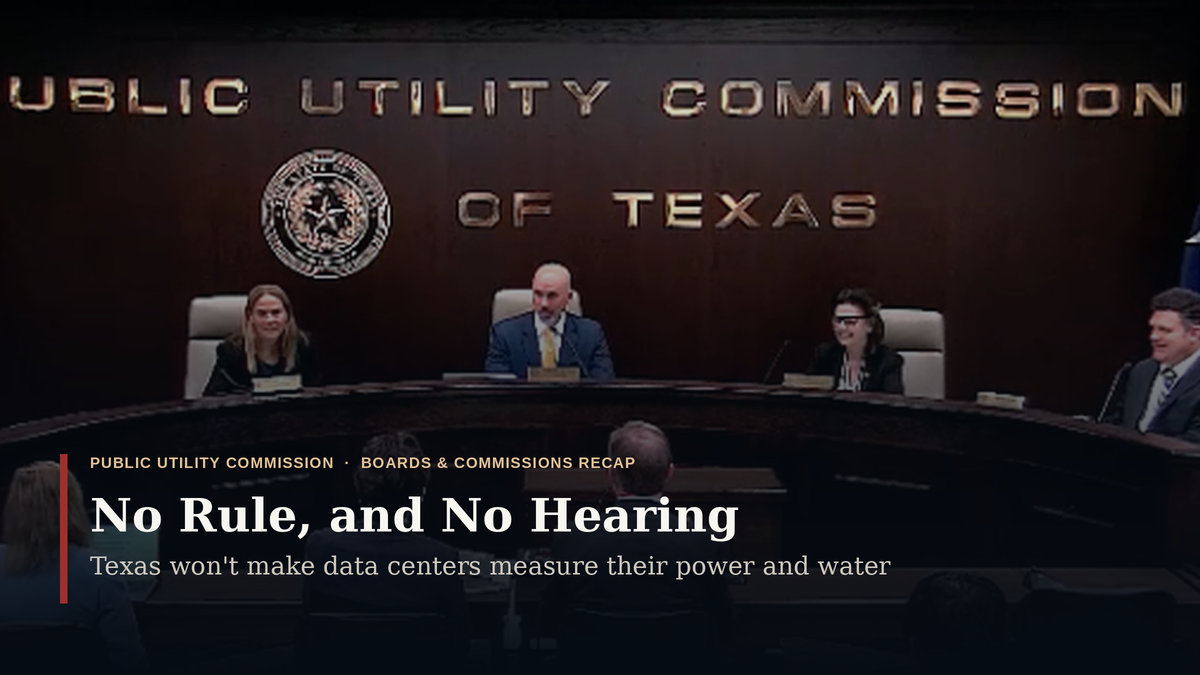
Texas will not require data centers to measure how much electricity and water they use inside their buildings. State utility regulators turned the idea down Oct. 1 — not on its merits, which they never reached, but because the proposal in front of them was, by their own staff’s account, too broken to build a rule on.
A data center has one meter, where the utility’s wires reach the property. It works like the meter on a house, at enormous scale: it records the total and nothing else. The petition would have put measurement inside the building, tracking which servers and cooling equipment drove the sharpest demands on the grid and the local water supply — so the state could charge the data center for the power lines, generating capacity and city water it needs, “rather than passing those costs onto residential and small business ratepayers,” as staff summarized it.
More than 248 data centers have been proposed in Texas, and the state’s current method of finding out what they consume is to ask them. The Water Development Board has sent mandatory water-use surveys since 2023, and its list has grown from 22 data centers to 341; a third answered in 2024, and 17 percent answered in 2025. The penalty for ignoring one is a $500 fine. Told the response rate at a June hearing, one state representative called it “pretty pathetic”.
The proposal in front of the commission was neither the state’s nor the industry’s. It came from Green Recursive Utility Service LLC, a Weatherford company that calls itself a data infrastructure utility and that its own website says was formed May 5, 2026, about twelve weeks before it filed.
Anyone could have filed it. Texas law lets any resident or business in the state ask an agency to write a rule, with no fee and no test beyond that, and gives the agency 60 days to open a rulemaking or deny the request in writing and say why. That clock is also why nobody got a public hearing: hearings belong to rulemakings, and 60 days leaves no room.
The commission’s rules director recommended denial in a Sept. 25 memo, and his objections were mostly about the filing, not the idea. State rules require a petition to arrive carrying the text of the rule it wants, and this one did not. The company then replaced its proposal mid-comment-period with a 62-page rewrite nobody else had a chance to read, and its own correction log conceded that earlier filings overstated the heat coming off a rack of servers “by an entire order of magnitude”. The first version would have made the state mandate patent-pending technology owned by one private company, which the memo said “would also codify an unacceptable monopoly”.
The order the commissioners signed is narrower than any of that. It says the commission is already writing a stack of rules under the 2025 grid law the petition leaned on, and that opening another “would require the Commission to redirect staff resources away from these essential rulemaking projects”. It does not say whether measuring what data centers use is a good idea.
Seventy-four people filed comments backing the petition, though staff described most as near-identical: a screenshot of the filing instructions, a line of support, or a flyer about grid reliability and water conservation.
Oncor, the only utility to comment, took no position on the merits but noted the plan was “silent as to who installs and operates its proposed behind-the-meter metering system”: who owns it, who reads it, who pays. The industry’s answer to the wider question came in June from Dan Diorio of the Data Center Coalition, who told lawmakers “Companies must protect proprietary, confidential, and competitive information” — while saying he was working with both agencies to lift response rates.
The company’s claims about itself do not always match the record. Its website points to another PUC number, 59976, as a utility tariff covering a completed first billing cycle. That number holds two filings, both made by the company, under a caption describing an informational tariff, and carries no commission order, no approval and no other party. The petition itself moved through four numbers in nine weeks, and twice an administrative law judge had to tell the company where to file it.
The company answered the memo two days before the vote, arguing that its revised plan read meters data centers already have, not anything of its own. The order does not mention the answer. What happens next is set elsewhere: the commission’s grid rules continue in a separate project, the governor’s freeze on data-center permits stands, and the audit he ordered of whether the power these projects have asked for is real is due back from the grid operator in December.
Thirty-seven items, and the biggest was a power-plant build-out. The Oct. 1 open meeting carried 17 contested cases, 18 rule and project items and a closed session. The largest contested case was a final order on Southwestern Public Service’s plan to build eight generation projects in Texas and New Mexico; administrative law judges recommended approving five and denying one and faulted the utility’s cost estimates, but a revised recommendation filed Sept. 10 was filed confidentially, so what the judges currently advise could not be read. What was not on it. The commission’s own large-load rulemaking under the 2025 grid law — the project the denial order points to as the reason it has no staff to spare — was not an agenda item. Outcomes not confirmed. No vote, motion or disposition on any of these items is asserted here; the only Oct. 1 outcome this story establishes is the one carried by a signed order in the docket.