
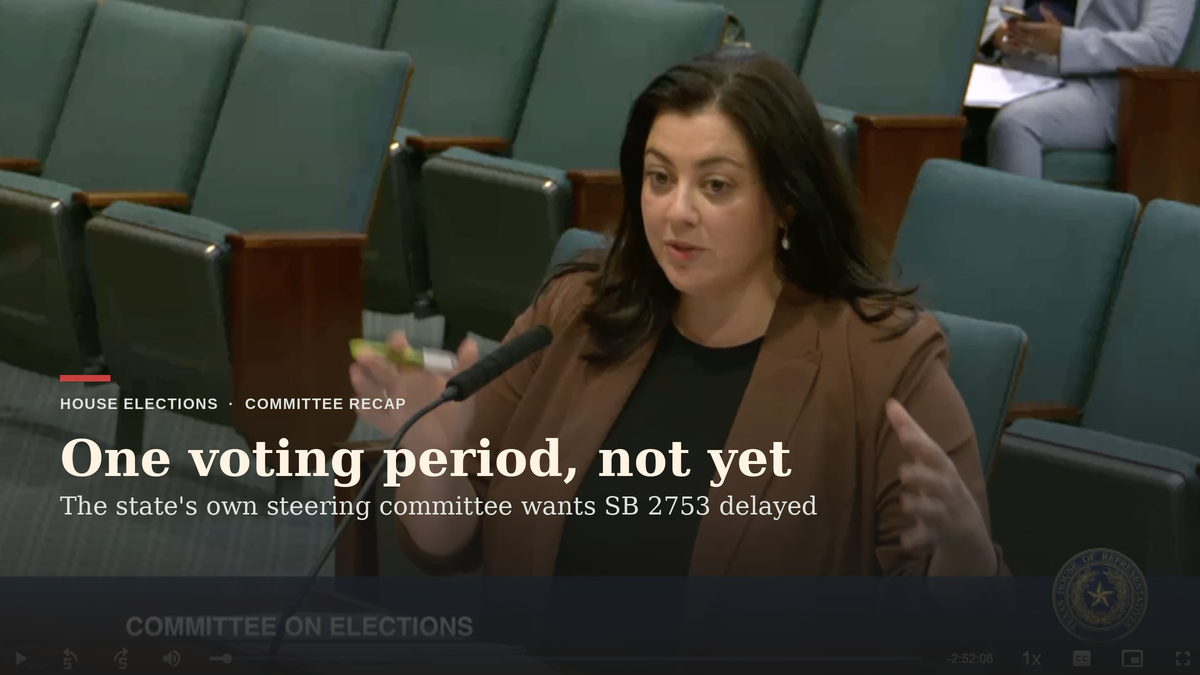
The state panel guiding Texas’ biggest election overhaul in years has voted — unanimously — to pump the brakes. Every member of the Secretary of State’s steering committee for Senate Bill 2753, the 2025 law that merges early voting and Election Day into one continuous voting period, has recommended the state hold off on implementation until next year, the agency’s elections director told the House Committee on Elections on Tuesday.
“It was unanimous,” said Christina Adkins, who leads the elections division at the Office of the Secretary of State, describing a July 30 steering committee meeting. “Every individual on the steering committee made the recommendation that we should not implement this bill until next year, after we have had time to work through some of these issues, do more training with our counties, and perhaps visit with the legislature about some potential changes that would make implementation much, much easier.”
SB 2753 “modifies the election process at its most basic level by eliminating the gap between early voting and Election Day,” Adkins told the committee, “creating one continuous voting period.” The law carries a target implementation date of Aug. 1, 2027, and for nearly three hours Tuesday — the bulk of a hearing that ran just under three hours total — county election officials from the Panhandle to the Gulf Coast told members the same thing: they like the concept, and they are not ready.
Chairman Matt Shaheen, R-Plano, signaled the committee would not force the issue. “We have 33 million citizens, a couple hundred thousand square miles — an election in the state of Texas is not the same as an election in Delaware,” he said. “There is zero problem if the working group does not feel that we are ready to implement this. We do not want any type of election failures in our state.” A delay, he added, is acceptable for what he called “an incredibly complex transformation of the way we do elections in our state.”
Vice Chair John Bucy III, D-Austin, backed the go-slow approach while defending the law itself. “I agree with you that we need to make sure we get this right and we have the time to do it right,” Bucy said. “But I think in the eight years that I’ve been on this committee, this is one of the most significant shifts to increase voter access in the state of Texas. We’re talking about continuous voting. We’re talking about two weekends of access without losing days. And I think that is ultimately going to be a win for all of the people of Texas.”
The county officials who followed Adkins sketched out why the runway matters. Testifying for the Texas Association of County Election Officials, Jennifer Doinoff told members counties have already adopted budgets for the 2026-27 fiscal year, making a rollout this cycle “very difficult because counties have not been able to budget any of these changes into their current budgets.” She also pushed back gently on a staffing concern raised by Rep. Valoree Swanson, R-Spring, saying the association is not seeking to unwind the law’s expanded schedule but wants flexibility on daily hours.
Swanson had pressed witnesses on the mechanics of a combined voting period: “Where’s the manpower going to be found to do all of that?” she asked, ticking through supply distribution, ballot security and the keys that control access to voting equipment. Ballots cast during the continuous period, she noted, “are now going to stay in there through actual Election Day” — a change she said deserves a hard look at chain-of-custody security.
Harris County Clerk Teneshia Hudspeth, who served on the SB 2753 steering committee, told the panel the law “represents one of the most significant operational changes to Texas elections in recent years” and warned her concerns fall in four areas: “cost, operations, staffing and election night reporting.” Harris County can run as many as 700 polling locations in a November election, she said, and the law’s reporting changes mean “results will be released even later than Texans have come to expect,” because early in-person and mail ballots will no longer post shortly after 7 p.m. on election night.
The rural math is different but no easier. Jefferson County Judge Jeff Branick, appearing for the County Judges and Commissioners Association of Texas, said his county has already absorbed roughly $467,000 in state-mandate compliance costs over the last two sessions and estimated about $20,000 more in overtime and security expenses under the extended voting schedule. With 11 early-voting sites and 31 Election Day locations, he asked whether the law would let commissioners consolidate — a question Adkins answered when she was recalled late in the hearing: the law’s separate location requirements for early voting and Election Day “didn’t change,” she said, pointing members to Section 85.062 of the Election Code, which gives commissioners courts broad authority over early-voting sites.
Denton County elections administrator Frank Phillips, another steering committee member, framed his testimony as friendly repair work. “I’m excited about the concept behind 2753,” he said. “My goal today is not to oppose an election period, but to help ensure” the law works in practice.
Laura Rogers, the Sherman County and district clerk who chairs the legislative committee of the County and District Clerks’ Association of Texas, offered what she called the small-county bookend to Hudspeth’s big-county testimony, thanking the bill’s authors — Sen. Bob Hall and Rep. Carrie Isaac, R-Wimberley, a member of the committee — for staying “accessible and receptive” to implementation concerns from clerks.
Adkins told members her office has been working “aggressively to educate our counties on what 2753 means, how it will impact them, and what are the potential cost implications,” including workshops, a cost workbook and worksheets. But the accumulating message from Tuesday’s witnesses — budget cycles already closed, staffing gaps on weekends, delayed election night returns, and a unanimous steering committee recommendation to wait — points toward the 90th Legislature revisiting the statute’s timeline and details when it convenes in January 2027. Because the committee met in the interim, it took no votes.
Also heard: In its final 20 minutes, the committee took up its agency-oversight charge for the Office of the Secretary of State, where Adkins detailed a new dark-web threat-monitoring contract and the state’s county election audit program — including the decision to place Val Verde County under administrative oversight.
Hearing at a glance
Issue
Implementation of SB 2753’s continuous voting period (~154 minutes, ~88% of hearing)
What happened
The Secretary of State’s elections director disclosed a unanimous steering committee recommendation to delay implementation to next year; county officials detailed cost, staffing and reporting concerns; no vote (interim hearing)
When
Tuesday, August 4, 2026, 10:00 AM CT · run time 2:56:12
Where
Room E2.012, Capitol Extension, Austin
Chair
Rep. Matt Shaheen, R-Plano (HD-66)
Archived video
house.texas.gov/videos/22742