
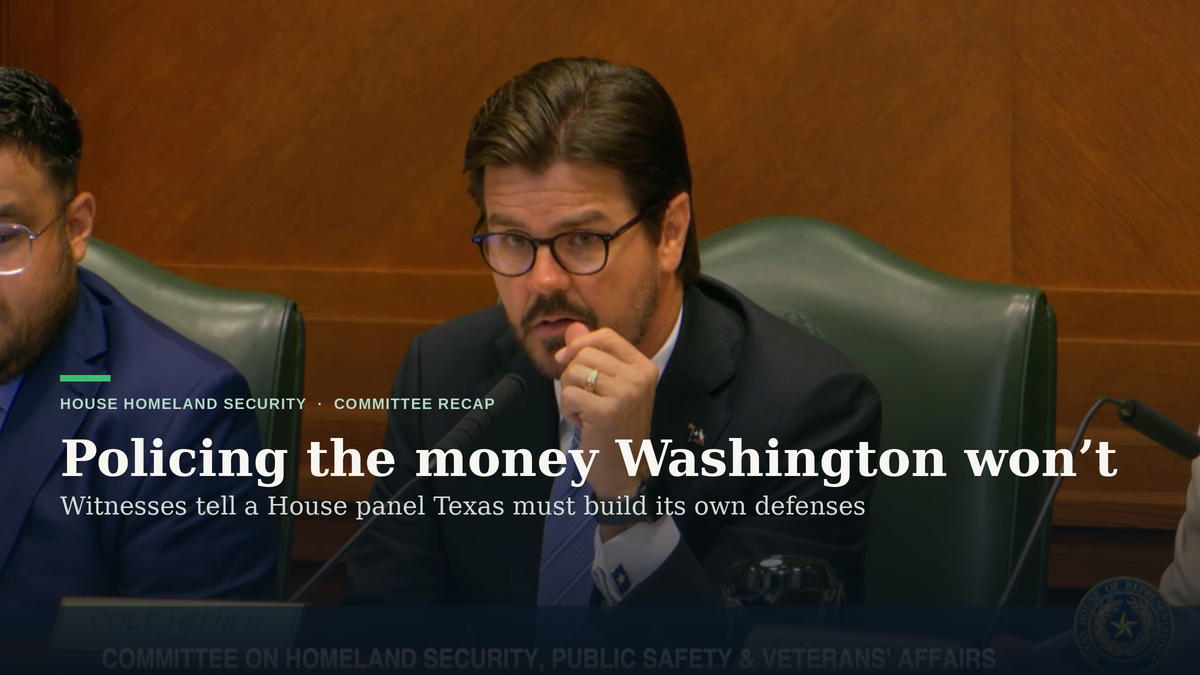
Foreign adversaries are moving money through Texas banks, licensed wire services and the crypto kiosks at neighborhood gas stations — and the federal government cannot keep up. That was the through-line Thursday as the House Committee on Homeland Security, Public Safety & Veterans’ Affairs opened its second interim hearing with a two-panel examination of foreign financial influence and illicit networks, the longest of the day’s three charges.
Chair Cole Hefner, R-Mount Pleasant, framed the stakes as a question of whether Austin should stop waiting on Washington and build the state’s own defenses. The answer from the witness table was close to unanimous.
Jesse Saucillo, Deputy Commissioner of Non-Depository Supervision at the Texas Department of Banking, walked members through the two kinds of money-services businesses the state licenses under Chapter 152 of the Finance Code — the “mom and pop” currency exchangers, the Casas de Cambio along the border, and the money transmitters that wire funds across it. Both carry reporting thresholds, he said: past a certain point, a customer “[has] to provide valid IDs, social security numbers, addresses.”
Kathy Tomasofsky, executive director of the Money Service Business Association, defended the industry as “among the most heavily regulated non-bank financial institutions in the country,” with members required to run “customer due diligence, sanction screenings, and suspicious activity reporting” and to file with the federal Financial Crimes Enforcement Network, FinCEN.
Danny Williams, president and CEO of First National Bank of East Texas, put a price on that compliance and a face on its failures. His bank spends “well over $200,000 a year just for the software to help fight this stuff,” he said, plus “three FTEs designated” to the work. What frustrates him is what happens after a report is filed: “We have victim after victim after victim every week, every day of every week.”
Rep. AJ Louderback, R-Victoria, drew out the enforcement gap, noting that fraud in the “3 to $5,000 [or] $10,000” range “largely go[es] unprosecuted” because federal agencies “won’t take but the largest cases.” He told witnesses he was “looking for a better way to address a common, very common problem.”
The exchanges turned technical but pointed. Asked how the system flags trouble, a witness offered a worked example: a customer who normally sends “grandmother $200 a week” and suddenly wires “$9,999 to be under a limit” triggers a suspicious-activity report “in all cases.” Rep. Katrina Pierson, R-Rockwall, pressed on how closely Chinese-owned licensees are watched, and members probed the blind spots in cryptocurrency — where, one witness conceded, a peer-to-peer transfer through “an unhosted wallet” means “nobody’s really monitoring that.”
If the first panel described the machinery, the second described who is gaming it. Sam Westrop, director of Islamist Watch at the Middle East Forum and a senior fellow at the Texas Public Policy Foundation, testified that governments “includ[ing] the governments of Iran, Turkey, Saudi Arabia and Qatar” have “financed schools, mosques and endowment projects” in the state, citing “$7 million of financing for a large commercial and residential development in Irving.” He traced a lineage of Sharia-finance and mutual-fund networks he said the federal government has been unwilling to touch.
When Hefner asked the obvious question — “if all of this is active and happening in Texas, what is the federal government doing?” — Westrop’s answer became the hearing’s thesis. Washington “has struggled to deal with what is often called the non-violent Islamist threat,” he said, hemmed in by “the constitutional dangers” and by conflating “Islamism with Islam, a political ideology with religious faith. So I think it falls to Texas to come up with a solution. The federal government hasn’t been able to. That doesn’t mean we cannot.” Texas, he added, could be “a blueprint to other states.”
He urged expanding House Bill 45 from the 2025 session, which he said reached only family law, into a broader bar on foreign-law influence.
Michael Lucci, founder of the Austin-based national-security firm State Armor, aimed at China. He pointed to the Justice Department’s July 1 “$600 million settlement with Alibaba Group and … Alipay,” noting that Alipay “has a license as an MTL” — a money-transmitter license — “in the state of Texas.” He described Chinese money-laundering networks that “FinCEN has issued a formal advisory on … since August 2025,” and did not soften the retail edge of it: “Those crypto kiosks that you see at the gas station, they are run by Chinese money launderers. I just want to make that very clear.”
Lucci flagged a loophole in the state’s money-transmitter rules that could be exploited by “informal value transfer systems” — the hawala networks addressed in a recent Nebraska law — and urged members to close it.
Former Ambassador Kelley Currie widened the lens to the industrial scale of the fraud economy. The “international global scam economy is now estimated to be between 400 and $500 billion a year,” she told members — “roughly the size of the economy of Denmark.” She cited enforcement to match: “the Justice Department seized a $15 billion crypto wallet from one Cambodian scam operator.” And she insisted the money is inseparable from human cost, describing how trafficking rings recruit teenagers with promises of “three grand a week to smuggle.”
Her point, echoing Westrop and Lucci, was that the illicit-finance charge and the state’s broader adversary problem are one and the same.
Because the panel met in the interim, it took no vote; the testimony will shape recommendations to the 90th Legislature, which convenes in January 2027. But the direction was set from the dais. Members and witnesses returned repeatedly to the same idea — that Texas should “build another package up” of state-level financial-crime and disclosure tools rather than wait for federal action. On the evidence of Thursday, a state answer to foreign money is headed for next session’s agenda.
Also heard: The committee’s remaining charges took up foreign-adversary transparency and critical-infrastructure security. On transparency, Texas Ethics Commission executive director James Tinley reported that a 2025 gift-disclosure law had drawn “just 147 disclosures” of foreign contacts since it took effect, with no complaints or civil actions yet filed. The day’s critical-infrastructure charge — the state’s exposure to Chinese-made grid equipment and the cyber threat to the power system.
The hearing at a glance
Issue
Countering foreign financial influence and illicit networks — money transmitters, banks, cryptocurrency and Sharia/Islamist finance.
What happened
Regulators and industry described how Texas licenses and monitors money-services businesses; a second panel of national-security and finance experts argued the federal government has failed to police foreign illicit money and urged state-level tools. Interim hearing — no vote.
When
10:00 AM CT, Thursday, July 30, 2026
Where
Room E2.016, Capitol Extension, Austin
Chair
Rep. Cole Hefner, R–Mount Pleasant (HD-5)
Archived video
house.texas.gov · video 22732