
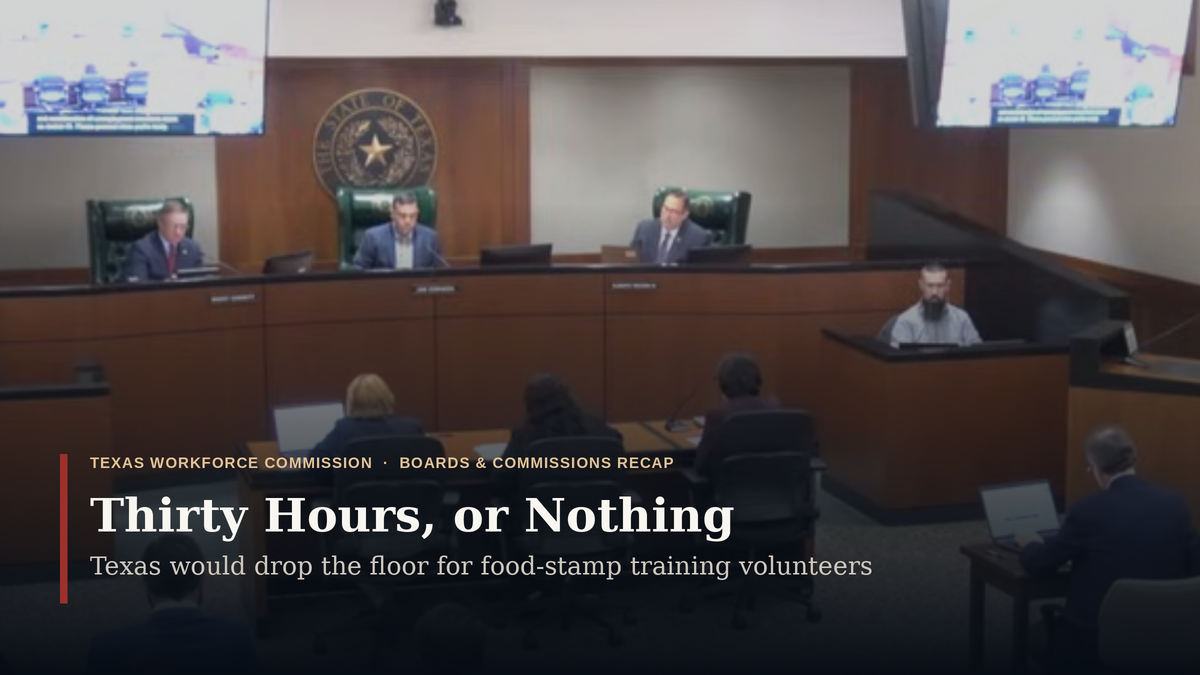
Texans who are excused from working for their food stamps but want the state’s job training anyway would no longer have to promise 30 hours a week to get it, under a rule the Texas Workforce Commission sent out for public comment Oct. 6.
The people this reaches are the ones the federal government has already said do not have to work for the benefit — Texans past 60, parents caring for a young child, people with a disability, people already working enough hours. Some of them want the training regardless: the job-search help, the skills courses, the paid work experience that local Workforce Solutions offices run. The commission’s own lawyers describe what stands in their way.
Under the current rule, exempt SNAP recipients are not allowed to volunteer for SNAP E&T activities unless they are able to participate for 30 hours per week, which limits voluntary participation.
Texas reported 3.1 million people eligible for food stamps at the end of April, state figures reported by the Texas Tribune show — nearly 500,000 fewer than a year earlier. The training program sitting beside that caseload is small. The state’s most recent plan to the U.S. Department of Agriculture, covering the federal year that ended Sept. 30, budgets $2.6 million to reimburse 5,642 participants for transportation and other costs, and calls that 40 percent of everyone it expects to serve — which works out to roughly 14,100 people statewide. That last figure is this newsroom’s own arithmetic from the plan’s two numbers. It is a projection rather than a count, and the 152-page plan gives no participant total to check it against.
The change itself runs to eleven words struck and one sentence added. The rule on participant responsibilities lists what people in the program must do: attend appointments, take part in assigned activities for “a minimum weekly average of 30 hours”, report to an employer they are referred to, accept a job offer, report their hours. The amendment deletes the phrase “and exempt recipients who voluntarily participate in SNAP E&T services” from the top of that list, so the obligations stop reaching them, and gives volunteers a subsection of their own.
Exempt recipients who voluntarily participate in SNAP E&T services shall participate in accordance with their employment plan.
An employment plan is the individual roadmap a caseworker writes with each participant — what training, how many hours, finished by when. The 30-hour floor does not move for anyone the program requires to be there.
Reed O’Brien, a lawyer in the commission’s general counsel office, told the commissioners the rewrite is meant to get more people through the door. The amendments would “eliminate administrative barriers for exempt SNAP recipients who volunteer for the program, thereby allowing them to participate based on their individualized employment plans rather than the 30-hour mandate”, he said. One of the commissioners thanked staff for answering questions about how the program’s incentives would change, and said: “I think this is a good and positive change and pleased to vote for it.” The captions carry no speaker names, so the Dispatch does not say which commissioner spoke. The motion to publish carried.
Two things cut against the agency’s framing, and one of them is the agency’s own. Its impact statements tell the state the rules “will not change the number of individuals subject to the rules” and carry no cost — no appropriation, no new positions, no new training slots.
Every Texan, an Austin policy group that analyzes the program, wrote in July 2025 that Texas has roughly 136,000 people a year the commission is federally required to help find a training slot, and that “the agency struggles to meet that mandate due to a lack of available slots in which to place people”. That was written about a federal law, fifteen months before this rule existed, and the group has taken no position on the proposal.
The commission’s own page for the program still tells exempt recipients: “If you meet certain criteria, you don’t have to participate, but you can if funding allows.” The amendment does not touch that condition, and nothing in the package says who decides when funding allows, or how many people are being turned away now. How many exempt Texans volunteer now, and how many more would if the floor came off, is not a number the record contains.
Nobody has said anything about the proposal on the record yet; the text had not reached the Texas Register when this was written. The commission is taking written comment, and asking for cost-and-benefit data, at TWCPolicyComments@twc.texas.gov through Nov. 23. Only after that can the commissioners adopt anything.
A battery-storage annex, 1.9 miles away. The commissioners waived the rule that makes a career school get a fresh certificate of approval for a second location, letting Training Center of Central Texas open an instructional annex 1.9 miles from its main campus. Staff said the main campus is at capacity and the annex is needed to house high-voltage equipment for a new partnership with a solar and battery-storage manufacturer, and that students report to one location for a full day rather than travelling between the two. Five sheltered-work employers recertified. Five community rehabilitation programs — in Pittsburg, Lufkin, San Angelo, Corpus Christi and Houston — were recertified for the state’s set-aside purchasing program for people with disabilities. Staff said all five pay minimum wage or higher. Nothing from the public. Nobody signed up to speak, and the executive director’s report was taken with no substantive content.