
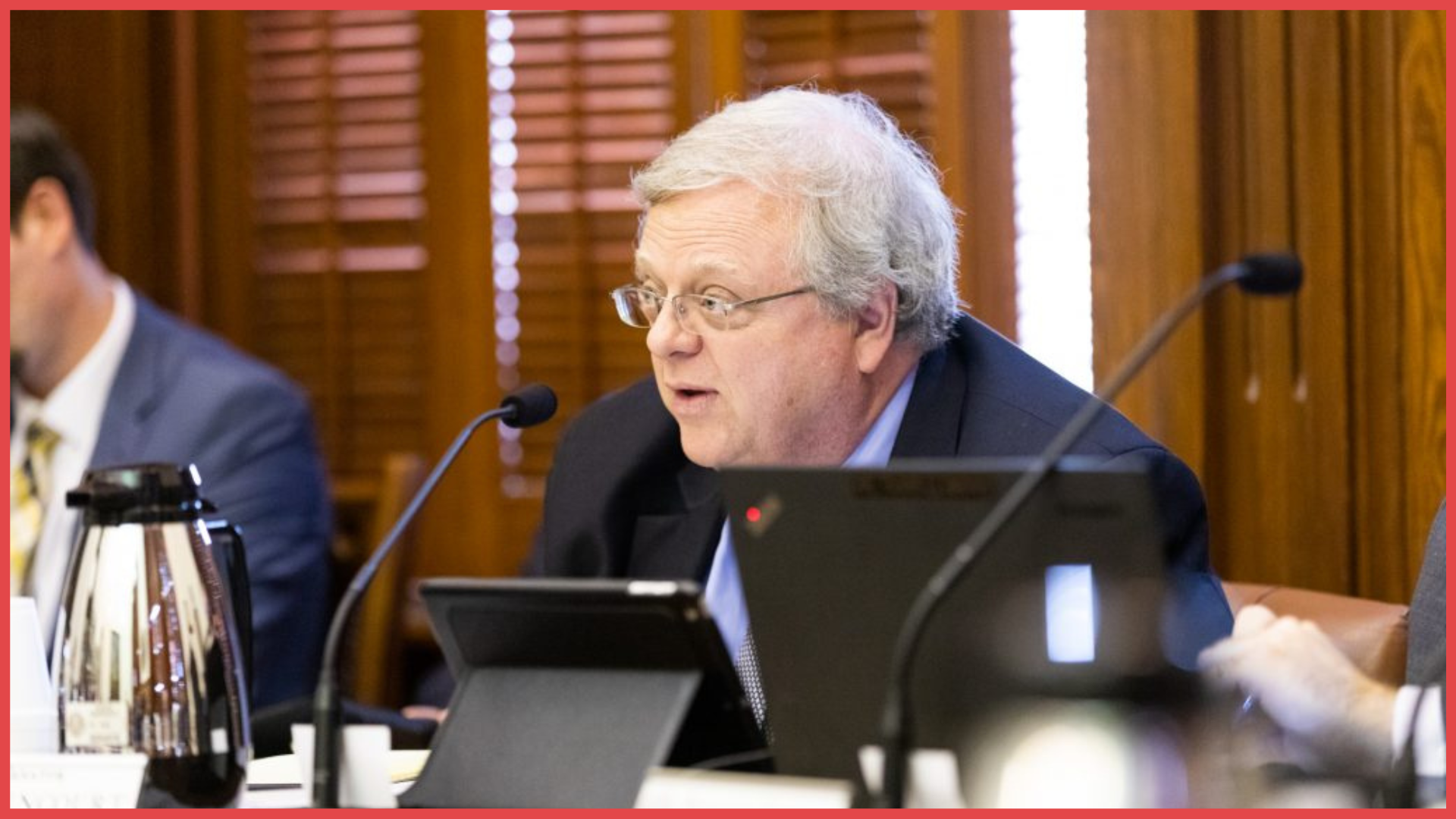
Sen. Paul Bettencourt’s committee will hear invited testimony July 28 on curriculum-review and governance changes, campus research security rules and whether the outcomes-based finance formula for junior colleges is holding up.
- When: 12:00 PM CT, Tuesday, July 28, 2026
- Where: Room E1.028 (Hearing Room), Capitol Extension, Austin
- Chair: Sen. Paul Bettencourt, R–Houston (SD-7)
- Vice Chair: Sen. Brent Hagenbuch, R–Denton (SD-30)
- Format: Invited testimony only — the notice does not provide for public testimony; no written-testimony copy requirement stated; interim charges only — no vote on legislation
- Live video: senate.texas.gov/av-live.php
- Submit comments online: N/A — the Senate does not operate an online comment portal for this hearing
- Full agenda: Official hearing notice (capitol.texas.gov)
The Texas Senate Committee on Higher Education will gavel in at noon Tuesday to hear invited testimony on how two of the 89th Legislature’s higher education laws are being implemented and on whether the state’s outcomes-based funding model for community colleges needs structural repair.
Chaired by Sen. Paul Bettencourt, R-Houston, the seven-member panel is one of the Senate’s newest — it was established Sept. 4, 2025, splitting higher education work out of the Senate Committee on Education K-16 — and carries a 5-2 Republican majority. Its posted archive shows no video from a prior full-committee meeting. Tuesday’s hearing covers two of the three interim charges Lt. Gov. Dan Patrick assigned the committee.
The Monitoring charge names two bills. The first is Senate Bill 37, the governance overhaul that took effect Sept. 1, 2025. According to the Senate Research Center’s bill analysis, the law requires each institution’s governing board to review the general education curriculum at least once every five years, directs boards to certify that courses are foundational and free of content promoting racial, gender, ethnic or religious superiority, restructures the role of faculty councils and senates, mandates training for board members and creates an Office of the Ombudsman at the Texas Higher Education Coordinating Board. Governing boards must complete their first review and certify compliance by Jan. 1, 2027 — six weeks before the 90th Legislature is well underway — which makes Tuesday the committee’s main opportunity to hear how far along campuses are. The fiscal note projected a net cost of roughly $1.57 million in general revenue for the 2026-27 biennium, most of it for the ombudsman’s office.
The second is House Bill 127, which also took effect Sept. 1, 2025, and addresses foreign-adversary risk on campus. The law creates a Higher Education Research Security Council drawn from research security officers at eligible institutions, requires risk-based due diligence before institutions enter agreements with foreign entities, restricts certain transactions with federally banned companies, and raises the criminal penalty under Section 31.05 of the Penal Code for theft of trade secrets committed on behalf of a foreign adversary. Members are likely to press coordinating board and university system witnesses on how the compliance frameworks, international travel monitoring and researcher background checks are working in practice.
The Public Junior College State Finance Program charge is the one with an immediate fiscal edge. House Bill 8, passed in 2023, replaced enrollment-based funding for community colleges with a model that pays for outcomes: credentials of value, transfers to four-year institutions and dual-credit participation. The coordinating board administers it, and the 89th Legislature refined the fundable outcomes and the definition of a credential of value in 2025. The strain now is that the model is working faster than the appropriation. El Paso Matters reported July 2 that the coordinating board prorated performance payments after colleges collectively outearned the $1.2 billion allocated for the fiscal year, leaving El Paso Community College with $35.9 million instead of the $40.9 million the formula would have produced. The agency told the outlet that a supplemental appropriation would be a matter for the 2027 session.
That is the structural question in front of the committee: an outcomes formula that rewards success creates a funding obligation the appropriation may not cover. The charge asks members to recommend structural changes while “continuing to ensure a dynamic structure” tying outcomes to workforce demand.
Because the committee is meeting in the interim, it will take no vote on legislation, and the notice provides for invited testimony only. Findings will shape recommendations to the 90th Legislature, which convenes in January 2027.
Committee members
- Sen. Paul Bettencourt, R–Houston (SD-7) — Chair
- Sen. Brent Hagenbuch, R–Denton (SD-30) — Vice Chair
- Sen. Carol Alvarado, D–Houston (SD-6)
- Sen. Phil King, R–Weatherford (SD-10)
- Sen. Tan Parker, R–Flower Mound (SD-12)
- Sen. Angela Paxton, R–McKinney (SD-8)
- Sen. Royce West, D–Dallas (SD-23)