
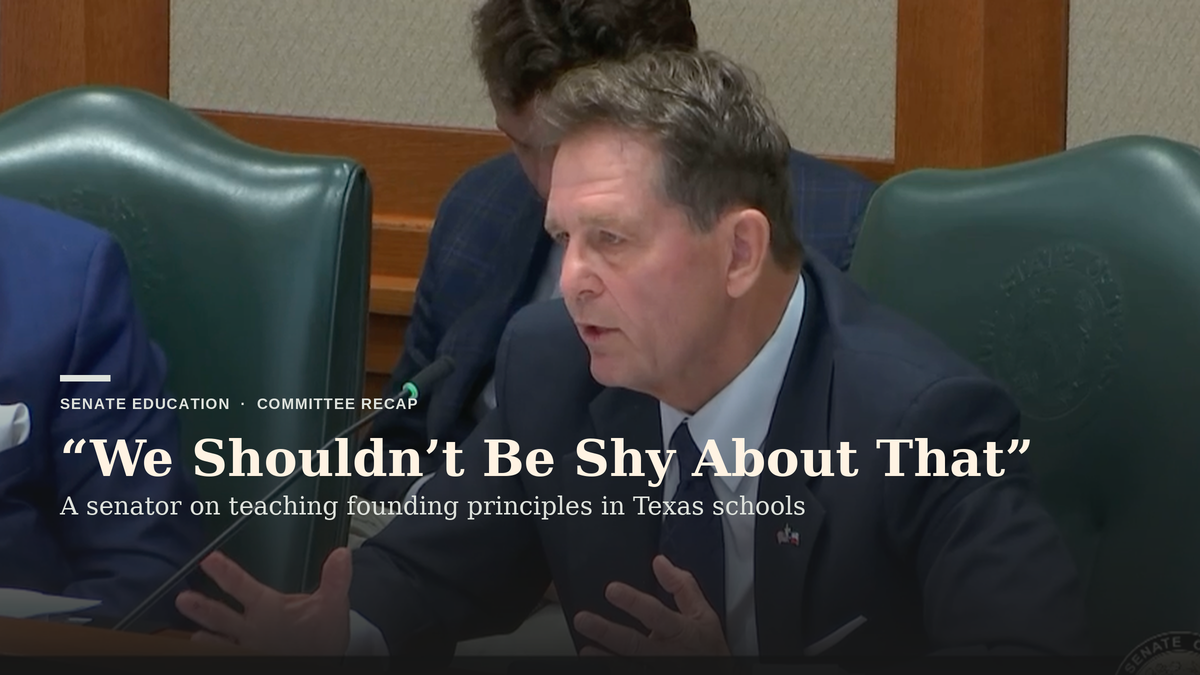
Foreign money in schools and the way Texas teaches American history drew sharply different views at the Senate Education Committee on Oct. 7. A Texas Public Policy Foundation analyst presented records on foreign-funded programs in Austin and Houston schools. A Republican senator questioned whether the materials belong in Texas classrooms, and and another Senator questioned how the State Board of Education defines American identity. The charge took about 44 minutes, 11% of the hearing.
The charge directs the committee to examine schools that promote events or partnerships with federal or state designated hostile actors and to recommend ways to ensure schools teach American and Texas exceptionalism, according to the hearing notice.
Kate Byerly, education campaign director at the Texas Public Policy Foundation, said Arabic curriculum materials in Austin ISD came largely from foreign sponsors such as the Qatar Foundation International, and became accessible only after the Attorney General’s Office intervened. She said QFI gave $85,000 to an Arabic immersion magnet school in Houston and that its contracts let staff observe classes and request lesson plans first. “Foreign entities are currently observing Texas classrooms and influence what is being taught across Austin and Houston,” she said, citing public records of more than $1.5 million to the two districts since 2015. The Dispatch previously reported on House testimony on foreign financial influence.
Byerly described a bill she proposed that would require districts and colleges to report gifts and contracts “down to the dollar amount” and bar money from sources tied to what she called radical extremist groups. “We know gifts always come with strings attached,” she said.
Sen. Brent Hagenbuch, R-Denton, asked what those materials had to do with teaching Western civilization. “Nothing,” a witness answered. “They should not be in our curriculum.” Hagenbuch also pressed State Board of Education Chairman Aaron Kinsey on the Heritage Foundation’s Phoenix Declaration, a framework for civics-centered schools that he said Florida adopted in 2025. Kinsey said he was not familiar with it.
Hagenbuch said Texas should teach its founding principles directly. “We shouldn’t be shy about that,” he said. Asked whether the state curriculum identifies America as a great source of good in the world, Kinsey said, “conceptually, yes,” and offered to confirm the standards’ wording.
Kinsey described the board’s work as grounded in the Education Code and the state’s existing standards. Civil disagreement is covered in various grades and in the government course, he said, and civics training institutes created under an earlier law are rolling out for teachers. The social studies standards were overdue for revision, and a sequential model now governs grades three through seven. The board “leaned on statute,” he said, in deciding how to cover difficult topics.
Sen. José Menéndez, D-San Antonio, asked how the emphasis on American and Texan identity is defined. “Who defines what it means to be an American,” he asked, “and how do you decide?” He said he is proud to be a Texan and an American and the son of two immigrants. He asked whether Latino, Black and Indigenous contributions would remain in K-12 textbooks and noted that Mexican American and African American studies electives are not offered in every district. Kinsey said the electives are opt-in for districts, outside the board’s purview, and were not revised this cycle because they were adopted within the last five years or so.
On slavery, Kinsey said, “We need to tell the good, the bad, and the ugly. And I believe that’s what we did.” Menéndez also asked about the board’s approval of a required reading list that includes Bible passages. Kinsey agreed “the Constitution does not establish a religion,” but said the Education Code specifies that Old and New Testament scriptures be taught. He said he asked the attorney general for an opinion on how to meet that duty and chose to cover the material in language arts and reading, with a reference in each grade.
Menéndez closed with the state’s 5.5 million students, who come from many races, ethnicities and religions. Asked about the board’s legislative wish list, Kinsey said he valued the relationship with lawmakers and would call with a short list.
No vote was taken. Findings feed bills for the 90th Legislature, which convenes in January 2027. The Texas Dispatch previewed this hearing.
The committee spent about 81 minutes on the school choice rollout; see the companion recap, “Comptroller’s Office Defends School Choice Safeguards as Senators Probe Pre-K Demand and Award Data.” It also heard monitoring testimony from TEA officials on Senate Bill 12 (parental rights, about 30 minutes), Senate Bill 13 (school libraries, about 23 minutes) and House Bill 6 (discipline and telehealth, about 31 minutes). Public testimony ran roughly three hours.
Fact box
- Issue
- Interim charge on hostile foreign influence in schools and teaching American and Texas exceptionalism (approx. 44 minutes, about 11 percent of the hearing)
- What happened
- A policy-group analyst presented records on foreign-funded programs in Austin and Houston schools; Sen. Hagenbuch pressed for civics-focused standards; State Board of Education Chairman Aaron Kinsey described the board’s changes; Sen. Menéndez questioned how American identity is defined. No vote — interim hearing.
- When
- Wednesday, Oct. 7, 2026 · run time about 6:43 (4,023 caption segments)
- Where
- Room E1.028, Capitol Extension, Austin
- Chair
- Sen. Donna Campbell, R–New Braunfels (SD-25); Vice Chair Sen. Paul Bettencourt, R–Houston (SD-7)
- Key witnesses
- Aaron Kinsey, chairman, State Board of Education; Kate Byerly, education campaign director, Texas Public Policy Foundation
- Archived video
- senate.texas.gov video 22859