
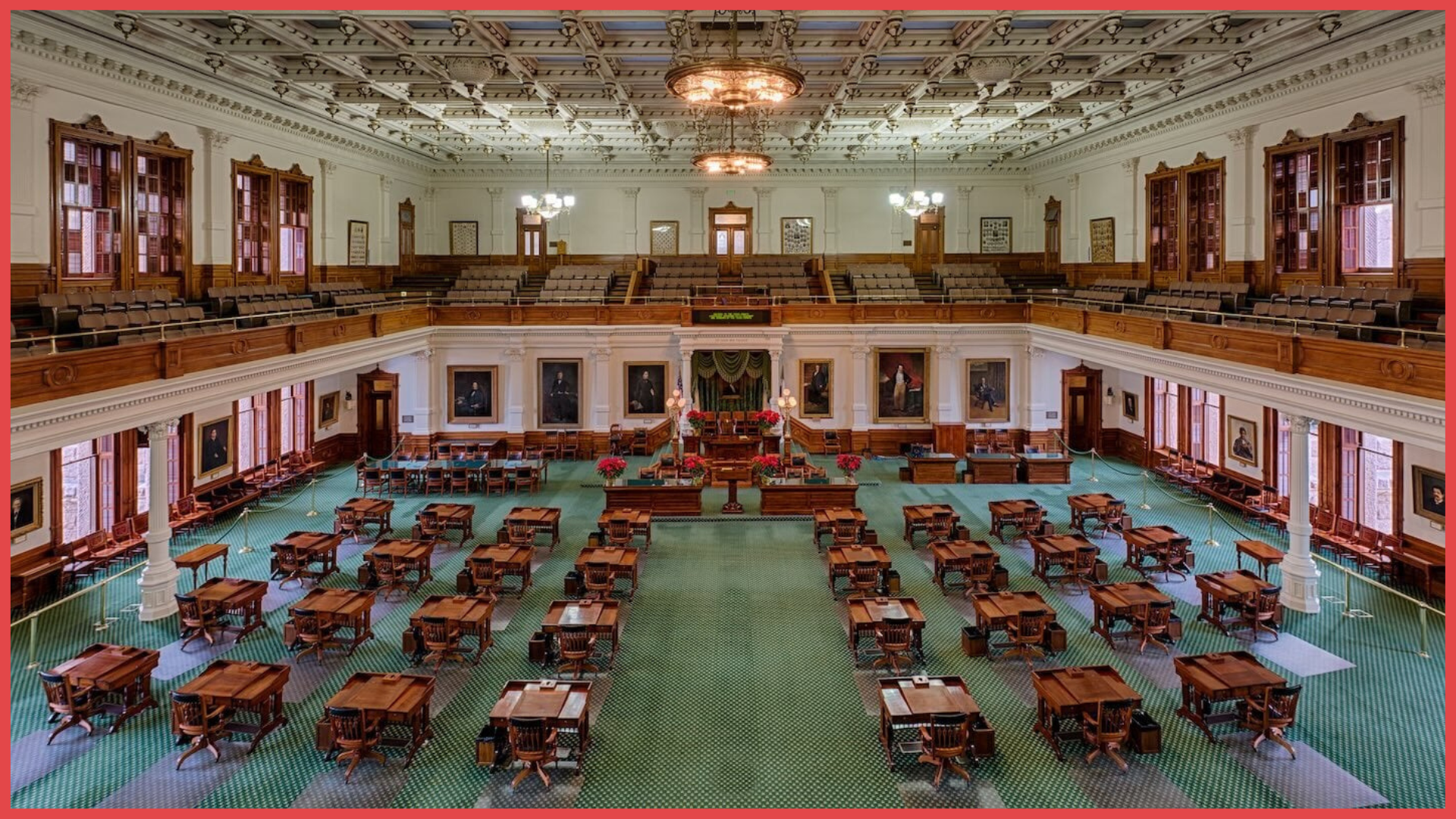
The Texas Senate Committee on Business and Commerce will take invited and public testimony July 29 on ERCOT reliability and Senate Bill 6’s large-load rules, and on how a fast-expanding network of 765-kilovolt transmission lines will affect Texas landowners.
- When: 9:00 AM CT, Wednesday, July 29, 2026
- Where: Room E1.012 (Hearing Room), Capitol Extension, Austin
- Chair: Sen. Charles Schwertner, R–Georgetown (SD-5)
- Vice Chair: Sen. Phil King, R–Weatherford (SD-10)
- Format: Invited and public testimony; public testimony limited to 2 minutes per witness; written testimony requires 15 copies to the clerk plus a digital copy emailed to the committee; interim charges only — no vote on legislation
- Live video: senate.texas.gov/av-live.php
- Submit comments online: N/A — the Senate does not operate an online comment portal for this hearing
- Full agenda: Official hearing notice — revised (capitol.texas.gov)
The Texas Senate Committee on Business and Commerce will gavel in at 9 a.m. Wednesday to take invited and public testimony on the reliability of the state’s electric grid and on the property-rights implications of a fast-expanding network of high-voltage transmission lines.
Chaired by Sen. Charles Schwertner, R-Georgetown, the 11-member panel splits 7-4 in favor of Republicans and holds jurisdiction over electric utilities, ERCOT, insurance and the state’s financial-technology markets. Wednesday’s hearing is an interim charge review — the committee will take no vote on legislation — but it lands as ERCOT projects electricity demand could climb significantly by 2030, driven by Texas continued growth and development.
The first charge asks members to assess the state of the grid and monitor rulemaking under Senate Bill 6, the 2025 law overhauling how large electric loads connect to ERCOT. SB 6 directs the Public Utility Commission to set interconnection standards for loads of at least 75 megawatts — a category that captures data centers, cryptocurrency miners and large industrial plants — imposes a transmission screening study fee of no less than $100,000, and requires the commission to re-examine how transmission costs are allocated so that all loads help pay for the system. The commission published draft interconnection rules in March 2026.
The charge also revisits the reliability tools built after the February 2021 blackouts. The Texas Energy Fund, the low-interest loan program voters created in 2023 to underwrite new dispatchable generation, has drawn heavy interest but slow output — The Texas Tribune reported in August 2025 that the roughly $7.2 billion program had closed on only two projects in two years. Members are also likely to weigh the durability of the post-Winter Storm Uri reforms enacted in Senate Bill 3 and Senate Bill 2, 87th Legislature, which imposed weatherization mandates and remade the ERCOT governing board.
The second charge turns to the 765-kilovolt transmission lines that are planned to move power to the Permian Basin and West Texas. The PUC in 2025 approved the first of these ultra-high-voltage import paths, and ERCOT’s board in December 2025 signed off on the 765-kV backbone. The charge directs the committee to weigh those route plans against their effect on homes, businesses and communities, and to assess whether current permitting and siting timelines adequately protect landowners whose property values and long-term land use could be affected. It is the property-rights versus the state’s build-fast posture on transmission needed in its most economically critical region.
Public testimony is limited to two minutes per witness, and the committee asks that written testimony be submitted in 15 copies to the clerk with a digital copy emailed to the committee. Because the panel is meeting in the interim, any recommendations will feed into legislation for the 90th Legislature, which convenes in January 2027.