
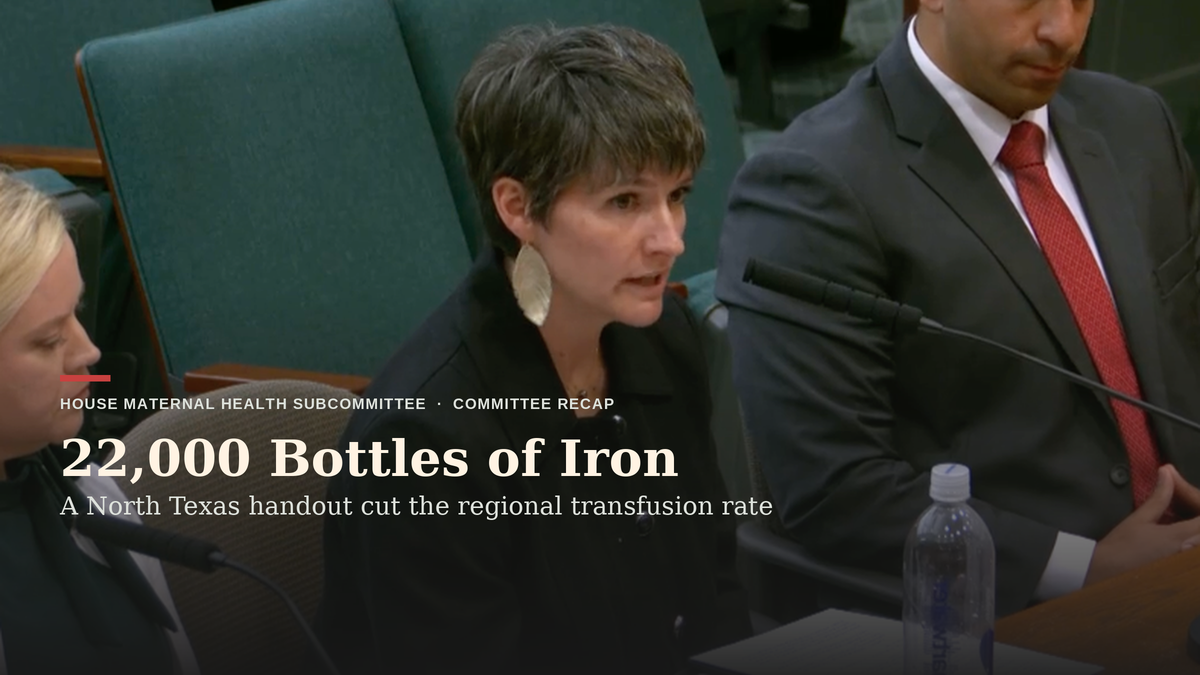
A coalition of North Texas hospitals has handed out more than 22,000 bottles of over-the-counter iron to pregnant women, and the region’s blood transfusion rate has fallen. On Sept. 15 its leaders told a new Texas House subcommittee they are drafting legislation to scale it statewide — with that subcommittee’s chair already at the table.
“We are engaged in conversations alongside critical partners, including Representative [Pierson] and the Texas Pharmacy Association, to craft a statewide standing delegated order, or SDO, for iron,” said Heather Stancil Morris of the Burnett School of Medicine at Texas Christian University. “If enacted, an SDO will allow any pregnant woman on Texas Medicaid to receive high quality, effective iron supplements as a Medicaid benefit.”
That is the sharpest legislative signal from the subcommittee’s first hearing. The panel, created Aug. 20 by Speaker Dustin Burrows, gave two hours — about 41 percent of its day — to an interim charge on iron and prenatal supplements, under a notice limiting testimony to invited witnesses. The gap it would close was established earlier the same day, when the Texas Health and Human Services Commission told members that Healthy Texas Women “does not cover iron supplements or prenatal vitamins at this time,” while full Medicaid covers them by prescription.
Dr. Farrah Amaro, a maternal-fetal medicine specialist at UTHealth Houston, opened the charge by describing a problem Texas cannot currently measure. Iron demand rises as much as eightfold by the third trimester, she said, and roughly half of mothers have iron deficiency — but “I can’t really tell you how big of a problem this is in Texas because there isn’t good tracking of iron deficiency anemia.” Texas PRAMS, the state’s main postpartum survey, “tracks things such as multivitamin use, BMI, perinatal depression, but it doesn’t track” anemia.
The consequences she laid out were not marginal. “Your severe maternal morbidity is up four fold if you’re an anemic mom compared to a non-anemic mom,” Amaro said. “Your chances of getting a blood transfusion 11 fold more likely.” Her recommendations: add anemia and iron status to what the state collects, and make iron screening a covered Medicaid benefit.
Dr. Deborah Fuller, a Dallas obstetrician-gynecologist testifying for the Texas Medical Association and herself, put the clinical standard next to the price. A pregnant woman “needs twice as much iron, so 27mg a day at minimum,” she said. “Testing costs a few dollars and iron tablets pennies a day.”
Fuller’s second ask reaches a different population entirely. Wheat flour in the United States is fortified with folic acid; masa is not. “Getting corn flour, masa flour, with folate in it, would be very important to match what is happening with wheat flour, because the incidence of neural tube birth defects in South Texas is much higher than in the rest of the state,” she said. Asked how the effect is known, she pointed to the wheat record: “after it was initiated, there was a 28% reduction in neural tube birth” defects. Amaro added the timing that makes prevention hard: “the neural tube itself does not close till 8 to 10 weeks.”
Rep. Joanne W. Shofner, R–Nacogdoches, asked most of the questions, pressing Amaro on postpartum visits that 40 to 60 percent of women miss. Amaro answered with the reason her clinic now screens mothers at the baby’s well-child visit instead: “half of moms who develop hypertension in the postpartum period do not have an underlying hypertensive disorder of pregnancy.”
The North Texas panel then turned the charge into arithmetic. Cameron Combs of the Child Poverty Action Lab said the North Texas Maternal Health Accelerator — more than 200 partners led by TCU’s Burnett School of Medicine and UT Southwestern — has cut severe obstetric complications by about 10 percent and aims for 35 percent by the end of 2028. A Milliman analysis, he said, “finds that if Texas were to reduce severe obstetric complications with those same targets, it would save over $95 million for Texas” Medicaid.
Dr. Sheena Dillon, an obstetrician-gynecologist hospitalist at Baylor Scott & White All Saints Medical Center in Fort Worth, explained why iron specifically. “Blood transfusions are the most common severe obstetric complication in Dallas Fort Worth, and occur in about 3% of all deliveries,” she said. “That is roughly twice the national” rate. Hemorrhage is a leading cause of maternal death, she added, “with 90% of deaths attributed to hemorrhage being preventable.”
Her point was about delivery mechanics, not prescribing. “There are many reasons patients don’t know that they should take iron, can’t afford it, or can’t get to the pharmacy,” Dillon said. Physically “handing moms the supplement” cut the transfusion risk from symptomatic anemia “by a third when implemented at Dallas Public Hospital.”
Morris supplied the field data. “Over 30,000 bottles of iron have gone out to our iron distribution partners and over 22,000 of those have made it into the hands of pregnant women,” she said. The regional transfusion rate was 3.08 percent in the 2024 baseline year. “As of last month, the regional transfusion rate has dropped to 2.61.” The whole effort started with less than $200,000 in seed money from Fort Worth funders — “and that’s what we used to purchase the first boxes of iron.”
Dr. Shannon Abraham, CEO of Delfina Care, closed with a contrast. Texas recorded 29.3 maternal deaths per 100,000 births as of 2025, she said, “nearly twice the state’s 2030 target of 15.7.” Her company’s number, across 8,000 Texas births in its care, is zero.
Chair Katrina Pierson, R–Rockwall, spent her questions on whether any of it is being measured. Asked whether her clinic tracks downstream cost savings, Amaro said no: “That’s a great idea. Not at this time.” Dr. Natalie Polis of the University of Texas at Austin flagged a parallel blind spot: Texas does not track food insecurity among pregnant women at all.
No votes were taken. What members heard will shape the women’s health bills filed for the 90th Legislature, which convenes in January 2027.
The subcommittee’s longest block, two hours 55 minutes, went to Healthy Texas Women, where the Health and Human Services Commission confirmed that enrollment now outruns use of the program’s services and that a 3 percent Legislative Budget Board directive has the agency proposing to eliminate cost-reimbursement funding for 32 of roughly 3,500 providers — the subject of the companion recap, “Healthy Texas Women Enrollment Keeps Rising While Use of Its Services Falls.” Rep. Liz Campos, D–San Antonio, also pressed the agency on the state maternal mortality report, which she said has slipped from a Sept. 1 due date to Dec. 1.
Fact box
- Issue
- Interim charge — benefits of iron and other essential supplements for pregnant women and expanding access to supplementation, testing and prenatal nutrition (approx. 2 hours, about 41 percent of the hearing; second-longest block)
- What happened
- The North Texas Maternal Health Accelerator reported distributing more than 22,000 bottles of iron to pregnant women and a regional transfusion rate falling from 3.08 percent to 2.61 percent, and said it is drafting a statewide standing delegated order to make iron a Texas Medicaid benefit; witnesses told members Texas does not track iron deficiency anemia in pregnancy; the Texas Medical Association asked for folate fortification of masa flour; no vote (interim hearing)
- When
- Tuesday, Sept. 15, 2026, 10:00 AM CT · run time 4:58:16
- Where
- Room E2.030, Capitol Extension, Austin
- Chair
- Rep. Katrina Pierson, R–Rockwall (HD-33); no vice chair designated
- Key witnesses
- Dr. Farrah Amaro, UTHealth Houston; Dr. Deborah Fuller, Texas Medical Association; Dr. Elizabeth Widen, Dr. Natalie Polis and Dr. Elizabeth Klingbeil, University of Texas at Austin and Texas Academy of Nutrition and Dietetics; Cameron Combs, Child Poverty Action Lab; Dr. Sheena Dillon and Heather Stancil Morris, North Texas Maternal Health Accelerator; Dr. Shannon Abraham, Delfina Care
- Archived video
- house.texas.gov video 22862