
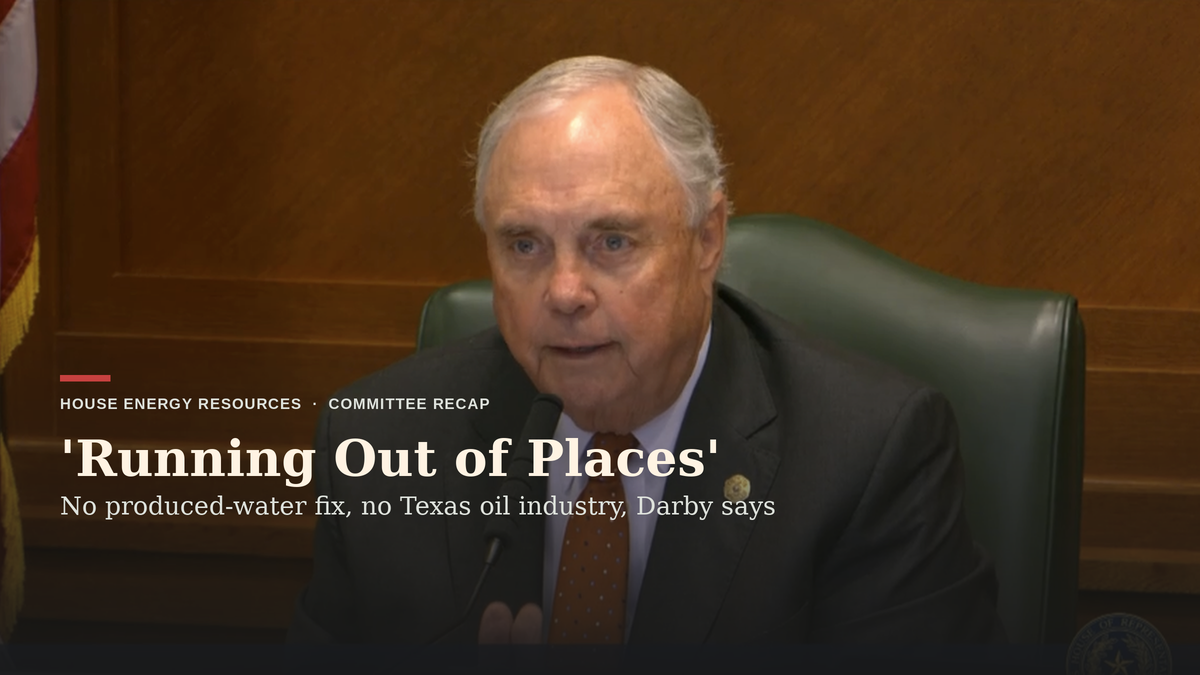
Texas oil and gas wells throw off roughly 26 million barrels of salty wastewater a day, and operators pump nearly 30 million barrels a day back underground. The chairman of the House Committee on Energy Resources told witnesses Sept. 14 that the arithmetic has an end point.
“The bottom line is we’re running out of places to put this stuff,” Chair Drew Darby, R–San Angelo, said. “And if you want to know why this is important, if oil and gas industry cannot figure out a way to treat the produced water problem in the state, we will have no oil and gas industry. Am I clear on that? This is an industry that contributes $27 billion to this state.”
The committee gave produced water about three hours 25 minutes, its second-longest block of an eight-hour day, in the first full review of House Bill 49 since it took effect. Darby authored that law, which this committee reported out unanimously in 2025. It limits tort liability for landowners, operators, treaters and transporters once produced water is transferred for beneficial use, while preserving liability for gross negligence, intentional misconduct and permit violations.
Paul Dubois, assistant director for technical permitting at the Railroad Commission of Texas, supplied the baseline and a caveat: the agency still cannot measure produced water directly. A new reporting system is coming — “we expect that system to go live this spring,” he said — and until then the commission works backward from injection volumes. Operators “report, a total of 29 to 30 million barrels of produced water is injected per day, about 22 to 23 million barrels of that is injected for disposal. And of that, about 4 million barrels of water is imported from out of state.”
Against those volumes, treatment is still small but no longer experimental. Shane Walker of the Texas Produced Water Consortium told members pilot systems ran “in the range of 20 to 800 barrels per day” in 2024 and 2025. “In 2026, companies are demonstrating 2,000 to 20,000 barrels per day,” he said. “So we see an order to two orders of magnitude increase in the scale of treatment capacity, which is promising.”
The obstacle members kept returning to was price. Darby laid it out himself: disposal runs “50 to $0.75 a barrel,” while treatment “may be as much as three times that. I mean, $1.75 to $2” to bring the water to a level fit for reuse. Nobody on the witness table disputed the spread. Scott Mitchell, chief executive of Deep Blue, argued the pilot phase has run its course. “I think we’re ready to move on to commercial scale facilities,” he said, “and by that, I mean, you know, in excess of 20,000 barrels a day.”
Industry witnesses credited HB 49 and asked for more. Jim Newman, an executive vice president at Aqua Fortis, said the law “moved Texas in the right direction, clarifying liability for those, involved,” and warned that analysts forecast “as much as a 5 million barrel a day deficit in the Delaware” basin. Michael Lozano of the Permian Basin Petroleum Association paired HB 49 with Senate Bill 1145 as “natural extensions of our long standing efforts that we’ve been working on for decades now,” and told members that managing produced water “is of existential importance for the health, the growth, and the vitality of the communities in the Permian Basin.”
Researchers from the Bureau of Economic Geology reframed the problem as pressure rather than volume. Director Lorena Moscardelli noted the bureau has served as the State Geological Survey since 1909. Her colleague, who leads the bureau’s injection and seismicity research center, said shutting in 20 deep disposal wells in the North Culberson-Reeves Seismic Response Area “cut earthquake rates by two thirds from 2022.” But the pressure has moved. “Curtailing deep injection near problematic seismicity worked,” she said. “Now, as the challenge moves increasingly to shallow reservoirs, we need to take the same proactive approach we took to monitoring seismicity.”
Environmental witnesses argued the liability shield has outrun the science. A witness for the Sierra Club’s Lone Star Chapter, whose name the captions render unusable, told members HB 49 “limits corporate liability provided they meet the standards” set by the Texas Commission on Environmental Quality, and that if those standards are set too early, “the public rather than industry will carry the risk and pay the price.” A witness for Chispa Texas turned the scarcity argument around: “Industry depletes, and then uses a community’s need as leverage to to deplete even further. And yet, we rarely hear about industry curtailment as a solution to our water crisis.”
The most quoted public witness of the afternoon was neither. Larry Lindenschmidt introduced himself as “a theologically conservative Christian and a politically conservative voter” and then objected to imports. “I’ve always wondered why Texas should be a dumping ground for this water coming in from New Mexico and Louisiana,” he said, citing “187,000 barrels per day” arriving from Louisiana and a phenomenon he called “transborder pressure migration.” He pointed members to reporting about Joaquin, in East Texas, “where oil and gas wastewater is flowing up from an old oil and gas wells.”
George Hillhouse, an Upton County mineral owner, aimed at the statute itself. “It’s like yesterday’s trash is tomorrow’s treasure,” he said. “And we really need to change section 122 to reflect that.” As The Texas Dispatch reported in August, senators heard a similar account of a rollout moving faster than the line between agencies; the Dispatch reported this month that Pecos-area landowners remain split over discharging treated oilfield water.
No votes were taken and no legislation was before the panel.
The committee opened the day with about four hours on carbon capture, utilization and storage — the subject of the companion recap, “Carbon Storage Permits Lag in Texas As Liability Questions Go Unanswered.” It closed with roughly 49 minutes on seismic activity and injection wells, where Dubois conceded that the Railroad Commission’s permitting guidelines “were never going to constrain seismicity when production and disposal continued to increase rapidly,” and Commission Shift asked for a centralized state system for tracking leaks and spills.
Fact box
- Issue
- Interim charge — produced water and House Bill 49 (approx. 3 hours 27 minutes, about 42 percent of the hearing; second-longest block)
- What happened
- The Railroad Commission reported 29–30 million barrels of produced water injected daily, including about 4 million imported from out of state, and said a direct reporting system is not yet live; the Texas Produced Water Consortium reported treatment capacity rising from pilot scale to as much as 20,000 barrels a day; industry witnesses credited HB 49 and asked for further statutory clarity; environmental witnesses argued the liability limit outruns the science; Chair Darby called produced water an existential problem for the industry; no vote (interim hearing)
- When
- Monday, Sept. 14, 2026, 8:30 AM CT · run time 8:22:59
- Where
- Room E2.026, Capitol Extension, Austin
- Chair
- Rep. Drew Darby, R–San Angelo (HD-72); Vice Chair Rep. Eddie Morales, D–Eagle Pass (HD-74)
- Key witnesses
- Paul Dubois, Railroad Commission of Texas; Robert Sadler, TCEQ; Shane Walker, Texas Produced Water Consortium; Michael Lozano, Permian Basin Petroleum Association; Jim Newman, Aqua Fortis; Scott Mitchell, Deep Blue; Lorena Moscardelli, Bureau of Economic Geology; Larry Lindenschmidt
- Archived video
- house.texas.gov video 22739