
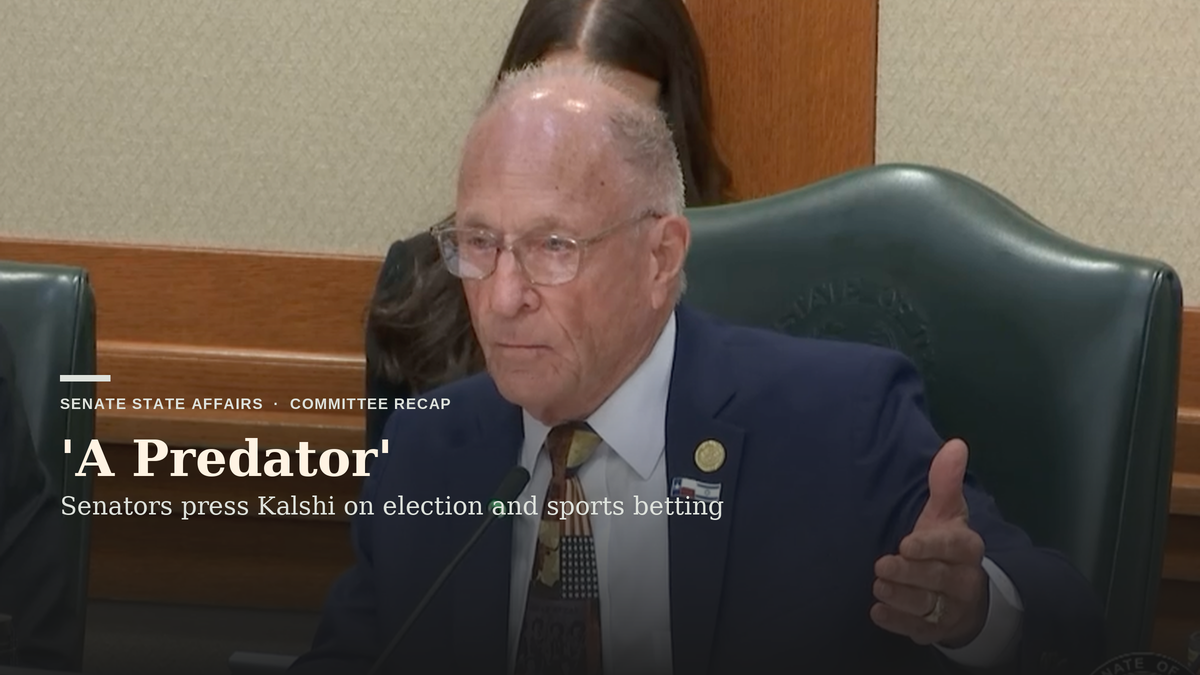
A lawyer for the prediction market Kalshi sat before the Senate Committee on State Affairs on Sept. 15 and told Texas senators that betting on the Cowboys is a federally regulated swap, not gambling. Sen. Bob Hall, R–Edgewood, did not take it well. “The gambling industry across the board is a predator,” he said.
The committee gave the charge an hour and 41 minutes — the longest block of a five-hour hearing — and the question underneath it was jurisdictional. Texas outlaws gambling under Chapter 47 of the Penal Code. Prediction market platforms list event contracts on elections and sports under the Commodity Futures Trading Commission, and argue federal law preempts the state. Chair Bryan Hughes, R–Mineola, named his two concerns: “One is election integrity. And also Texas sports.”
Robert J. Donley, head of enforcement and legal counsel at Kalshi, made the preemption case directly. The company “operates its exchange and clearinghouse under the same exact federal regulatory structure as every CFTC licensed exchange,” he said, and its contracts “are federally regulated as swaps, not as gambling under state law.” He drew a business-model distinction too: sportsbooks’ “primary source of profits are derived from customers losing on their platforms,” while Kalshi takes “a $0.01 fee for every contract.”
The American Gaming Association, which represents the licensed casinos and sportsbooks that pay state taxes, was there to dispute that. “So-called sports event contracts on prediction markets like [Kalshi and] Polymarket are gambling,” said Tracy York, the association’s vice president for government relations. Texans could “put money down on who would win the Cowboys [and] Giants game. That’s a sports bet.” York put the litigation score at “42 state and federal rulings that have been issued so far, states have won 36 of them,” and said “85% of their gambling volume is on sports and parlays. If 85% of betting on your side is on sports, you’re a sportsbook.” She closed with a line aimed at the dais: “Prediction markets think they can mess with Texas. I hope you prove them wrong.”
Hall asked the witnesses to help him write a bill, and framed the preemption argument as a category error. If a company “decided to set up Murder Incorporated and say, we’re going to regulate the murdering of people, and so states you can’t do anything about it,” he said, “we would find that absurd.” He also questioned whether a new law is needed at all: “I’m not sure why the law is not even being enforced today, because I think the law is adequate.”
York gave him two routes — sue in state court, where states have mostly won, and pass language making clear that sports event contracts are illegal gambling in Texas. Donley warned Texans would end up “just going offshore to an even more dangerous platform.” Hall was unmoved: “that’s kind of like we’re going to give you some drugs here so that so when we cut your throat, it won’t hurt.”
Sen. Charles Schwertner, R–Georgetown, worked the election side and got the number that will follow the company around. Asked what share of Kalshi’s business is election markets, Donley said, “Put it between 15 and 20% of the businesses.” Schwertner then delivered the warning of the day. “If politicians feel like they’re not getting, they’re being influenced by prediction markets, that’s a good way to to irritate us and shut y’all down,” he said. “It’s a dangerous area.”
Schwertner also walked Donley through the court record — a win in the Third Circuit out of New Jersey, a loss in the Ninth Circuit out of Nevada — and asked whether the president’s son remains a company adviser. Donley confirmed he is, and added that Kalshi “first obtained a license under the Biden administration.”
Sen. Adam Hinojosa, R–Corpus Christi, asked the question the committee has to answer: “what stops a casino from saying, well, we’re not going to take the money. We’re just going to charge a facility fee?” York’s answer was practical rather than legal — the fee model “is very, very much not as profitable” than a licensed book.
Sen. Judith Zaffirini, D–Laredo, kept returning the panel to the charge as written. “Does any of you have any data related to the impact of gambling on Texas sports or elections?” she asked. York conceded there was none “specifically related to Texas.”
Donley described know-your-customer screening that blocks candidates and campaign staff from trading on races. A problem-gambling policy consultant on the same panel answered with Ohio: “They allowed 620 children to gamble. $2.78 million. Are those KYC controls stringent enough that you’re comfortable?”
Hughes spent his own time on manipulation, and got an anecdote that cut both ways. A single trader “traded over $1 million on this person” in a Los Angeles mayoral market, Donley said, and “the market corrected that position in nine seconds.”
The second panel narrowed the ask. Dr. Lindy McGhee, a Houston pediatrician testifying for the Texas Medical Association, said it and the Texas Pediatric Society “support a minimum age of 21 years with age verification to participate in these prediction market platforms” — a position the Dispatch reported in August. Her framing was blunter: “We have people just walking around, you know, with Vegas in their pockets these days.” Jonathan Covey, policy director at Texas Values, argued the state already has a hook: “Texas has Texas penal code 47.02, which already prohibits election wagering.”
The clearest request for state action came in public testimony. Jason Nelson, general counsel for the Kickapoo Traditional Tribe of Texas, asked the committee to push the attorney general off the sidelines: “We want to call on the attorney general to investigate these operators for violations of chapter 47. Texas gaming policy should be decided in this capital, not by private companies exploiting a federal label.”
No votes were taken. What members heard will shape the bills filed for the 90th Legislature, which convenes in January 2027.
The committee gave an hour and 14 minutes to fair banking, where Hughes signaled he wants “more teeth” than Senate Bill 13 and two bank trade groups said debanking is not a Texas problem — the subject of the companion recap, “Texas Bankers Doubt Debanking Is a Texas Problem As Hughes Promises a Tougher Law.” The day opened with 24 minutes on private-label liquor, where a Texas Alcoholic Beverage Commission attorney told senators “the term private label is not actually a legal term of art” and “does not actually even appear in the alcoholic beverage code.” A 49-minute charge on judicial integrity, which names no organization in the notice, was aimed by all three invited witnesses at the Environmental Law Institute’s Climate Judiciary Project; former Texas Supreme Court Chief Justice Nathan Hecht testified, and both Hughes and Hall warned repeatedly against writing anything that would restrict judges’ access to Federalist Society or ACLU programming.
Fact box
- Issue
- Interim charge — closing gambling loopholes and prediction market gambling (approx. 1 hour 41 minutes, about 32 percent of the hearing; longest block)
- What happened
- Kalshi defended its event contracts as CFTC-regulated swaps preempting state gambling law; the American Gaming Association said states have won 36 of 42 rulings and that 85 percent of prediction market volume is sports; Sen. Bob Hall called the industry “a predator” and asked witnesses for drafting help; Sen. Charles Schwertner put Kalshi’s election-market share at 15 to 20 percent and warned the area is “dangerous”; the Texas Medical Association asked for a minimum age of 21; the Kickapoo Traditional Tribe asked the attorney general to investigate under Chapter 47; no vote (interim hearing)
- When
- Tuesday, Sept. 15, 2026, 9:00 AM CT · run time 5:12:55
- Where
- Room E1.012, Capitol Extension, Austin
- Chair
- Sen. Bryan Hughes, R–Mineola (SD-1); Vice Chair Sen. Angela Paxton, R–McKinney (SD-8)
- Key witnesses
- Robert J. Donley, Kalshi; Tracy York, American Gaming Association; an unnamed problem-gambling policy consultant; Dr. Lindy McGhee, Texas Medical Association and Texas Pediatric Society; Jonathan Covey, Texas Values; Jason Nelson, Kickapoo Traditional Tribe of Texas; Rob Kohler, Christian Life Commission
- Archived video
- senate.texas.gov video 22784