
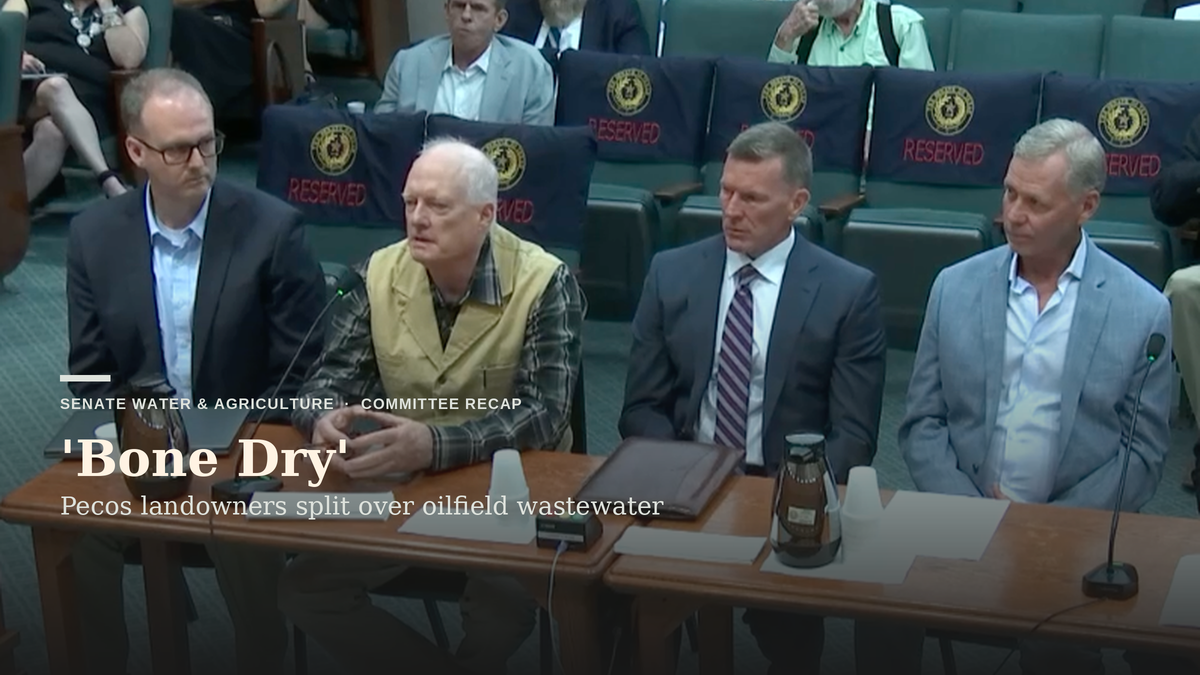
A spring on Ryan White’s ranch in the Pecos River basin flowed 1,200 gallons a minute until 2014. It has not flowed since. Pecos County once had 42 named springs; it now has one. White told senators Sept. 2 that he pays taxes to a Ward County irrigation district and cannot name a benefit he gets for it.
“The best place to store water is underground. When you store it in a reservoir, it evaporates,” White said.
The Senate Committee on Water, Agriculture and Rural Affairs, chaired by Sen. Charles Perry, R–Lubbock, took invited and public testimony on an interim charge covering the Pecos basin, including the treated oilfield wastewater that companies want to discharge into it. Because this was an interim hearing, the committee took no votes. The Texas Dispatch previewed the hearing and reported Aug. 11 that regulators asked the Senate Natural Resources Committee for clearer lines between agencies on produced-water rules. The Texas Commission on Environmental Quality told the committee it holds six pending discharge applications, five in the Pecos watershed, totaling about 55,000 acre-feet a year at full build-out.
The witnesses who followed the agencies agreed the river is dying and disagreed on the cure. Eric Bernard, a Midland land planner and former co-director of the Texas Produced Water Consortium, made the case for discharge. “Re watering the Pecos River would be the first major rewatering of a river in the world,” he said. “There is a potential to restore 8.6 million acres of a degraded landscape.” He urged senators to measure basin recovery rather than discharge volumes alone, and said treated samples he has seen are “higher quality water than most people get off a grocery store shelf.”
Eric Selinger, a landowner in the lowest of Red Bluff’s districts, said the middle Pecos is dry for more than 100 miles. “One company alone holds a permit for more than 7500 acre feet per year,” he said. “That’s 2.44 billion gallons.” He asked senators to “order a full audit of the Red Bluff Water and Power Control District, its industrial water sales, the revenue from those sales, and where that revenue is gone,” and to “require that any industrial water sales from Red bluff include mandatory downstream releases for irrigation and for environmental flow.”
Trey Allgood, a fourth-generation Ward County farmer whose family built the canals still in use, asked for the opposite restraint. “Only God can make it rain,” he said. “None of us can make any more water come down the river from New Mexico than what they release under the compact.” He came, he said, “to humbly ask to don’t forget the production of agriculture and making any decisions down here in Austin.”
Sen. Lois Kolkhorst, R–Brenham, went to White’s photographs of the spring before 2014 and after. “This is really it today?” she asked. “Yep. Bone dry,” he said. She asked whether the member districts spend tax money on “make work projects, i.e cleaning out ditches that rarely, if ever, run” and “building new offices.” White said “a couple of the districts” had built new offices.
Conservation groups asked for science before discharge. Bobby Janecka, a regional board member of American Rivers, said Independence Creek “contributes roughly 42% of the lower Pecos volume and cuts its salinity nearly in half,” which he called “proof that this basin still has the natural capacity to heal itself.” He urged the committee “to treat basin restoration as a water supply strategy, not just an environmental one.” Myron Hess, testifying for himself and the National Wildlife Federation, said the 2007 environmental flows law did “the easy part” and never funded the voluntary reallocation of water it promised. William Simpson of Friends of the Pecos River asked for “a new expert science team” to recommend river and reservoir management.
Downstream landowners said the reservoir does not work for them. “Perhaps the Red Bluff Reservoir serves the farmers of Ward County, but it does not serve the landowners downstream,” said Kelly Duncan Garrett. Sean Gaston, vice president of a family partnership with about 2,000 acres on the river, said it “seems as if Red bluff has gone from a governmental entity to being a for profit business for water transfer.”
Julie Louis, Lower Pecos and Devils River program director for The Nature Conservancy, which conserves about 159,000 acres in the watershed, said produced-water reuse and brackish desalination “may play a role” if “supported by a rigorous science, transparent monitoring and clear standards.”
Ira Yates, a Pecos County landowner, said the basin is recoverable but “transactionally this is currently a Mission Impossible,” and that if brackish desalination proves cheaper, “that’s where AI and the data centers will go.” Sen. Adam Hinojosa, R–Corpus Christi, asked him to name “1 or 2 things we could do next session legislatively.” Yates did not. “There’s not a silver bullet to this problem,” he said. “What we recommend is setting up the study.”
Vice Chair Kevin Sparks, R–Midland, asked Janecka whether wells selling water to oil and gas are dropping the water table, and closed the way he opened: “I’m optimistic about restoring the Pecos River.” Kolkhorst called data centers “a new frontier” for the basin and said she would work with Sens. Sparks and César Blanco on the districts. “I just hate studies. It just takes too long,” she said. Perry’s closing action items were the district’s financials and “a produced water permit that needs to be moving.” The 90th Legislature convenes in January 2027.
The first 97 minutes went to TCEQ, the Pecos River Compact commissioner, a Midland nonprofit that said Red Bluff released no meaningful water for two years while selling frack water, and the district’s defense; Chair Perry ordered the district’s financials. That is the subject of the companion recap, “Senators Demand Red Bluff Financials as Witnesses Say Pecos Ran Dry While District Sold Frack Water.” The committee recessed subject to the call of the chair.
Fact box
- Issue
- Interim charge — Managing the Pecos River Basin: landowner, conservation and public testimony on produced-water discharge and Red Bluff releases (approx. 1 hour 20 minutes, about 45 percent of the hearing; second block)
- What happened
- A rancher described springs dry since 2014 and questioned irrigation district taxes; a former Texas Produced Water Consortium co-director said discharge could rewater the river; a downstream landowner asked for a Red Bluff audit and mandatory releases; conservation groups asked for science first; Sen. Hinojosa asked for next-session fixes and was told there is no silver bullet; no vote (interim hearing)
- When
- Wednesday, Sept. 2, 2026, 9:00 AM CT · run time approx. 2:57:47
- Where
- Room E1.012 (Hearing Room), Capitol Extension, Austin
- Chair
- Sen. Charles Perry, R–Lubbock (SD-28); Vice Chair Sen. Kevin Sparks, R–Midland (SD-31)
- Key witnesses
- Eric Bernard (KDC & Associates); Ryan White (rancher, Pecos and Ward counties); Eric Selinger (landowner); Trey Allgood (Ward County farmer); Bobby Janecka (American Rivers); Myron Hess (National Wildlife Federation); Kelly Duncan Garrett and Sean Gaston (downstream landowners); Julie Louis (The Nature Conservancy); Ira Yates (Pecos County landowner)
- Archived video
- senate.texas.gov video 22749