
On Sept. 30, a Texas House select committee will take testimony on a question no Texas Legislature has formally studied: whether the state can absorb counties that currently belong to New Mexico.
The charge before the House Select Committee on Governmental Oversight asks members to examine the constitutional, statutory, fiscal and economic implications of adding one or more contiguous New Mexico counties to Texas, and to identify every state and federal step it would require. The counties in view are Lea, Eddy and Roosevelt — the southeastern corner of New Mexico, sitting on the same Permian and Delaware basin rock that runs under West Texas.
Committee Chair Cody Vasut, R-Angleton, described the charge on the Dispatch’s Texas Talks podcast as the most unusual item his committee has drawn.
“There are a couple counties in eastern New Mexico that don’t feel that they are being adequately served by their state government,” Vasut said. “A member has filed a bill to essentially ask Texas to take his district. And the question is, okay, one, why? And two, how would that operate? And no one’s really studied that in the legislature before.”
The “why” is answerable in a paragraph. The “how” is where two centuries of American history become relevant, and where the answer narrows sharply.
Where this came from
The idea did not start in Austin. In January, New Mexico Reps. Randall Pettigrew and Jimmy Mason, Republicans representing parts of Chaves, Eddy and Lea counties, filed a draft constitutional amendment that would have let three or more contiguous counties secede from New Mexico. Pettigrew said he filed it to draw attention to the distance between those counties and the Democratic majority in Santa Fe. The measure never got a committee hearing and was postponed indefinitely before the session ended in February.
Texas noticed. Rep. Carl Tepper, R-Lubbock, who sits on the oversight committee, has been the most direct about the appeal.
“These are oil producers. They’re cattlemen. They’re farmers. They are fiercely independent. They don’t rely on government,” Tepper told Spectrum News in April. “Texas is a smaller government state, less regulations, less taxes. They feel much closer to us than they do the government in Santa Fe.”
He was careful about the origin: “We didn’t initiate this, state representatives from New Mexico initiated bills to remove themselves — not to become their own state — but to become part of West Texas.”
Speaker Dustin Burrows, also of Lubbock, directed the study and has been enthusiastic in public. In a statement to Spectrum he framed it as being “about culture, opportunity, and the right to choose a path that reflects the shared values of the Permian and Delaware basins.” Earlier this month, after President Trump posted about renaming New Mexico, Burrows posted a map on X showing most of New Mexico east of the Rio Grande — the Republic of Texas’s old claim — labeled “Reclaimed Texas.”
Vasut has been more measured, framing it as a research question rather than a campaign. Asked on the podcast what the mechanism looks like, he sketched the consensual path: “One option is for two states to effectively agree to a transfer and then to have Congress authorize it. So you have both of them pass resolutions and the Congress approves it.”
That is the correct answer. It is also the whole problem.
What is actually at stake
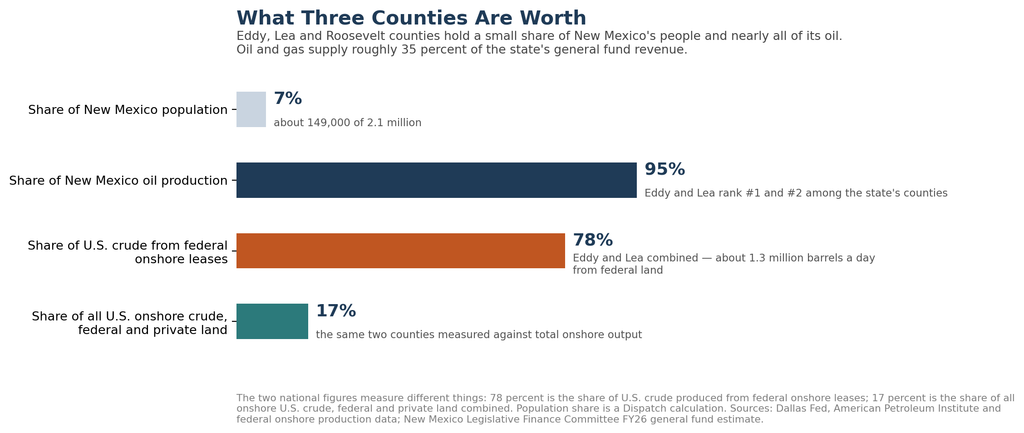
The three counties hold roughly 149,000 people out of New Mexico’s 2.1 million — about seven percent of the state’s population. What they hold underground is not proportional.
Eddy and Lea rank first and second among New Mexico counties in crude oil pumped from federal onshore leases nationwide. Together they produced about 2.1 million barrels a day at the end of 2024, and they account for roughly 78 percent of onshore federal oil production in the United States. Oil and gas revenue supplies about 35 percent of New Mexico’s general fund in the current fiscal year.
Transferring Lea and Eddy would not trim New Mexico’s budget. It would remove the largest single source of it, along with the flow into the state’s permanent funds. This is why the proposal reads differently in Santa Fe than in Austin: what Texas describes as three counties choosing their government, New Mexico experiences as the proposed removal of its fiscal base.
The politics are equally lopsided. Lea was New Mexico’s most Republican county in 2024 at 80 percent for Trump, Eddy second at 77 percent, Roosevelt seventh at 71 percent.
What New Mexico is saying
Nothing encouraging, and not much that is diplomatic.
New Mexico’s House speaker, responding on social media, said: “Dude, over my dead body, man. No way, no way.” A spokesperson for Gov. Michelle Lujan Grisham called the proposal “not serious,” and her office has since said New Mexico intends to remain intact. The Santa Fe New Mexican’s read is that the idea “appears dead on arrival” because New Mexico will not cede land.
That matters more than the rhetoric suggests, because New Mexico’s consent is not a courtesy in this process. It is the process.
The constitutional machinery
Any transfer runs into Article IV, Section 3 of the U.S. Constitution:
“New States may be admitted by the Congress into this Union; but no new State shall be formed or erected within the Jurisdiction of any other State; nor any State be formed by the Junction of two or more States, or Parts of States, without the Consent of the Legislatures of the States concerned as well as of the Congress.”
There is a real legal question, which the committee may hear argued, about whether that clause even governs this scenario. It addresses forming new states from parts of existing ones. Moving counties from one existing state to another is arguably a boundary adjustment, which runs through the Compact Clause in Article I instead — the provision the Supreme Court construed in Virginia v. Tennessee in 1893, holding that interstate agreements need congressional consent when they affect federal supremacy or the balance of political power.
The distinction changes the doctrine but not the arithmetic. Either route requires New Mexico’s legislature, Texas’s legislature and Congress. And a transfer of 149,000 people between states would shift House apportionment and electoral votes, which is precisely the kind of change Virginia v. Tennessee says Congress must approve.
Sanford Levinson of the University of Texas School of Law put the odds plainly: “It’s very, very hard to imagine winning that trifecta.” He also named the incentive problem underneath it — New Mexico would likely lose congressional representation and Texas would gain it, which gives one legislature every reason to say no.
What history actually shows
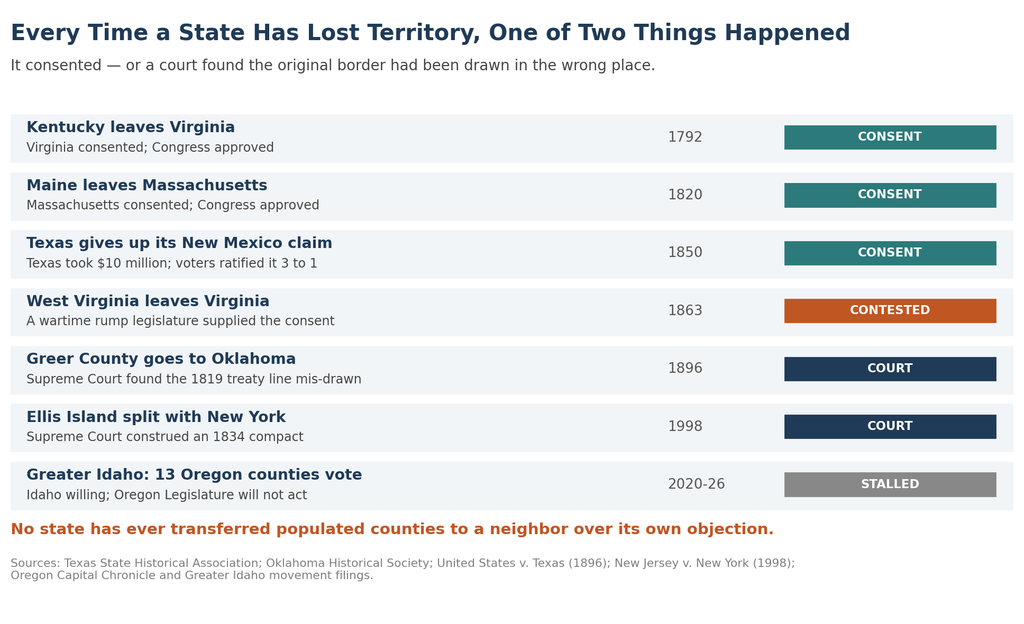
American state borders have moved more than people assume. But the mechanism has been the same every time, and it has only ever been one of two things.
The state agreed. Kentucky left Virginia in 1792 and Maine left Massachusetts in 1820 with the consent of the parent legislature and Congress, exactly as Article IV requires.
Texas itself did this — in the direction now being proposed in reverse. The Republic claimed territory to the Rio Grande, including Santa Fe, and sent the disastrous Santa Fe Expedition to enforce the claim. In the Compromise of 1850, Texas surrendered its claims to what is now eastern New Mexico and parts of four other states in exchange for $10 million, which retired the Republic’s debts. Texas voters ratified it three to one and the governor signed it. Texas gave up its claim to these counties by treaty and by referendum, for cash.
A court found the border had been drawn in the wrong place. This is the other path, and it is narrower than it looks. Greer County — the case Vasut cited from memory on the podcast — was Texas territory for decades based on an 1819 treaty map that identified the wrong fork of the Red River. In United States v. Texas in 1896, the Supreme Court held the South Fork was the true boundary. Texas did not lose a negotiation; it lost a surveying argument. The same logic produced the 1998 Ellis Island decision, where the Court construed an 1834 compact to find most of the filled island belonged to New Jersey.
Neither category fits what is being proposed. Nobody argues the Texas–New Mexico line was mis-surveyed in a way that would move three counties. The 103rd meridian boundary has been litigated and settled. That leaves consent.
The contested case proves the rule. West Virginia is the exception everyone reaches for, and it is not a helpful precedent. When Virginia seceded in 1861, a Unionist “Restored Government” in Wheeling claimed to be Virginia’s legitimate legislature and supplied the consent Article IV required. Congress accepted it and West Virginia entered in 1863. The consent was real only if you accept that the rump government spoke for Virginia — a proposition that required a civil war to settle. New Mexico has one legislature, it is in session in Santa Fe, and it is not offering consent.
The live parallel
The closest modern analogue is not historical at all. Since 2020, 13 eastern Oregon counties have voted to explore moving the Idaho border west to take them in. Two later reversed. The Idaho House has been receptive. The movement is organized, funded and has won at the ballot box repeatedly in the counties that want to leave.
It has gone nowhere. Bills to open border talks stalled again in the Oregon Legislature this year, and the movement has shifted to asking the Trump administration to break the impasse — which the Constitution does not empower the executive branch to do.
The structure is identical to what Texas is contemplating. A willing receiving state, counties that want to go, and a legislature in the capital that will not take it up. Six years of county votes have not moved Oregon an inch. Vasut drew a distinction on the podcast between Greater Idaho as an “internal negotiation” and the New Mexico question as one “between two states,” but in constitutional terms they are the same problem: the departing counties’ own legislature holds the veto.
So what is the hearing for?
Taken literally, the charge is a research exercise with a foregone legal conclusion, and Vasut has not oversold it. “There’s not a preconceived notion, at least in my mind, coming in or what comes out of this,” he said of the committee’s work generally.
There are three things a hearing can produce even when the headline outcome is unavailable.
It can establish the record. No Texas Legislature has formally examined what absorbing another state’s counties would entail — the tax code conflicts, the school finance implications, the water rights, the pending interstate compacts. Texas and New Mexico are already adverse parties in long-running litigation over the Pecos River and Rio Grande compacts, which is its own reason the two capitals are not in a trading mood.
It can put a marker down. Tepper has said the appeal is partly precedential: “If we could find a way to essentially liberate these New Mexico counties into Texas, I think we would also be cutting a path for other counties that are frustrated with their centralized governments.”
And it can register a grievance that is real regardless of whether the remedy is available. Levinson’s observation is the durable one: “The polarization that we talk so much about is found as much within states as among states. If you look at practically any state in the union, you find these sharp divisions.” Two counties producing most of a state’s revenue while holding almost none of its votes is a genuine governing problem. It is not obvious that redrawing a state line is the tool for it, and it is fairly clear the tool is not available.
What to watch
Sept. 30: The hearing convenes at 9 a.m. Central in Capitol Extension room E2.026. Watch the witness list. If it is weighted toward constitutional scholars, this is a study. If it is weighted toward county officials from Lea and Eddy, it is something closer to an organizing meeting.
Whether anyone from New Mexico appears. No New Mexico official has indicated they will participate. Their absence, or presence, is the story.
January 2027: The 90th Legislature convenes. A resolution expressing Texas’s willingness to accept the counties would cost nothing and commit nothing — it is the step Idaho’s House already took. It would also be the furthest this can go without Santa Fe.
The New Mexico legislative session. Any path forward requires a New Mexico bill passing a chamber that postponed the last one indefinitely without a hearing.
Sources
The Texas Dispatch
- House Oversight Panel to Study Annexing New Mexico Counties, Outside Influence on Prosecutors (Sept. 23, 2026)
- House Panel Presses Barbers Hill on $97M Foundation Transfers (Aug. 2026)
- Senate Water Panel to Study Pecos Basin Decline, Red Bluff Governance and Produced-Water Reuse (Aug. 27, 2026)
- Texas Talks with Brad Swail — interview with Rep. Cody Vasut (recorded August 2026)
Constitutional and legal
- U.S. Constitution, Article IV, Section 3 — Constitution Annotated
- Interstate Compacts: An Overview — Congressional Research Service
- Virginia v. Tennessee, 148 U.S. 503 (1893)
- New Jersey v. New York, 523 U.S. 767 (1998)
History
- Texas State Historical Association — The Texas–New Mexico Boundary Dispute and the Compromise of 1850
- Texas State Historical Association — Greer County
- Oklahoma Historical Society — Texas–Oklahoma Boundary Controversies
Current reporting
- New Mexico Political Report — Texas legislature to hold hearings on annexing New Mexico counties (Sept. 10, 2026)
- Santa Fe New Mexican — The Roundhouse Report: Texas moves forward with studying New Mexico annexation (Sept. 15, 2026)
- Spectrum News — Political divisions fuel push to have Texas annex part of New Mexico (April 2026)
- KXAN — Texas House panel to study possibility of adding New Mexico counties (Sept. 10, 2026)
- KRWG Public Media — TX lawmakers study annexation of three oil-rich NM counties (April 2026)
Data
- Federal Reserve Bank of Dallas — New Mexico fuels U.S. crude oil output
- New Mexico Legislative Finance Committee — FY26 budget recommendations
- Oregon Capital Chronicle — Greater Idaho movement wants a seat at the table
- Central Oregon Daily — Greater Idaho bills fail in Oregon legislature