

Two of the three charges before the House Select Committee on Governmental Oversight today share a structure. One asks whether outside consultants and nonprofits have gained undue influence over local prosecutors. The other asks how cities and counties spend public money on third-party contractors for services like homelessness, public health and public safety, and whether anyone is checking the results.
Neither charge tells a local government what to do. Both ask whether the state should be looking over its shoulder — and both grow from the same soil as the 3.5 percent revenue cap, the Regulatory Consistency Act and last session’s housing preemption laws. The Texas tradition of deferring to local decisions has been narrowing for a decade, one domain at a time. Today’s hearing is the first to ask whether that narrowing should extend to who local officials take advice from and who they pay.
The Dispatch’s view is that the framing this debate has carried since 2017 is the wrong one. “Local control” describes a governing convention, not a constitutional entitlement. The question that matters is different: when a local decision imposes costs on people who cannot vote it down — taxpayers who cannot exit, businesses that operate across city lines, crime victims in a county whose prosecutor has adopted a policy — does the state have an obligation to set limits?
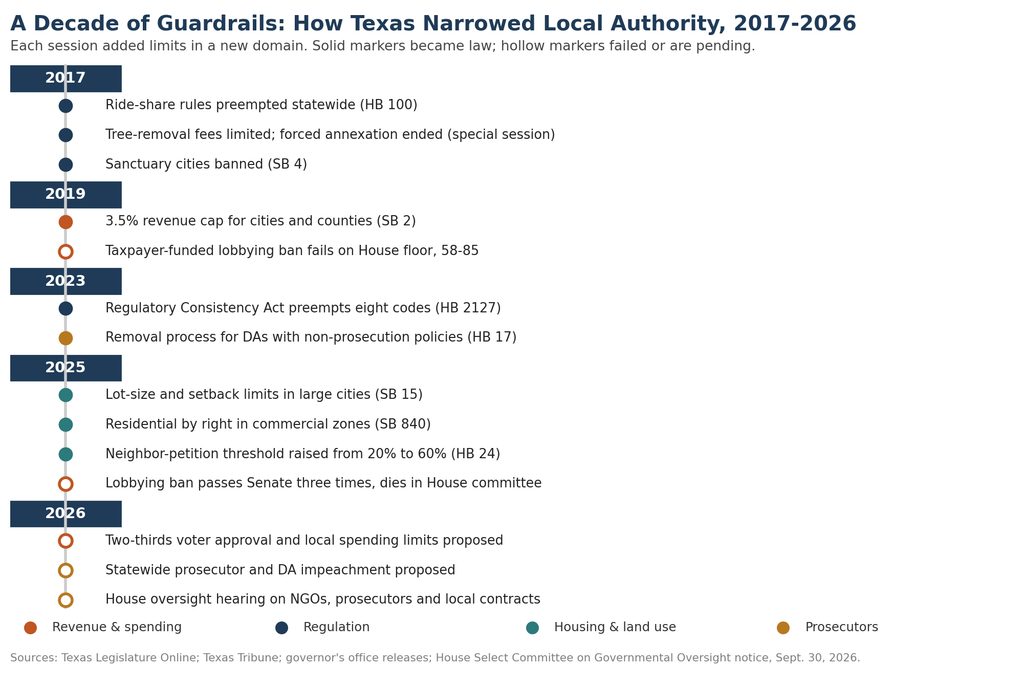
What the hearing surfaced
The prosecutorial charge dominated the room. Jennifer Stevens, president of the Central Texas Public Safety Commission, told members: “I wish I was here to tell you our work was getting better, but it is not, and our district attorney is the problem.”
Travis County District Attorney José Garza was invited and did not appear. Assistant District Attorney Stephanie Gharakhanian read a written statement in his place: “A prosecutor’s decision to reject a charge or dismiss a case based on insufficient evidence does not mean that a prosecutor has gone ‘rogue.’ It does not mean that the prosecutor is not enforcing the law. To the contrary, it means the prosecutor is following the law.” The statement listed August convictions, including a capital murder verdict carrying life without parole, and cited DPS data showing crime in Austin down over five years. Rep. AJ Louderback, a former Jackson County sheriff, questioned the numbers.
Rep. Mitch Little, R-Lewisville, said the Legislature should investigate and impeach Garza — “If he cannot diligently represent the interest of the state of Texas rather than the offender, then perhaps he shouldn’t be doing that job” — and said he intended to move to subpoena him. Chair Cody Vasut noted a subpoena would require two-thirds of the committee and raised the problem of transactional immunity, which prompted Rep. Carl Tepper, R-Lubbock, to ask, “Chairman, are we anticipating he is going to be indicted by someone?”
The exchange that best captured the tension came from a Democrat. Rep. Richard Peña Raymond, D-Laredo, pressed Gharakhanian on dismissed murder cases: “Part of why we’re having this hearing is because on the big ones where people die, people have the right to know what the hell is going on.” Shannon Edmonds of the Texas District and County Attorneys Association offered the institutional answer — that prosecutors often cannot explain dismissals publicly because investigations continue — and suggested lawmakers ask privately.
The NGO thread under the charge is specific. A January 2022 agreement between Garza’s office and the Wren Collective, a for-profit consultancy founded by Texas attorney Jessica Brand, provided a year of policy and communications support under a nondisclosure agreement. Records show dozens of meetings and hundreds of emails between Wren and Garza’s office since 2021; KSAT found the same firm’s work in the Bexar County DA’s office went beyond messaging into office policy. The agreement does not identify a payment amount, and nothing public establishes that Wren directed a charging decision. That gap — influence without a paper trail — is precisely what the charge asks the committee to examine.
The convention and the law
Texans tend to assume local control is baked into the state’s constitutional design. It is not, and the difference matters.
Home-rule cities do derive their authority from Article XI, Section 5 of the Texas Constitution rather than from the Legislature. But the Texas Supreme Court has been consistent for eighty years about what that means. In Payne v. Massey (1946), the court wrote that municipalities “are creatures of our law” that “represent no sovereignty distinct from the state and possess only such powers and privileges as have been expressly or impliedly conferred upon them.” In City of Laredo v. Laredo Merchants Association (2018), Chief Justice Nathan Hecht put it directly: “the Legislature can limit or withdraw that power by general law. Deciding whether uniform statewide regulation or nonregulation is preferable to a patchwork of local regulations is the Legislature’s prerogative.” Counties are weaker still — State v. Hollins (2020) calls them “subordinate and derivative branch[es] of state government.”
What Texas had, then, was not a constitutional guarantee of local autonomy but a long political habit of not exercising the state’s authority. That habit began to break in 2017 and has not recovered.
The arc
The break was announced before it happened. In January 2015, Gov. Greg Abbott told the Texas Public Policy Foundation that “Texas is being California-ized and you may not even be noticing it” — that cities were “forming a patchwork quilt of bans and rules and regulations that are eroding the Texas model.” By March 2017 he had a method: “As opposed to the state having to take multiple rifle-shot approaches at overriding local regulations, I think a broad-based law by the state of Texas that says across the board, the state is going to pre-empt local regulations, is a superior approach.”
The rifle shots came first. House Bill 100 overrode Austin’s voter-approved ride-share ordinance. A special session ended forced annexation and limited tree-removal fees. Then the aim widened.
Revenue. Senate Bill 2 in 2019, authored by Sen. Paul Bettencourt and carried in the House by then-Ways and Means Chair Dustin Burrows, cut the rate at which cities and counties may grow property tax revenue without an election from 8 percent to 3.5 percent. Lt. Gov. Dan Patrick’s framing was that it “requires cities and counties to stay within their taxpayers’ ability to afford their local government.”
Regulation. House Bill 2127 in 2023 — Burrows’s Regulatory Consistency Act, called the “Death Star” by opponents — did what Abbott had described six years earlier. It inserted a single clause into eight state codes barring cities and counties from regulating any field those codes occupy, “unless expressly authorized by another statute,” and created a private right of action with attorney’s fees. Burrows on the floor: small-business owners should be “not trying to navigate a byzantine array of local regulations that twist and turn every time” they cross a city limit. Houston, San Antonio and El Paso sued. A Travis County judge declared the law facially unconstitutional; the Third Court of Appeals reversed in July 2025 on standing, holding the cities had not identified a single ordinance the law unconstitutionally reached, and the State — which has no enforcement role — was the wrong defendant.
Housing. Last year’s session moved into land use, the field cities have guarded most closely. Senate Bill 15 caps minimum lot sizes at 3,000 square feet for new subdivisions in large cities. Senate Bill 840 requires those cities to allow residential development in commercial zones without rezoning. House Bill 24 raised the neighbor-protest threshold that can block a rezoning from 20 percent to 60 percent. Bettencourt’s count: a housing shortfall of 306,000 units.
Prosecutors. House Bill 17 in 2023 made a prosecutor’s adoption of a policy of refusing to prosecute a class of offense “official misconduct” grounds for removal by petition. Its author, Rep. David Cook, said the purpose was “to eliminate politics from prosecution.”
Each step targeted a different lever — how much local government can collect, what it can regulate, what it can prohibit, whom it can decline to charge. Today’s charges add two more: who advises it, and whom it pays.
The case the cities make
It deserves to be stated at full strength, because it is not frivolous.
The first argument is democratic. Houston Mayor Sylvester Turner, on HB 2127: cities “cannot pass ordinances in these areas unless the state of Texas explicitly gives us permission to do so. That is a total reversal from the way things have been in this state for more than a century.” San Antonio Mayor Ron Nirenberg called it “probably the most undemocratic thing the Legislature has done.” Rep. John Bryant: “the greatest transfer of power away from the public and into the hands of a few people in Austin that we’ve ever seen.” On housing, Rep. Ramon Romero, D-Fort Worth: “They didn’t elect their state representatives to decide how their city would develop.” Polling backs the instinct — a UT/Texas Politics Project survey in July 2023 found 60 percent of Texans opposed reducing city and county authority.
The second is fiscal. Texas Municipal League director Bennett Sandlin called the revenue cap “a service reduction” that “could prevent cities from paying for first responders’ raises, filling potholes, and keeping recreation centers or libraries open.” Ten North Texas mayors wrote that it “will not work, both practically and mathematically.” Moody’s said homeowner savings would be “minimal” and the harm to local governments substantial. Harris County Judge Lina Hidalgo: “If the state passes an arbitrary cap on our growth, they will effectively place an arbitrary cap on the roads we can build and maintain and the law enforcement resources we can fund.”
The third is that the state’s premise is exaggerated. Sandlin again: “This idea that we need uniformity of regulation is overblown. It’s kind of a fiction that Texas is suffering economically because of the so-called patchwork quilt.” On prosecutors, Rep. Donna Howard’s point is unanswerable as far as it goes: “No DA prosecutes all crimes; all DAs use prosecutorial discretion.” Sen. Sarah Eckhardt, on the lobbying ban: “where there is no dissent, there is no democracy.”
And the fourth is that the state does not always deliver what it promises. Abbott himself said in May that HB 17 is “a cumbersome tool that basically is ineffectual.” Garza’s reply was pointed: “The governor pushed a proposal to make it easier to remove locally elected district attorneys. That proposal became law. And today the governor described that proposal as ineffective.”
The case for the guardrails
Against that, we have three observations.
Local majorities impose costs on people who cannot vote them out. A property tax is not voluntary. As Vasut put it on the Dispatch’s Texas Talks podcast, “every tax dollar is taken from somebody, either by compulsion or in the worst case scenario, at the point of a gun.” A resident who loses a council vote on how that money is spent “doesn’t really have a functional recourse.” A business operating in twelve cities has no vote in eleven of them. A crime victim in a county whose prosecutor has announced a policy has no remedy at the ballot box until the next election, and the offense is not deferred until then. The state is the only body that represents all of those people at once.
The record of local performance is not what the democratic argument assumes. Austin’s own auditor found in July that in 25 social-service contracts with 20 nonprofits, 67 of 151 performance expectations went unmet — and that “the City fully paid nonprofits that did not meet most of their performance expectations.” Mayor Kirk Watson did not dispute it: “Let’s be candid, the findings are troubling. Those numbers don’t just represent boxes that were left unchecked on a report. They likely represent vulnerable Austinites who didn’t receive services.” That is the second charge before the committee today, in the words of the city most often cited as the reason for it.
The constitutional design already assigns this role to the state. This is not a case for Austin to seize power from cities. It is a case for Austin to exercise a responsibility the courts have said it holds. The phrase “local control” implies a boundary the state crosses at its peril. Laredo Merchants says the boundary is the state’s to draw. What follows from that is not that the state should draw it everywhere, but that when it declines to, it is choosing not to protect people it is constitutionally responsible for.
Where the argument gets hard
An honest version of this position has to concede three things.
The state’s guardrails do not always restrain what they claim to. The 3.5 percent cap limits revenue growth, not spending, and not the rate — a distinction the Dispatch examined this month as counties set rates at exactly the ceiling. HB 2127 went more than two years without a single big-city enforcement notice; the first major suit, TPPF’s challenge to 83 Dallas ordinances, was filed last October and has not been decided. HB 17’s one serious use, the petition against Garza, was dismissed on the motion of the state’s own appointed prosecutor. A guardrail that does not hold is a statement, not a policy.
Preemption can become the thing it criticizes. The strongest version of Nirenberg’s objection is not that state limits are illegitimate but that a legislature meeting 140 days every two years cannot administer 1,200 cities. Vasut, a former city councilman, said as much: “the state neither has the resources of time nor efficient ability to micromanage local government.” The distinction the Dispatch would draw is between a guardrail — a limit on what local government may do to people — and a mandate that tells it how to govern. SB 2 is a guardrail. A statute dictating a city’s contracting vendors would not be. Today’s charges could produce either.
The consultant question cuts both ways. If outside influence on prosecutors is a problem when the consultant is the Wren Collective, it is a problem when the consultant is anyone. The principle the committee lands on will apply to district attorneys who take advice from police unions and victims’ groups as well. A rule written to reach one office will reach all of them, and that is the test of whether it is a rule.
The reframe
Every fight on the timeline above was reported as a test of local control, and every one was lost by the cities. That framing was always misleading. Local governments are not sovereign in Texas and never were; the deference they enjoyed was a political courtesy, extended for as long as the costs of local decisions stayed local. The courtesy dissipated when they didn’t.
The better question — the one today’s hearing actually poses — is whether the state will accept the responsibility that comes with its authority. Setting a limit is the easy half. Making it hold, aiming it at conduct rather than at particular officials, and applying it evenly to allies and adversaries is the half Texas has been less consistent about. A state that caps local revenue but not spending, preempts local regulation but does not enforce the preemption, and creates a removal process it later calls ineffectual has been asserting its role more than performing it.
That the role may be the right one. Whether the state is performing it is what the 90th Legislature will be judged on.
What to watch
The committee’s interim report. Whether the prosecutorial-integrity recommendations address consultant disclosure — a transparency rule that applies to every office — or single out particular arrangements. The former is a guardrail; the latter is a target.
Whether the taxpayer-funds charge produces anything. Coverage of today’s hearing centered on prosecutors. The contracting charge is the one with a documented failure to point to — Austin’s audit — and the one most likely to affect small cities that never make the news.
January 2027: Abbott’s proposals for a statewide prosecutor and legislative impeachment authority over district attorneys. Both would be a step past a guardrail and into direct state operation of a local function. That is the line this analysis draws, and it is where the argument in this piece would part ways with the state.
The Dallas ordinances case. If a Denton County court voids 83 Dallas ordinances under HB 2127, the Regulatory Consistency Act becomes operational. If it does not, three sessions of preemption have produced a law that exists mainly on paper.
Sources
The Texas Dispatch
- House Oversight Panel to Study Annexing New Mexico Counties, Outside Influence on Prosecutors (Sept. 23, 2026)
- In Texas Budget Season, the Tax Rate Is the Last Number Decided, Not the First (Sept. 2026)
- Texas Talks with Brad Swail — interview with Rep. Cody Vasut (August 2026)
Today’s hearing
- KXAN — Texas lawmakers discuss power to impeach Travis County District Attorney José Garza (Sept. 30, 2026)
- Hearing notice, House Select Committee on Governmental Oversight
- Governor’s office — Governor Abbott, Speaker Burrows, Lt. Governor Patrick Demand Greater Prosecutorial Accountability (Sept. 18, 2026)
- Dallas Express — Texas House hearing on prosecutor oversight
- KSAT — Emails reveal Wren Collective had hands in more than just messaging in Bexar Co. DA’s office (March 2024)
Case law
- City of Laredo v. Laredo Merchants Association, 550 S.W.3d 586 (Tex. 2018)
- State v. Hollins, 620 S.W.3d 400 (Tex. 2020)
- Texas Department of Transportation v. City of Sunset Valley, 146 S.W.3d 637 (Tex. 2004)
- State of Texas v. City of Houston, No. 03-23-00531-CV (Tex. App.—Austin, July 18, 2025)
- Texas Constitution, Article XI, Section 5
Legislation
- Senate Bill 2 (86R, 2019) · House Bill 2127 (88R, 2023) · House Bill 17 (88R, 2023) · Senate Bill 15 (89R, 2025) · Senate Bill 840 (89R, 2025) · House Bill 24 (89R, 2025) · Senate Bill 19 (89R, 2025)
Reporting and analysis
- Texas Tribune — Abbott signs property tax bill (June 2019); Texas Municipal League has struggled to influence lawmakers (May 2019); Texas House passes local control bill (April 2023); Death Star law upheld on appeal (July 2025); Texas House rogue prosecutors bill (April 2023); Abbott public safety priorities (May 2026); Abbott supports broad-based preemption law (March 2017); Texas is being California-ized (Jan. 2015)
- Lt. Governor’s office — SB 2 gives property tax power to the people (June 2019)
- Dallas Morning News — Ten mayors of North Texas: property tax cap could hurt cities (April 2019); Dallas sued over dozens of city rules (Oct. 2025)
- Austin Monitor — Council strongly opposes property tax bills (April 2019); Why is someone suing to get Travis County DA José Garza out of office (April 2024)
- Community Impact — City audit: contracted nonprofits often missed service goals while receiving full payment (July 2026)
- Austin Current — Austin budget audit, social service contracts (July 2026)
- UT Texas Politics Project — GOP preemption bill steers power to state; most Texans still express positive views of locals (July 2023)
- Texas Municipal League — SB 840 letter; SB 12 letter