
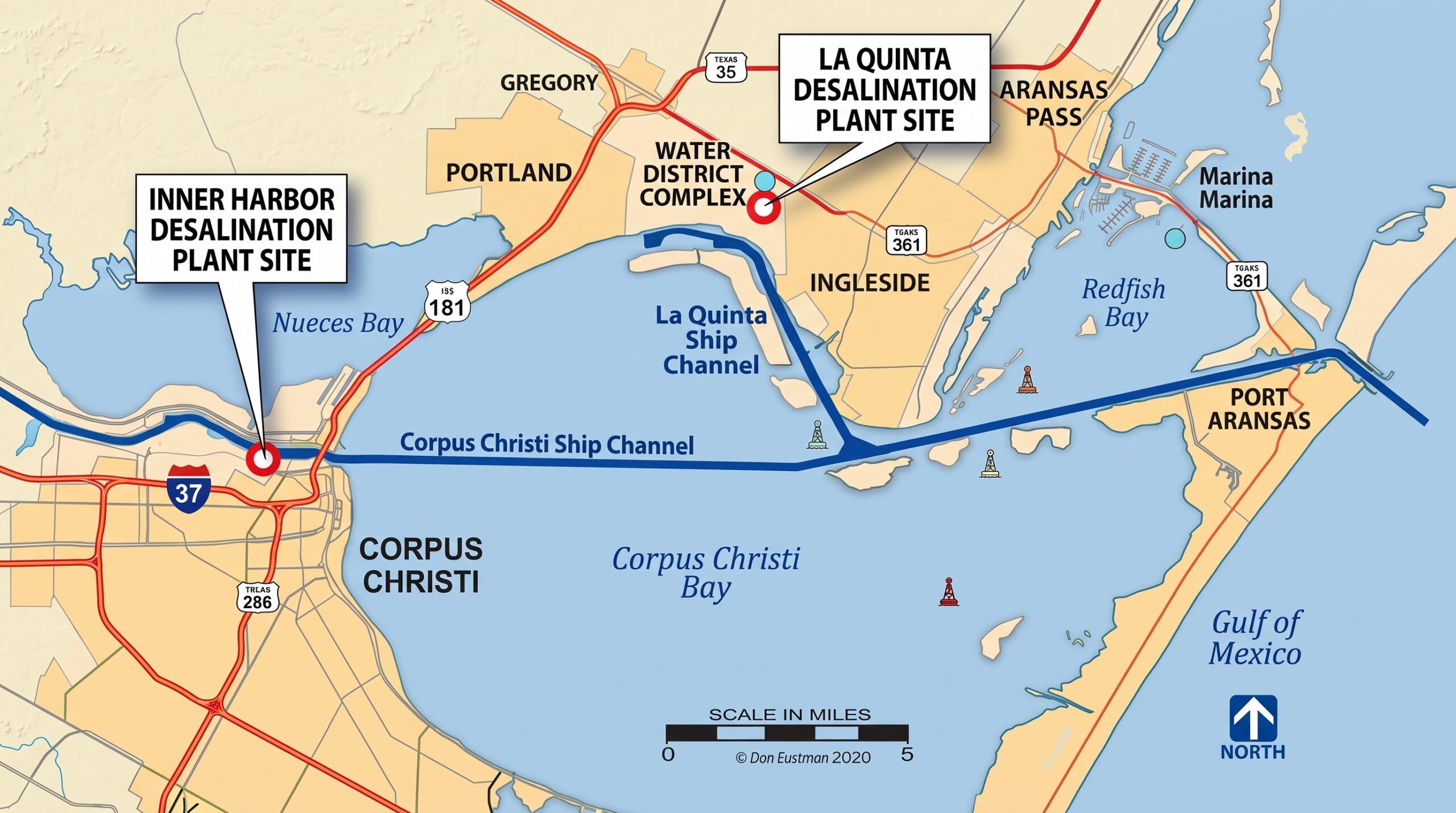
The Texas Commission on Environmental Quality approved the final discharge permit for the Harbor Island desalination plant on Sept. 23, two days before a Corpus Christi lawmaker told a Texas Tribune Festival audience that seawater desalination is a key issue for the next legislative session.
The permit lets the Port of Corpus Christi send the plant’s concentrated salt water into the Gulf, KRIS reported, through an outfall roughly 9,800 feet offshore, according to an earlier Dispatch account. Permission is not construction. The project has not broken ground, and design work on its pipeline stopped when an engineering contract ran out, the Texas Tribune reported Sept. 24.
For Corpus Christi, the stakes are the water in the tap. The city came within months of asking residents, businesses and industry to cut water use by 25 percent, the Tribune reported from the festival panel. Summer rains bought time: city officials said in July that the projected date of a water emergency had moved from September 2027 to September 2028.
On the panel, Rep. Denise Villalobos, R-Corpus Christi, said local elected officials “need to get out of the water business” and leave technical decisions to water boards and experts. Jeremy Mazur of Texas 2036 said lawmakers must examine a state planning process that failed to predict the city’s crisis. Dorina Murgulet of Texas A&M University-Corpus Christi said groundwater is a buffer, not a permanent answer, and that the region should have pursued recycling sooner.
The record on desalination, though, is largely one of elected bodies, and of the state pressing them. On Sept. 1, the Corpus Christi City Council voted 5-3 to reject a $978.8 million desalination plant at the Inner Harbor for the second time. Council member Gil Hernandez said, “I just don’t like this particular project, and I’ve been consistent with this since 2020,” and bay impacts and cost were the main objections, the Tribune reported.
Gov. Greg Abbott’s chief of staff asked, “Will they do the right thing and move forward, or will they punt the future?” The council had voted 5-3 in October 2025 to pay $2.7 million to reserve half of Harbor Island’s planned 100 million gallons a day. The council’s split has run over which plant to build, not whether to desalinate.
Harbor Island’s own footing is less settled. John Byrum, executive director of the Nueces River Authority, which is advancing the plant with the private firm IDE Technologies, is retiring effective Oct. 31 as the authority’s board prepared to discuss his employment in closed session, the Tribune reported. Byrum has put the cost at roughly $6.4 billion. Cities and water districts have paid $4.1 million in nonrefundable reservation fees, the state approved a $7 million grant for early pipeline work, and officials warned in June that desalination funds could run out by August without more payments.
Port Chief Executive Kent Britton said the port had “addressed reasonable concerns for our local bay system by moving the plant intake and discharge offshore.” The commission’s Sept. 23 agenda also asked whether people who objected to the plant would get a contested hearing, but reports on the approval did not say how commissioners ruled on those requests.
The permit settles where the brine goes. Who pays for a plant of that size, and who leads the authority building it after Byrum leaves Oct. 31, remain open.