
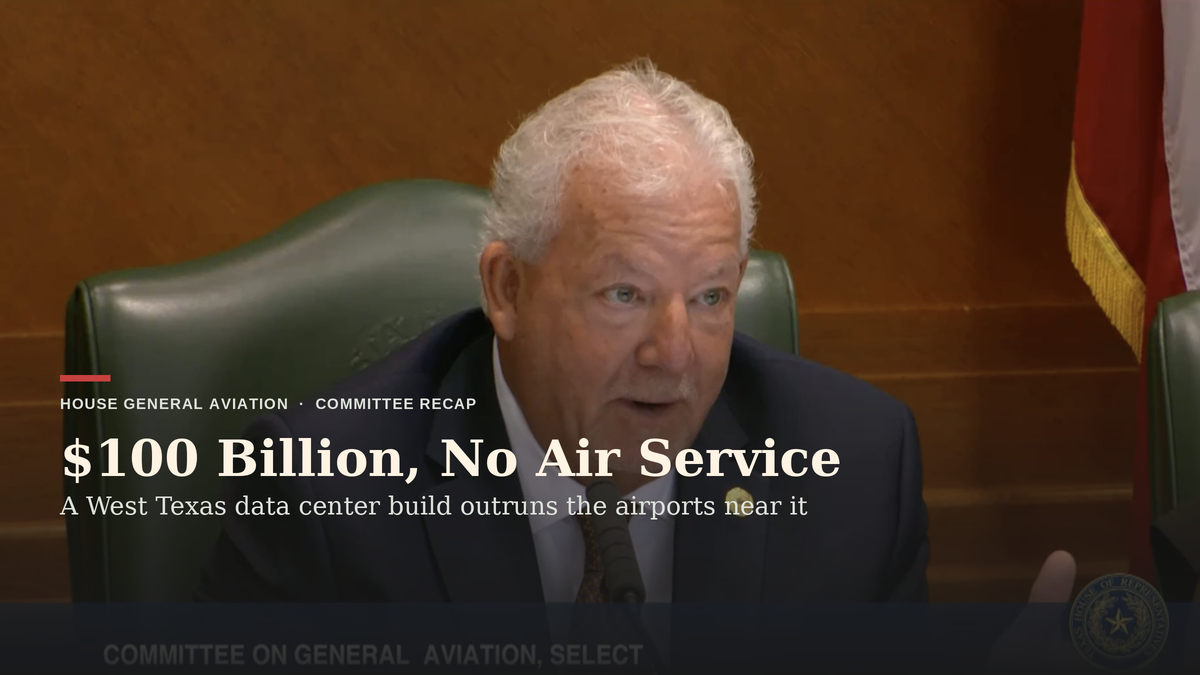
A developer building three gigawatt-scale AI data centers in West Texas told state lawmakers Aug. 18 that two of the sites cannot be reached by air. “Those locations are ideal for these projects because the land is plentiful, the power is plentiful,” Michael McNamara, chief executive of Lancium, told the House Select Committee on General Aviation. “But they do not have great air service.” The company’s Abilene project alone is two gigawatts; the other two, at Childress and Turkey, are a gigawatt each.
McNamara put the arithmetic of that gap in front of members. His people move “every week going between Amarillo, Lubbock, Childress, Turkey, Abilene, Houston, Austin,” he said — “either a potentially 8 to 9 hour drive or it’s potentially $10,000 an hour in private aircraft.”
“Our projects are $100 billion of investment, just the ones we have today,” McNamara said, and another $100 billion of data centers sits within 50 miles, “which will all lean on the Abilene infrastructure, including their airport.” The company has already pledged “over $1.5 billion to the system” in deposits and contributions to local utilities, plus more than $40 million to TxDOT. The construction workforce is 8,000 and could stay through 2034, leaving “at least 1400 people of permanent workforce.”
He came without a bill to ask for. “I’m here to encourage thoughtful ways to encourage private public partnerships, to invest in infrastructure to enable the growth that’s going to happen in West Texas,” he said — an estimated “$1 trillion” over ten years.
Rep. Pat Curry, R–Waco, ran the questioning and treated Abilene as a test case the state nearly missed. “I think you have one of the largest construction projects going on in the world at the moment,” he said. Curry noted the airport had absorbed roughly 80 percent passenger growth year over year, which McNamara confirmed and extended: “When we first arrived, there was two flights a day to Dallas. And now there’s dailies to Houston, Denver, Phoenix and Dallas.”
That did not happen on its own — the Abilene development corporation “helped subsidize some of those new regional flights,” he said, asking members “to think about what are the ways to streamline and ease the way to get more air service, especially to these underserved communities.”
Curry drew the lesson. “That’s a great example of an industry growing into a town that really didn’t expect it,” he said. “And us as the state of Texas, these are the kinds of things that we need to be prepared for. And we’ve got to be forecasting ahead.”
The obstacle witnesses described is not engineering but local politics. Justine Ruff, director of airports for the City of Midland, said turnover in city halls and commissioners courts keeps resetting the argument. “A new official may see the airport only as an expense or as a facility used by a few private aircraft owners,” she said. “It is viewed as a playground for the wealthy pilots rather than an essential infrastructure.”
Most of what a rural airport does is invisible, Ruff said. “A company may use the airport to visit a facility, make an investment or maintain operations in a community. A medical flight may occur when most residents are asleep,” she said. “These activities may not generate a crowd in the terminal, but their economic and public value is very real.” The consequence compounds: “A community may decline to provide a relatively small local match and lose the much larger state or federal investment it would have leveraged.” Airports, she argued, “should be treated like a road, utility or industrial park, as an essential infrastructure.”
TxDOT aviation director Dan Harmon gave members the state’s ratio — “for every $1 invested in Texas airports, it supports $56 in annual economic benefit.” Chair Keith Bell, R–Forney, accepted the frame: “It is about economic development, and general aviation plays a huge role into that.”
Witnesses split hard on what the state should pay for. Jeff Simmons of JSX argued for sharing route risk, citing a municipal partnership in Hobbs, New Mexico, and warned against expansion for its own sake: “The goal should not be to build more airports. The goal should be to maximize the value and use of the airports that Texas already has.” Scott D’Angelo of Avelo Airlines rejected the premise from the next seat: “Subsidized routes are a form of sugar rush. They feel good at the time, but all too often when the subsidy runs out, so does the service.”
The same split ran through incentives. Southwest Airlines’ Sherri Hull said state and city money decided where roughly 2,000 new jobs landed: “these incentives are earned. They’re not given.” Port San Antonio’s chief executive made the opposite boast — “those 10,000 jobs were added with absolutely no public dollar incentives.”
Rep. Terry Canales, D–Edinburg, brought the conversation back to whether the underlying math works at all. On hangars — the revenue that makes a small field self-supporting — he said his own community could not close the numbers: “When you look at the construction cost of the hangar and the rate of return on the investment, it’s impossible.” His conclusion was blunt: “The legislature needs to find a way to help fund general aviation airports, because they are a pillar.” Gillespie County’s airport manager said his field solved it by opening up to private hangar investors: it has been “self-sufficient since 2004.”
Because this was an interim hearing, the panel took no votes; findings feed the select committee’s report and any legislation filed in the 90th Legislature, which convenes in January 2027. Curry left members with the market he knows best: “Think about the possibilities of feeding Waco as an example. We have one flight, I think a day or maybe two that go to Dallas, and that’s it.”
Also heard
The committee worked five interim charges in a single 7.5-hour sitting with no recess, and the economic development argument ran through all of them rather than sitting in any one. The two enumerated charges that took the most time are covered in companion recaps: airport condition and capital funding, where TxDOT disclosed that the statewide airport system plan still dates to 2010 against $643 million in queued projects and aviation workforce shortages, where Texas State Technical College said it is waitlisting qualified mechanic students for lack of hangar space. A 94-minute charge on governance, procurement and emerging technology covered Project Nexus, the FAA electric vertical takeoff and landing pilot program Texas won in March, and a 36-minute charge on disaster response drew testimony from the Texas Division of Emergency Management.
Fact box
Issue
Rural and small-market airports as economic development infrastructure — a thread running across all five interim charges rather than a single enumerated charge (roughly 105 to 125 minutes of the hearing, about 25%)
What happened
A developer with $100 billion in West Texas AI data center projects told members two of its three sites lack usable air service, forcing 8-to-9-hour drives or $10,000-an-hour charters, and asked lawmakers for a public-private partnership framework rather than a specific bill; airport operators said local officials treat airports as amenities for wealthy pilots and forfeit state and federal match money as a result; carriers split publicly over route subsidies and employers split over incentives; no vote (interim hearing)
When
Tuesday, Aug. 18, 2026, 10:00 AM CT · run time 7:30:08
Where
Room E2.026, Capitol Extension, Austin
Chair
Rep. Keith Bell, R–Forney (HD-4)
Archived video
house.texas.gov, video 22744