
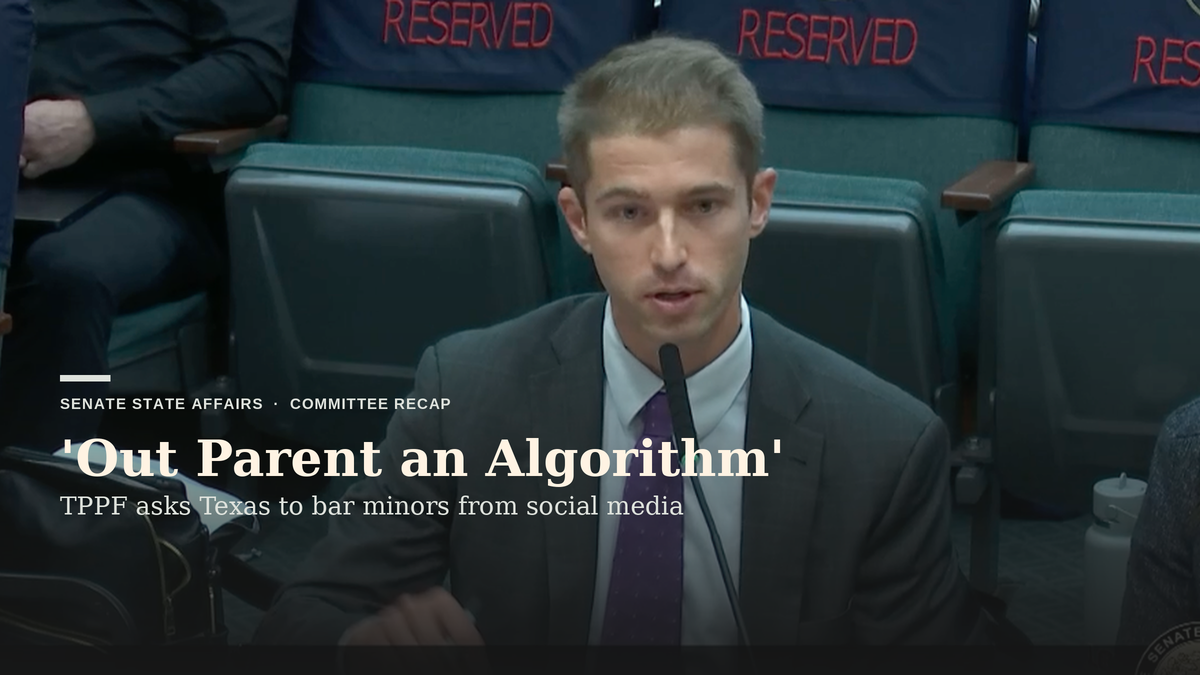
The state’s most influential conservative think tank told a Senate panel Sept. 14 that parental controls are not enough and Texas should prohibit social media for anyone under 18 — a mandate, from an organization that usually argues against them.
“We’re conservative organization at TPPF, and we believe that it is time that we prohibit social media for minors,” David Dunmoyer of the Texas Public Policy Foundation told the Senate Committee on State Affairs. Getting every senator and the full House behind it, he said, “would be, to me, a great goal for next session.”
The committee spent roughly two hours 19 minutes on the charge, one of two child-focused assignments Lt. Gov. Dan Patrick added for the panel this interim, as The Texas Dispatch reported. Chair Bryan Hughes, R–Mineola, split it in two: “Content protections are about what a child can see, communication protections about who can reach a child.”
Dunmoyer built his case on a test he ran the week before. “I went on Roblox last week, and I attempted to create an account as a nine year old,” he said. Platforms, he told members, “explicitly state that for data for under 13 year olds, and this is including your name, your age, critically, your age, it’s non personal information as defined by federal statute known as the Children’s Online Privacy Protection Act.”
He also gave the committee a causal claim about why platforms change. Roblox extended parental controls, he said, only after “ten state attorneys general sued the company after 177 federal cases were consolidated into a single Multidistrict litigation charge, and after the company booked a $57 million charge for legal fees.” His conclusion: “when and only when it is no longer profitable, will we see these changes made on any of these platforms.” He then read the platform’s own chief executive back to the room — “if you’re not comfortable, just don’t let your kids be on Roblox.”
The line members repeated all afternoon came from a pediatric psychologist at Texas Children’s Hospital. “You cannot out parent an algorithm,” she said. Her department’s screening data shows “over 40% of teens admit they’ve actively tried to cut down on their social media use, but failed. But only 6% of parents had any idea that their teens were struggling.” The design is deliberate, she said: platforms “operate on variable reward schedules, the exact mechanism behind slot machines,” and “kids are conditioned into purchasing randomized loot boxes, which is outright gambling packaged in bright colors for middle schoolers.”
Sen. Adam Hinojosa, R–Corpus Christi, seized on it. “You cannot out parent an algorithm — that’s such an important statement,” he said, and tied it to a bill that failed. “Last session, I sponsored House Bill 186 that was authored by Representative Patterson, and we were trying to get a social media ban for anyone under 18. And we got the pushback and we’re trying to create a nanny state.” Carve-outs for games “like, what is it, Roblox,” he said, were part of what stopped it. House Bill 186 did not reach the governor.
Not every Republican on the dais accepted the framing. Sen. Charles Schwertner, R–Georgetown, pushed back on where the duty sits. “You mentioned that parents have the capacity and authority, but I would also go further and say they have the responsibility,” he said. “I think the society is just complicit in all this. We we have parents buying phones for 4 or 5 year old people and getting them addicted to TikTok and games.”
Sen. Charles Perry, R–Lubbock, went the other way, and further than anyone. “It’s just so derelict and irresponsible and evil that it makes me sick,” he said of the platforms. “I’m just fed up with people putting crap that pollutes our bodies, our minds, and our souls.”
Sen. Judith Zaffirini, D–Laredo, the only Democrat on the panel, kept returning to method. She reminded members where the state’s existing law stands: “In 2023, the legislature passed House Bill 18, requiring the social media platforms to protect children from harmful content. It’s my understanding that parts of that bill have been declared unconstitutional in court.” Then she offered a sequence for the interim’s work. “Would you agree that step one in our process should be to look backward and look at the legislation that has been filed before, legislation that did not advance … and see what went wrong with that legislation, what barriers we have to overcome and start there.” She called the SCOPE Act “a phenomenal starting point to build on for next session.”
Dr. Lauren Gamble, an Austin pediatrician representing the Texas Medical Association and the Texas Pediatric Society, said “85% of U.S. teens report that … they play video games, and 41% say that they play every single day,” with about the same share reporting the habit has hurt their sleep. The platforms are “intentionally designed to make it really difficult to stop,” she said. “There’s features like streaks, persistent notifications, rewards, leaderboards.”
Maureen Molak, co-founder of the David’s Legacy Foundation, whose son’s death led to the state’s 2017 cyberbullying law, said he “used our credit cards without our consent to buy virtual assets that increased his player power through these gaming platforms.” Her ask was jurisdictional. “If the federal government continues to fail to act, Texas must continue to lead.”
Enforcement capacity drew a harder number. Christina Green of the Children’s Advocacy Centers of Texas said the state funds three internet crimes against children units — in Dallas, in Houston and one run statewide by the attorney general’s office — at $800,000 a year total. “They are inundated,” she said. Jennifer Ritchie, co-founder of the gaming chat platform Haven, described an industry “that knows how” to protect players “but endangers children anyway because they can get more money out of it.”
No votes were taken and no legislation was before the panel.
The committee devoted the largest share of the day to delays in divorce and custody cases, the subject of the companion recap, “Senate Panel Presses for Deadlines As Texas Custody Cases Drag On for Years.” It opened with about 72 minutes monitoring Senate Bill 3070, the law that moved the lottery and charitable bingo to the Texas Department of Licensing and Regulation, where Executive Director Courtney Arbour reported $1.6 billion transferred to the state through July 31 and Sen. Bob Hall revisited the April 2023 $95 million draw.
Fact box
- Issue
- Interim charge — Protecting Minors Online, on gaming platforms, advertising to children and age verification (approx. 2 hours 19 minutes of invited testimony, about 25 percent of the hearing; the longest invited block)
- What happened
- The Texas Public Policy Foundation called for prohibiting social media for minors; a Texas Children’s Hospital psychologist told members “you cannot out parent an algorithm” and reported screening data on teen use; Sen. Hinojosa tied the testimony to his failed 2025 under-18 ban; Sen. Schwertner pushed back on parental responsibility; Sen. Zaffirini urged the committee to audit prior failed bills first; child-protection witnesses said the state funds three internet crimes against children units at $800,000 a year; no vote (interim hearing)
- When
- Monday, Sept. 14, 2026, 9:00 AM CT · run time approx. 9:22 (computed from the caption playlist)
- Where
- Room E1.012 (Hearing Room), Capitol Extension, Austin
- Chair
- Sen. Bryan Hughes, R–Mineola (SD-1); Vice Chair Sen. Angela Paxton, R–McKinney (SD-8)
- Key witnesses
- David Dunmoyer, Texas Public Policy Foundation; Dr. Lauren Gamble, Texas Medical Association and Texas Pediatric Society; Maureen Molak, David’s Legacy Foundation; Christina Green, Children’s Advocacy Centers of Texas; Jennifer Ritchie, Haven; an unnamed pediatric psychologist, Texas Children’s Hospital
- Archived video
- senate.texas.gov video 22783