
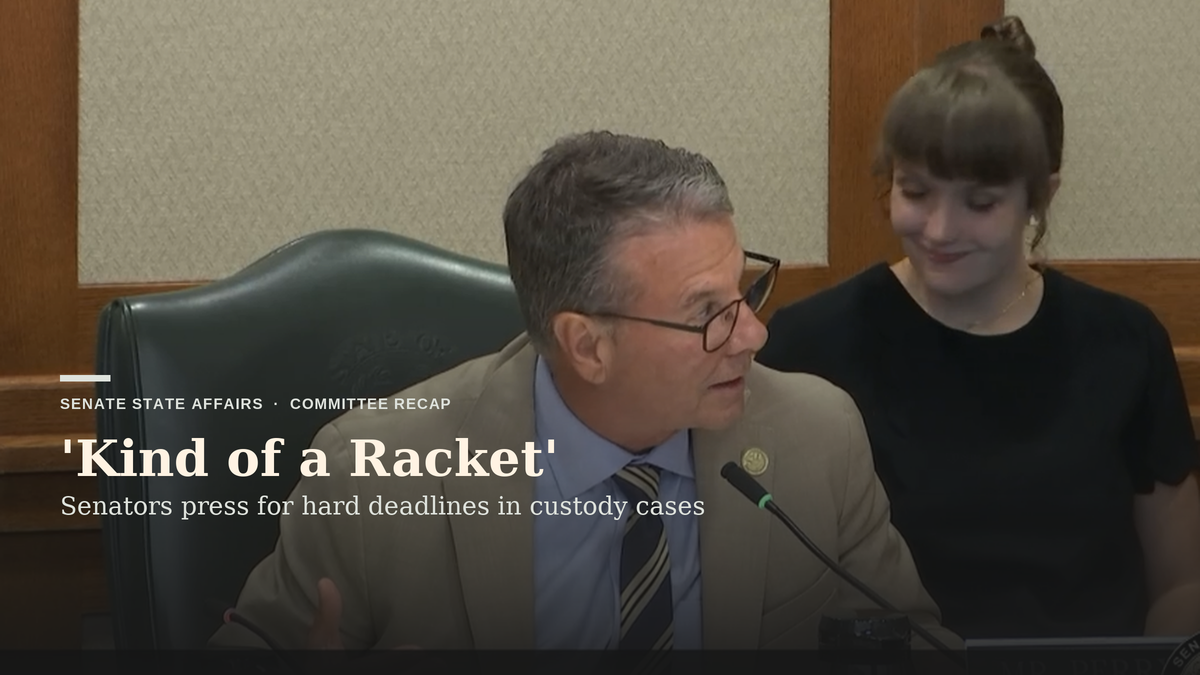
A Texas Senate panel spent most of a nine-hour hearing Sept. 14 on a question with no bill in front of it: whether the state’s family courts take too long to end a marriage and decide who raises the children. By the time the chairman gaveled out, members had heard an appellate judge say ten of every 2,000 cases in her former court needed more than a year, and a Houston father describe 30 months of litigation that changed almost nothing.
Chair Bryan Hughes, R–Mineola, set the boundary before the first witness spoke. “This is not about making it easier to get a divorce, about making it easier to break up families,” he told the Senate Committee on State Affairs. “That is not our goal.” The charge is one of two child-focused assignments Lt. Gov. Dan Patrick added for the panel this interim, as The Texas Dispatch reported, and it targets unpredictable timelines, delays and repeat evaluations.
Justice Emily Miskell of the Dallas Court of Appeals, who spent seven years as a family district judge in Collin County, gave the committee its organizing idea. A judge handling a traffic case is not asked to fix the driver, she said: “We would not expect that judge to appoint a driving evaluator to order driving lessons, to have periodic report back hearings.” The same should hold in family court. “The North Star that I think the legislature could provide is to clarify the public policy, that family courts are courts,” she said. “Their job is to try lawsuits and sign judgments.”
Sen. Charles Schwertner, R–Georgetown, asked the question the day turned on. “Is there any reason a contested divorce case should take longer than 12 months from filing to final order?”
Miskell’s answer was close to none. “I got about, I want to say like 2000 cases per year filed in my court … So ten out of 2000 that need to take longer than 12 months,” she said. Limiting parties to a single interim hearing let her set trial within six months. Left to their own schedules, litigants will not move: “If you were allowed to schedule when you took your own final exam, final exams would constantly be delayed, right?”
Sen. Charles Perry, R–Lubbock, a certified public accountant who has worked as a valuation expert, was blunter about why. “To be perfectly frank, it’s kind of a racket,” he said. “It’s a racket amongst the attorneys. It’s a racket amongst the valuators, and it’s a racket in the court system.” Extensions, he said, get granted for no reason. “Their dockets not that full. And if it is full, it’s because they’re not a good judge. There’s no reason to drag most of this stuff out that they are.”
Vice Chair Angela Paxton, R–McKinney, who presided over part of the day, drew the same line from the other direction. “Our courts are not marriage counseling. They’re not family counseling or they shouldn’t be,” she said. “There is a distinction between helping a family be better versus protecting a kid, right?” She pressed witnesses on whether reform language already exists, and was told drafts are with the Legislative Council.
Judge Carl Hayes, an associate district judge in Hays County and co-chair of the Texas Family Law Foundation’s legislative committee, previewed what is coming. “I don’t think the question is that reform is reform needed?” he said. “I think the the question is what reforms are going to work.” The foundation’s centerpiece is “a case management bill, which is modeled after rule 166 of the Texas Rules of Civil Procedure.” A second package would put “checks and balances on the courts use of child custody evaluations, psychological evaluations, and similar assessments.”
The case for urgency came from the witnesses who had lived it. Dr. Matthew Harbison, a Houston physician testifying as a father, laid out a calendar: filed May 2022, temporary orders that August, a certified decree in December 2024, and in between “four failed mediations, two dismissals with reinstatement of the case attorneys, therapists and amicus attorney for the children, a settlement and an arbitration.” The outcome barely moved. “There was almost no change from the temporary orders of the final decree. Despite the 30 months of litigation,” he said. “Children develop much faster than litigation progresses.” His daughter “consistently talked to four therapists, two CPS workers and the amicus attorney.” His parents, in their 80s, gave him $150,000.
Jeff Anderson, a family lawyer for 32 years with Court Reform Action for Families in Texas, put the same point in one image. In a case he handled, “at the beginning of that divorce, the little girl who was the subject of it was just over a month old. And when we finally tried that case, she was starting kindergarten.”
Russell Withers of the Texas Conservative Coalition Research Institute attached a price: litigation and trial “can range from 15,000 to 50 K per spouse.” Andrew Brown of the Texas Public Policy Foundation urged members to look upstream, noting a 2022 audit found only 2 percent of the state’s $484 million in annual federal welfare money went toward two-parent family formation.
The counterweight arrived in public testimony. Molly Voyles of the Texas Council on Family Violence told members her concern was not speed but screening — that courts ask whether violence is present before a schedule is imposed. Bronwyn Blake, chief legal officer at the Texas Advocacy Project, told the panel “1 in 3 Texans will experience domestic violence in their lifetime.”
Sen. Bob Hall, R–Edgewood, closed with a statement he asked to make. “I don’t think I have sat through a more depressing hearing since I have been here than what I’ve heard today about government service servants and how people are being treated,” he said, and called for rebuilding the system “down to its foundation.” He named the stakes: “the real losers in this are the children.”
No votes were taken and no legislation was before the panel.
The committee opened the day with about 72 minutes on Senate Bill 3070, the 2025 law that abolished the Texas Lottery Commission and moved the lottery and charitable bingo to the Texas Department of Licensing and Regulation. Executive Director Courtney Arbour reported $1.6 billion transferred to the state and $4.9 billion in prizes paid through July 31, and said the first annual report and legislative recommendations are due Dec. 1. Hall used the block to revisit the April 2023 $95 million draw, alleging the money “was stolen from the state.” The panel then gave roughly 139 minutes to online gaming platforms and minors, the subject of the companion recap, “Texas Should Bar Minors from Social Media, Senate Panel Told.”
Fact box
- Issue
- Interim charge — Protecting Texas Families, on delays and repeat evaluations in divorce and custody cases (approx. 2 hours 16 minutes of invited testimony, about 24 percent of the hearing, plus the large majority of roughly 3 hours 32 minutes of public testimony; the dominant subject of the day)
- What happened
- A sitting appellate justice and a family court associate judge told the panel Texas family courts should behave like courts and set enforceable timelines; Sen. Schwertner asked whether any contested divorce should exceed 12 months; Sen. Perry called the current system “a racket”; the Texas Family Law Foundation previewed a case management bill modeled on Rule 166 and amendments limiting repeat child custody evaluations; parents described multi-year cases; domestic violence organizations urged screening before scheduling; no vote (interim hearing)
- When
- Monday, Sept. 14, 2026, 9:00 AM CT · run time approx. 9:22 (computed from the caption playlist)
- Where
- Room E1.012 (Hearing Room), Capitol Extension, Austin
- Chair
- Sen. Bryan Hughes, R–Mineola (SD-1); Vice Chair Sen. Angela Paxton, R–McKinney (SD-8)
- Key witnesses
- Justice Emily Miskell, Dallas Court of Appeals; Judge Carl Hayes, Hays County; Andrew Brown, Texas Public Policy Foundation; Jeff Anderson, Court Reform Action for Families in Texas; Russell Withers, Texas Conservative Coalition Research Institute; Dr. Matthew Harbison; Molly Voyles, Texas Council on Family Violence; Bronwyn Blake, Texas Advocacy Project
- Archived video
- senate.texas.gov video 22783