
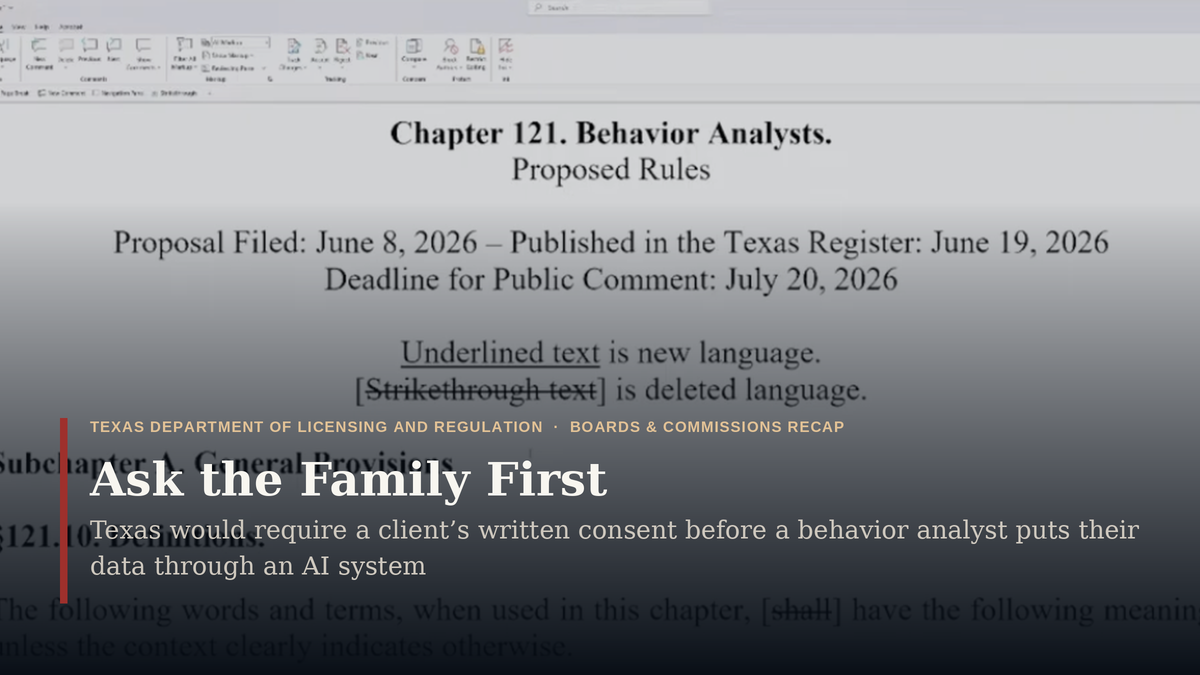
Texas would bar a behavior analyst from letting artificial intelligence help write a child’s therapy plan unless the family signed off first — and would forbid the analyst from ever letting the software make the call alone.
The advisory board the state consults on the profession voted Sept. 9 to send that rule package to the Texas Commission of Licensing and Regulation, the body with the power to adopt it. It would land on 7,474 licensed behavior analysts and 261 assistants — a workforce the Texas Department of Licensing and Regulation counted for the third quarter of fiscal 2026 and says has grown an average of 19 percent a year for five years. Most of their clients are children with autism, and one board seat is reserved for someone who received this therapy or raised a child who did.
The consent requirement is a single paragraph, and a broad one. Before an analyst may run a client’s confidential or personal information through an AI system to design treatment, assess a client, carry treatment out, generate a report, produce marketing material or judge whether a treatment plan is working, the client has to consent in writing (§121.75(b)(12)). The same signature is needed before client data goes to a company to train an AI. When the software belongs to the analyst’s employer, the file has to show when a copy of that consent reached the employer.
Behind the consent form sits a second set of duties with no equivalent in the current rules — a new subchapter, §121.100, governing what an analyst may let software do.
“A license holder must not use AI as the sole basis for a client treatment design, assessment, treatment implementation, report, or for the evaluation of a treatment plan.”
An analyst would have to individually review anything an AI produced, and be able to explain to the client, in understandable language, the evidence behind any change the software suggested. The sharpest provision covers what the rule calls restrictive or punishment-based procedures — interventions that limit what a client may do or attach an unpleasant consequence to behavior. If an AI recommends one, the analyst must personally satisfy himself that gentler means will not work and that the benefit outweighs the risk of harm, and write down why.
The department priced all of this at nothing. License holders “should incur no costs to comply with the AI ethics requirements,” its budget analyst wrote, and any cost that does arise “will be minimal.”
One organization put an objection on the record. ATA Action, the policy and legislative advocacy arm of the American Telemedicine Association, whose members include hospital systems, technology companies and payers, wrote to the department July 7 that it understood the point of requiring consent where AI touches a patient directly. Its complaint was narrower: “It is unclear in the proposed rule what ‘report generation’ refers to.” Clinics run internal reports — quality audits, compliance checks, billing analytics — that federal privacy law lets them run on patient data without asking, and as drafted, it argued, the Texas rule could require a signature for those too. It asked for a definition, not for the consent requirement to go. The department’s assistant general counsel told the board it agreed, and would narrow the phrase to reports “directly impacting client treatment and assessment.”
The other change it was asked for, the department refused. A commenter proposed letting providers post a general notice that AI may be used, alongside the privacy notice every medical office hands out, instead of collecting individual consent. The department answered that a blanket notice would weaken a client’s control over their own health information. A board member said the same thing in plainer terms: people would not register what a general statement had committed them to.
“I think a a general statement is probably just something that people would pass by without really reading.”
Texas already makes health care providers tell patients when AI is involved in their care, under the Responsible Artificial Intelligence Governance Act, in force since Jan. 1. Consent is a step past disclosure, and a licensing rule makes it enforceable against the license itself. The Council of Autism Service Providers, the trade group for the organizations that deliver this therapy, wrote in its own voluntary guidance that “practitioners have selected, adopted, and deployed AI faster than laws, regulations, and guidelines can keep up.” It has taken no public position on the Texas rule, and neither has any Texas behavior-analyst or autism group.
Nothing in the package binds anyone yet. Comments closed July 20, and the earliest the Commission could have adopted the rules was July 19; it has not, and no adoption notice has been published. The board’s staff liaison said he would poll members for their next meeting date.