
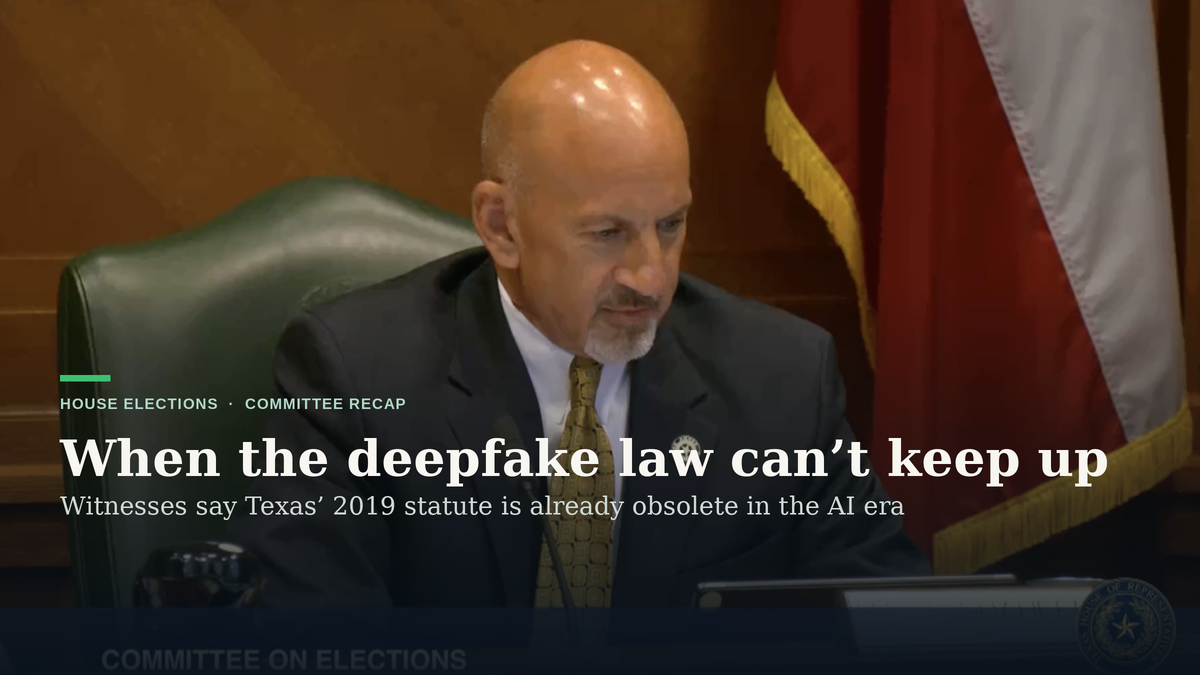
Texas criminalized election deepfakes before most states had heard the word. On Monday, the House Committee on Elections was told that head start is gone — and that the statute lawmakers wrote for 2019’s technology may not survive contact with 2026’s. The warning anchored the committee’s interim charge on Technology in Elections, which drew roughly an hour of the four-hour hearing and produced the day’s clearest menu of options for the 90th Legislature.
Andrew Cates, an attorney and former Capitol lobbyist testifying for himself, built his case from the text of the law. He read the committee Election Code Section 255.004: a person commits an offense by creating a deepfake video “with intent to injure a candidate or influence the result of an election” and publishing it “within 30 days of an election.”
The definition, he noted, covers only video that “appears to depict a real person performing an action that did not occur in reality.” That specificity was a virtue once. “This law was ahead of its time in 2019,” Cates said. But now, “the law that was ahead of its time is already insufficient to cover the capabilities of an AI era” — a statute aimed at fabricated video says nothing about cloned audio, synthetic still images, or the generative content that now floods campaign communication.
Cates came with fixes, and he pitched them directly at the dais. Pointing to Vice Chair John Bucy III, D-Austin, he sketched the enforcement problem in personal terms: “Some deepfake comes out by an opponent. You’ve been personally affected by it. You want to sue this person for violating the law.” His answer is to pair a private right of action with the state’s anti-SLAPP statute, “so that if your lawsuit is frivolous — if it actually, you know, would infringe somebody’s First Amendment rights — then a judge can decide that and they can dismiss it.”
He also urged members to borrow what he said most states now use: a disclaimer regime. “Just slap it on there, just like a political ad. ‘Disclaimer: this was made by AI,’ and let everybody go about their day.” Other states’ statutes, he noted, rest on “a reasonable person standard, which is what basically judges use for everything anyway.” The Legislature took a first step in that direction in 2025 with House Bill 366, which requires disclosure on certain altered political advertising, with rules set by the Texas Ethics Commission; Monday’s testimony framed that law as a floor, not a ceiling.
The charge’s second front was the machinery itself. Jenny Limcher of Harris County opened her testimony with the sentence that best compressed the afternoon: “Rapidly evolving election technology must be matched by vendor accountability.” She relayed the account of Karen Wiseman, a longtime Tarrant County election judge and logic-and-accuracy testing board member who could not attend, describing “two alarming incidents with the election equipment” Wiseman had previously reported to the Senate State Affairs Committee.
Limcher went further than complaint, proposing what she called a “Vendor Accountability Act” that would impose U.S.-citizenship requirements on election-equipment vendors, arguing “the voice of the American people cannot be compromised by outside influence.”
Earlier in the day, Chad Gauthier, appearing with Arise Labs LLC, connected the technology charge to public confidence: “The foundation of democracy is not simply counting votes. It is creating a system where every citizen can look at the process and understand what the outcome is.”
The committee’s members signaled where their own technology questions are headed. During the morning’s Secretary of State testimony, Rep. Terry Wilson, R-Georgetown — whose district sits in Williamson County — flipped the charge on its head: “Let’s talk about a lack of technology in elections,” he said, pressing the state on how much support the Secretary of State’s office owes counties like Williamson when their systems fall short during a primary.
Because the committee met in the interim, no votes were taken. But the technology charge produced the hearing’s most legislation-shaped record: an inventory of gaps in the deepfake statute, a disclaimer-plus-anti-SLAPP framework borrowed from other states, and a vendor-citizenship proposal — each a candidate for a bill when the 90th Legislature convenes in January 2027. With HB 366 barely a year old, members left Monday with testimony arguing the AI provisions of the Election Code will need another pass before the technology laps them again.
Also heard: The bulk of Monday’s hearing — roughly three of its four hours — went to the committee’s Voter Registration charge: the Secretary of State’s troubled TEAM system relaunch, the SAVE-database citizenship screening fight, and county officials’ demand for a public fix roadmap before November.
The hearing at a glance
Issue
The Technology in Elections interim charge — AI and deepfakes in political communication, and accountability for election-equipment vendors. Roughly 50–55 minutes, ~20% of the broadcast.
What happened
Witnesses told the panel the 2019 deepfake statute no longer covers current AI capabilities and proposed a disclaimer requirement tied to the anti-SLAPP statute, plus citizenship rules for equipment vendors. Interim hearing — no vote taken.
When
Posted 11:00 AM CT, Monday, August 3, 2026 (gaveled in ~30 minutes late per the chair) · broadcast runs 4 hours 13 minutes (both charges)
Where
Room E2.012, Capitol Extension, Austin
Chair
Rep. Matt Shaheen, R–Plano (HD-66)
Archived video
house.texas.gov · video 22748