
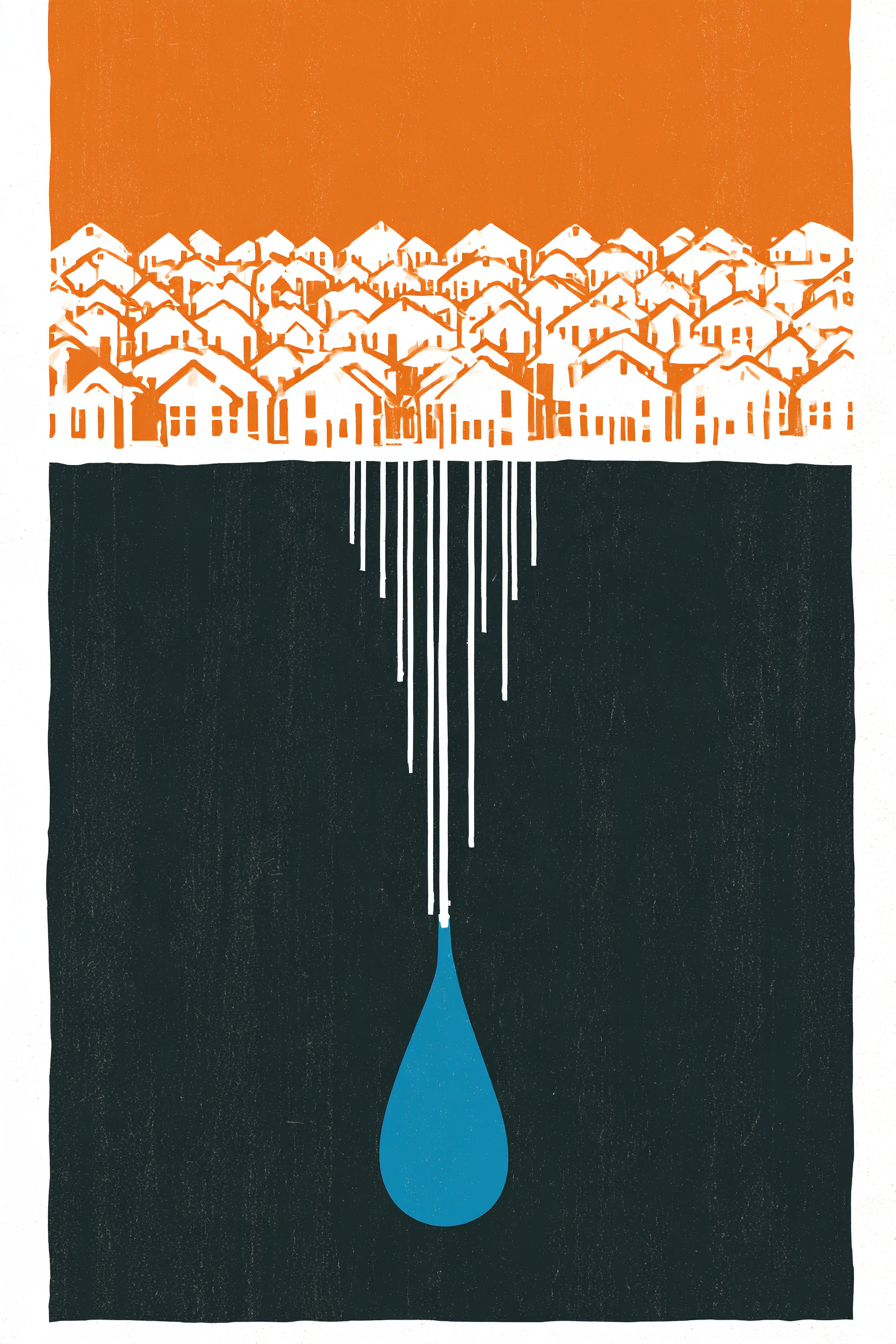
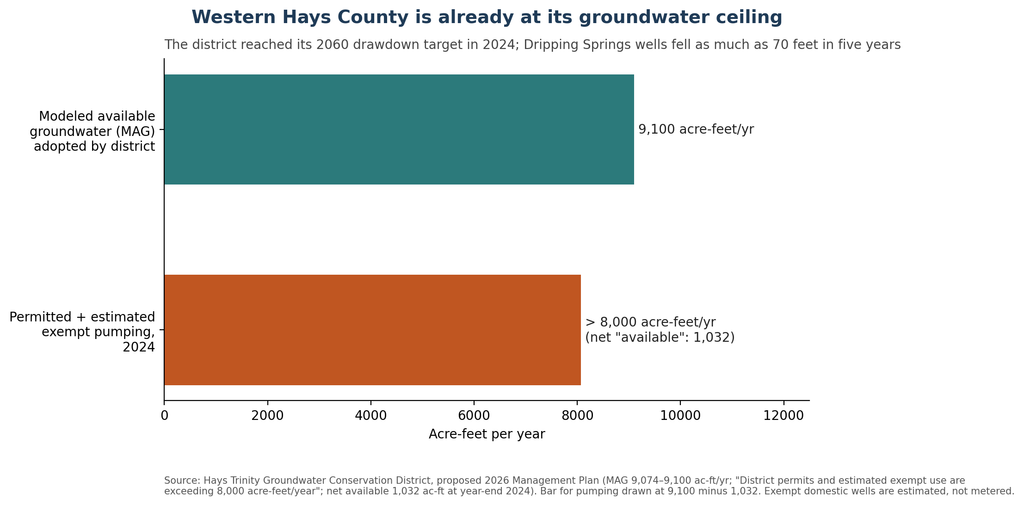
The groundwater district that covers western Hays County has a state-modeled ceiling of about 9,100 acre-feet a year. Its permits and estimated household wells already draw more than 8,000. By the end of 2024, average water levels in its monitoring wells had dropped past the target the district was supposed to hit in 2060, and in the Dripping Springs area some wells had fallen as much as 70 feet in five years. The district’s own proposed 2026 management plan puts the conclusion plainly: groundwater “cannot satisfy the water supply requirements of projected growth.”
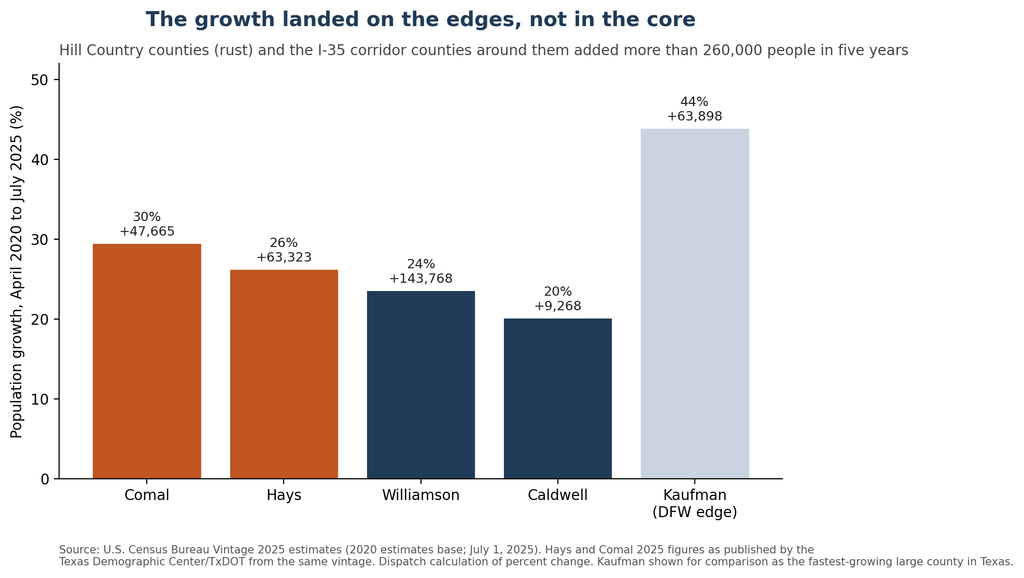
Over the same stretch, Hays County added about 63,000 people. Comal added nearly 48,000. Together with Williamson and Caldwell, the counties on the Austin–San Antonio edge grew by more than 260,000 residents between the 2020 census and July 2025, according to Census Bureau estimates that describe the pattern in one sentence: “the fastest-growing counties tended to be on the outer edges, a pattern especially pronounced in Texas.”
What connects the two numbers is the subject of this piece. The subdivisions that absorbed that growth were platted, financed, watered and drained under a set of state rules written for a slower Hill Country, and the three levels of government that touch them — county commissioners courts, groundwater conservation districts and the state agencies in Austin — each hold a piece of the authority but not the whole. When the 90th Legislature convenes Jan. 12, it will have in front of it the most specific set of requests from those local bodies in a decade. The question it must answer is not whether to let the Hill Country grow. It is who gets to say what the growth has to bring with it.
Why the growth landed here
The cause is less mysterious than the consequences. People are leaving the big urban counties for the counties next door. The Census Bureau reports that the 50 U.S. counties with a million or more residents lost a combined 637,634 people to domestic migration in the year to July 2025, while counties of 50,000 to 999,999 gained 533,766. In Texas, the Austin and San Antonio metros each ranked in the national top ten for numeric growth, adding 53,796 and 38,402 people respectively in a single year, and the gains went to the rim.
The rim is cheaper. Hays County’s median home price through August 2026 was about $364,000, well below the 2022 peak and below Travis County, and the master-planned communities along I-35 in Kyle and Buda were built for exactly the buyer who cannot afford Austin. A Community Impact survey of the Hays market as far back as 2021 quoted a broker saying first-time buyers were driving demand because Austin was out of reach.
Part of why it is cheaper is policy. Texas counties cannot zone, cannot charge road impact fees and must approve any plat that meets the statutory checklist, as the Dispatch detailed earlier this month. Developers can finance the pipes and roads through a municipal utility district created by the Texas Commission on Environmental Quality, which developers told the House Land and Resource Management Committee in July is the reason a family earning “$100,000 per year could generally qualify for a $300,000 home,” in the words of Momark Development’s Steven Spears. Hillwood Communities’ Fred Balda told the same panel his firm alone has built “more than 100 communities” and “more than 50,000 residential lots” with the tool.
Two 2023 laws lowered the bar further. Senate Bill 2038 lets a landowner petition out of a city’s extraterritorial jurisdiction, and the Texas Supreme Court held in 2025 that a city has no discretion to refuse a valid petition; a developer’s lawyer called it “the Sleeper Affordability Act” at a Senate hearing in September. House Bill 3697 struck language that had required a county plat whenever a subdivision built roads for its future residents, and, according to a March 2025 brief from the Texas Association of Counties, developers now read it to mean that lots of 10 acres or more need no plat at all “so long as the owner does not formally dedicate streets, alleys, squares, parks or other parts of the tract to public use.” The same bill barred counties from requiring any study or document with a plat application that state law does not explicitly require.
None of this was accidental. The Legislature chose, deliberately and more than once, to make it easier to build housing on unincorporated land, and the housing got built. The 2023 session’s choices and the 2025 housing package (SB 15, SB 840, HB 24) are part of one policy, and that policy has delivered homes at prices Austin and San Antonio proper cannot match.
What the growth brought with it
The bill for that policy is now arriving in four forms, and each one lands on a government that lacks the authority to send it back.
Water. The Trinity Aquifer is the only groundwater source in western Hays County, and the district reports its 2060 drawdown target was already breached in 2024. Jacob’s Well in Wimberley, historically a four-cubic-feet-per-second spring, showed zero flow in May 2026 despite a wet April, and Hays County kept it closed to swimming after a July surge receded. KUT reported in March that every monitored well in the Hays Trinity district was below its historic level, that a well driller in Wimberley and Dripping Springs was seeing water “staying very low at around 660 to 690” feet where it once recovered to 500, and that new wells in northern Hays County are being drilled into the confined Lower Trinity, which does not recharge. A new well can cost $75,000; one small community took a $40,000 loan to replace a well that went dry in 2025. South and west of there, the Edwards Aquifer Authority returned the San Antonio Pool to Stage 3 on Oct. 21, cutting permitted pumping 35 percent, after the J-17 index well hit its third-lowest reading on record in 2025.
The structural problem is exemption. Under Water Code Section 36.117, a district must exempt a domestic well on a tract larger than 10 acres that produces under 25,000 gallons a day; it cannot deny the permit, and it does not meter the use. The Hays Trinity district’s pumping ledger therefore counts exempt wells as an estimate, not a measurement, and a 10-acre-lot subdivision built under the HB 3697 reading needs neither a plat nor a groundwater permit. The 2023 Legislature did pass SB 2440, which requires a licensed engineer’s groundwater-availability certification with plat applications that rely on groundwater. But commissioners courts can waive it, the Texas Association of Counties says it “appears to conflict” with HB 3697’s ban on added requirements, and nothing in it lets a county reject a study it finds inadequate. That is the first item on the Hill Country counties’ list.
Drainage and impervious cover. When land leaves a city’s jurisdiction under SB 2038, the county inherits plat review but not the city’s stormwater rules. Sen. Molly Cook asked the Senate Local Government Committee in September who reviews drainage for a released tract “if there’s flooding downstream,” and the hearing produced no answer. Comal County’s commissioners rewrote their subdivision order in June, raising minimum lot frontage, tightening road specifications and requiring water availability for groundwater subdivisions regardless of lot count; the order itself notes that county authority remains “limited” over water use, density, landscaping and habitat. County impact fees are limited by statute to drainage, and only in counties of 3.3 million people or those bordering one, which excludes every Hill Country county. A UT Austin study cited by the Hill Country Alliance found that from 2000 to 2010 the region converted 77 acres to impervious cover for every 1,000 new residents.
Roads and emergency access. The Texas Association of Counties’ brief argues that subdivision authority “is the county’s only means to ensure neighborhood roads are accessible to emergency service providers, and that residents have adequate water supply,” and that HB 3697’s private-roads reading produces “flag lots” with just enough frontage for a driveway. Burnet County’s commissioners court voted unanimously in August 2024 to ask the Legislature to restore the language; Precinct 2 Commissioner Damon Beierle said the law “took away some of our abilities for platting on 10 acres and above tracts.” A Senate bill to do that, SB 325 by Sen. Charles Perry, was referred to committee in February 2025; we found no record it advanced.
Wastewater. The state, not the county, issues discharge permits. Lennar’s renewal for a 1,500-home Canyon Ranch subdivision would send 300,000 gallons a day of treated effluent toward Canyon Lake; a second Comal County application seeks 600,000. Comal County Commissioner Jen Crownover noted at the June public meeting that counties “maintain limited statutory authority over state-level environmental permitting decisions,” and Sen. Donna Campbell asked TCEQ whether the discharge bans the Legislature imposed on the Highland Lakes in the 1980s should extend to the Canyon Lake basin.
Then the data centers arrived
Onto a region already at its groundwater ceiling, the industry with the largest single-site water and power demand in the state began shopping for land. KUT counted five data centers on the horizon in Hays County in February. The Blanco-Pedernales Groundwater Conservation District became the first district in Texas to formally petition the Legislature on the subject in May, asking for explicit authority to deny industrial permits when demand exceeds sustainable yield, for mandatory water-use disclosure and for required evaluation of low-water cooling, out of a stated fear of being “sued into insolvency by industrial users over what they say are vague statutory thresholds.” That fear is not abstract: Hill County rescinded a one-year moratorium in June after a developer sued for $100 million, and Hays County Commissioner Walt Smith told KUT that if his county passed a moratorium as written, “we’re gonna get sued, and we’re gonna lose.”
Hays County’s answer, a 225-page draft of development regulations that went to public hearing Oct. 27, shows what a county can do without zoning: define a “high-intensity use” at 100,000 gallons a day or 20 megawatts, prohibit evaporative cooling for such users unless at least 75 percent of the water is reclaimed or brackish, and tie it all to county incentives and development agreements, which the draft concedes exist to “provide incentives for desired Development conditions that exceed the legal authority of these Regulations.” Caldwell County Judge Hoppy Haden told the Senate Water Committee Sept. 1 that he wrote closed-loop cooling and a 200-gallon-per-megawatt-per-month cap into tax agreements because that was the only lever he had, and then described the lever’s limit: “I’m a rancher, I’m 63… somebody floating an offer for $95,000 an acre for my biggest asset, what am I to do?” Caldwell County, 4.2 percent growth last year, is now tenth-fastest-growing in the nation among counties over 20,000 and is reviewing a 3,130-acre mixed-use project off SH 80.
The House Natural Resources Committee heard in June that in a county with no groundwater district, in the words of a Texas Water Development Board official, “there would be no entity in place to regulate that use.” Rick Thompson of the County Judges and Commissioners Association told senators that “almost 100 counties” lack one. The TWDB’s voluntary water survey of 341 data centers drew a 30 percent response; the penalty for ignoring it is a Class C misdemeanor.
Who can say no to what
The simplest way to see the 2027 problem is to list who holds each decision today.
| Decision | Who decides | What the Hill Country bodies can do |
|---|---|---|
| Land use on unincorporated land | No one (counties lack zoning under LGC 231) | Set road and drainage specs by order; approve compliant plats within 30 days or they auto-approve |
| Whether a subdivision needs a plat at all | Developer, under the HB 3697 private-roads reading for 10-acre lots | Dispute the reading; Burnet and Young counties have asked for legal research |
| Groundwater for a subdivision | District, except domestic wells on >10 acres are exempt by statute | Estimate exempt pumping; require SB 2440 certification, which the court may waive and cannot reject for inadequacy |
| Groundwater for an industrial user | District, within “vague statutory thresholds” and litigation risk | Permit or face suit; Blanco-Pedernales asked for a clear denial standard |
| Creating a MUD to finance the subdivision | TCEQ under Water Code Ch. 54 | Submit a written opinion the commission “shall consider”; Williamson County’s request for a contested hearing on MUD 78 is opposed by TCEQ staff and decided Nov. 4 |
| Releasing land from a city’s ETJ | Landowner by petition (SB 2038) | None; county inherits plat review |
| Wastewater discharge | TCEQ | Request a public meeting or affected-party standing |
| Stormwater and impervious cover | City inside its limits; largely no one outside | Counties asked for “stronger county authority to regulate impervious cover in flood-prone areas” |
What the counties and districts are asking for
The asks on the record are more specific than in any prior interim, and they overlap.
Eleven Hill Country counties, through the County-to-County Coalition the Hill Country Alliance hosts, drafted a joint letter last November with five priorities and refined them at a June 10 workshop in Boerne: authority for counties to deny inadequate groundwater availability studies at platting; more money for the Flood Infrastructure Fund; clearer county-versus-city roles on corridors after SB 2038; county stormwater and impervious-cover tools in flood-prone areas; and contested-case rights plus water and air safeguards in aggregate permitting. Kendall County Commissioner Andra Wisian’s framing: counties “are on the front lines of managing growth” and need “practical legislative solutions that reflect the realities facing Hill Country communities.”
The County Judges and Commissioners Association told the Senate Water Committee it wants buffer zones, mandatory community hearings and water availability studies for large projects, and a statutory duty for developers to talk to counties at all. Hunt County voted unanimously in July to ask for voter-approved groundwater districts, city-style development agreements and bonded road-use agreements for projects of 75 megawatts or more. Texans for MUD Reform and the city of Josephine asked the House for a statutory seat for cities and counties when a district is drawn at their edge. Blanco-Pedernales asked for a denial standard, disclosure and cooling review.
Some of it already has legislative sponsors. Sen. Lois Kolkhorst said Sept. 1 that “all 254 counties in the state of Texas need to be under water district.” Sen. Perry said a groundwater-district standardization bill he has “failed to pass for six years” will return, that evaporative cooling “won’t be allowed coming out of next session, I promise,” and that “there will be no confidentiality on water use.” Speaker Dustin Burrows’ State Affairs charge asks for ways to streamline regulation while “enabling communities to plan and manage growth responsibly,” and the Dispatch’s reading of the three state leaders’ statements this week found each of them moving toward some combination of local input and statewide standards for data centers, without yet saying which.
Where the argument gets hard
The developers’ case deserves its full weight, because the Legislature has sided with it repeatedly and for a reason. Texas ranks 43rd in homeownership and home prices are up 51 percent since 2020; the MUD and the unregulated county are, in the builders’ telling, the reason a teacher or a lineman can still buy a house within 40 miles of the Capitol. JD Hale of the Texas Association of Builders told the House committee in July, “It’s Groundhog Day here in the Land and Resource Management Committee,” and he is right that the counties have asked before and been refused before. Giving 254 commissioners courts a discretionary veto over plats or groundwater studies would reintroduce, at the county level, exactly the local discretion the Legislature spent 2019 through 2025 removing from cities, and the Dispatch has argued that state guardrails on local power are the appropriate role for the state.
That is also why the county veto is the wrong frame for 2027, and why the better question is the one this publication has put to every local-control fight this year: whether the state will step in to protect the broader interests of all Texans. Three of those interests are plainly at stake in the Hill Country, and none of them is served by the current allocation of authority.
The first is the aquifer itself. The Trinity does not stop at the Hays County line, and the Edwards recharge zone sits under the ETJ map on the second page of the counties’ own brief. Groundwater pumped by an exempt well in a plat-less subdivision is a public resource consumed without a count, and the Legislature has already decided, in Prop 4, to spend up to $20 billion of state sales tax through 2047 building replacement supply. A state that is paying to replace water has a direct interest in knowing how much is being drawn and in requiring that a subdivision prove its supply before the lots are sold. A groundwater certification that a county cannot reject when it is inadequate, and that a developer can avoid by calling the roads private, is not a statewide standard. It is a form.
The second is the downstream neighbor. Flooding does not respect the line between a released ETJ tract and the subdivision below it, and the 2025 Hill Country floods made the stakes of drainage design unmistakable. A uniform state minimum for stormwater in unincorporated flood-prone areas, applied the same way in every county, protects the Texan downstream without handing any one commissioners court a veto.
The third is the buyer. The Texas Association of Counties’ warning that purchasers of lots “without adequate road access to fire suppression services or a reliable water supply may find it difficult to insure their property or secure financing” is a consumer-protection point, not a growth-control one. The lender, the insurer and the county taxpayer who is eventually petitioned to fix the road all bear the cost of a standard that was never set.
Those three interests point toward a package the Legislature can write as state law rather than local discretion: close the private-roads reading of HB 3697 so that a subdivision is a subdivision; make the SB 2440 groundwater certification a real test with a state-defined evidentiary standard, as SB 1855 proposed in 2025 by assigning TCEQ to set it; extend groundwater-district coverage statewide and give districts the clear large-user permitting standard Blanco-Pedernales asked for; require water-use disclosure from any user above a stated threshold, with a penalty larger than a Class C misdemeanor; set a state stormwater floor for unincorporated land in mapped flood zones; and give counties and cities a defined, time-limited seat at the TCEQ table when a MUD or a discharge permit is drawn at their edge. Each of those is a rule the state would own and apply uniformly, which is what distinguishes a guardrail from a veto.
What that package would cost is also worth saying out loud. Every one of those standards raises the price of a lot on the Hill Country edge, and the price is the reason the growth came. The Legislature in 2027 will be choosing, more precisely than it has before, how much of the cost of growth to put on the house and how much to leave on the aquifer, the neighbor and the next buyer.
What to watch
Nov. 4 — TCEQ commissioners decide whether Williamson County is an “affected person” entitled to a contested hearing on MUD No. 78 near Leander; the executive director says no, the public interest counsel says yes.
November — Hays County commissioners’ adoption vote on the draft development regulations is not yet scheduled; watch whether the “high-intensity use” definitions survive and whether any applicant tests them.
December — House and Senate interim committee reports typically land before the holidays; the Natural Resources and Water, Agriculture and Rural Affairs reports will show whether groundwater-district coverage, disclosure and the HB 3697 fix made the recommendations.
Jan. 12, 2027 — The 90th Legislature convenes. Perry’s groundwater-district standardization bill and a data-center water bill are the first filings to watch; a refiled SB 325 or companion would signal the county platting fix is live.
Through 2027 — Groundwater Management Area 9 districts, having proposed a desired future condition of roughly 30 feet of average Trinity drawdown through 2080 in March, move to adopt it; Hays Trinity’s plan says the district has already exceeded the comparable 2060 figure.
Ongoing — Edwards Aquifer Authority stage changes (currently Stage 3 for the San Antonio Pool) and Hays County’s Jacob’s Well closure, which the county said in July would remain “until further notice.”
Sources
Texas Dispatch
- Will Texas Give Communities More Say Over Data Centers? (Oct. 27)
- Edwards Aquifer Authority Returns San Antonio Pool to Stage 3 (Oct. 27)
- Williamson County Wants a Say on a New Utility District Near Leander (Oct. 26)
- Hays County Draft Rules Would Tie Data Center Incentives to Water and Power Limits (Oct. 21)
- Caldwell County Commissioners to Hear Developer’s Plan for 3,130-Acre Mirada Project (Oct. 20)
- Texas Counties Can Check a Plat but Cannot Zone the Land Around It (Oct. 5)
- Analysis: Local Control and State Guardrails (Oct. 1)
- Bettencourt Names West to Lead Probe of Cities Skirting Housing Laws (Sept. 4)
- Perry Vows to Ban Evaporative Cooling After 70 Percent of Data Centers Ignore Survey (Sept. 3)
- County Judges Tell Senators They Have ‘No Authority’ Over Data Centers (Sept. 2)
- Analysis: Texas Found $20 Billion for Water. The Fights Were About Permission. (Aug. 27)
- Developers call the MUD a Texas miracle (July 22)
- Across much of Texas, no agency limits how much groundwater a data center pumps (June 24)
- Lennar Wastewater Permit Would Send 300,000 Gallons a Day Toward Canyon Lake (June 15)
- Hill Country Water District Urges Lawmakers to Allow Permit Denials for Data Centers (May 19)
Government and data
- U.S. Census Bureau, Vintage 2025 county estimates press release (March 26, 2026)
- Texas Demographic Center, preliminary Vintage 2025 estimates
- Hays Trinity GCD, proposed 2026 Management Plan
- GMA 9 desired future conditions resolution (March 31, 2026)
- Texas Water Code §36.117
- SB 2038 (88R), enrolled; HB 3697 (88R), enrolled; SB 2440 (88R), enrolled
- SB 325 (89R), Senate Research Center analysis; SB 1855 (89R), analysis
- Texas Association of Counties, Land Use Regulation issue brief (March 2025)
Other reporting and organizations
- KUT: Hays County wells run drier as aquifers fall to lowest levels in 20+ years (March 26, 2026)
- KUT: With 5 data centers on the horizon, Hays County water advocates see the fight as just beginning (Feb. 26, 2026)
- MySA: Jacob’s Well shows no water flow as Memorial Day approaches (May 2026)
- Herald-Zeitung: Comal County adopts updated subdivision regulations (June 12, 2026)
- San Marcos Record: Regional leaders discuss groundwater, data centers and growth (June 30, 2026)
- Hill Country Alliance: County-to-County workshop release (Nov. 13, 2025); Growth scenario
- DailyTrib: Burnet County seeks law change for more power over subdivisions (Aug. 28, 2024)
- Neuhaus Real Estate: Hays County home prices 2026 (Unlock MLS data)
- Community Impact: Housing prices on the rise in Hays County (2021)