

On the morning of Aug. 18, nineteen people were receiving dialysis at Childress Regional Medical Center. Greenbelt Lake, which supplies the towns water, was 5.2 percent full — 3,087 acre-feet against a capacity of nearly 60,000, down by almost half in twelve months. That same morning, a Houston data center company offered to solve it. Lancium told the Greenbelt water authority board it would fund a treatment plant and roughly 16.5 miles of pipeline from three wells on its Childress campus, at no cost to the communities, for two years. “None of this water is for Lancium’s use,” chief corporate affairs officer Scott McFarland said.
A week later and 500 miles south, the state gave Corpus Christi permission to stop sending water to Nueces Bay. TCEQ’s executive director signed an emergency order suspending pass-through releases — roughly 48 million gallons a day — effective immediately and running through Dec. 23, with an automatic 60-day extension if combined reservoir storage is still under 50 percent. It stood at about 42 percent when the city announced it.
Neither of those decisions was made by the Legislature. Both are the kind of decision the Legislature will be asked to write rules for in January.
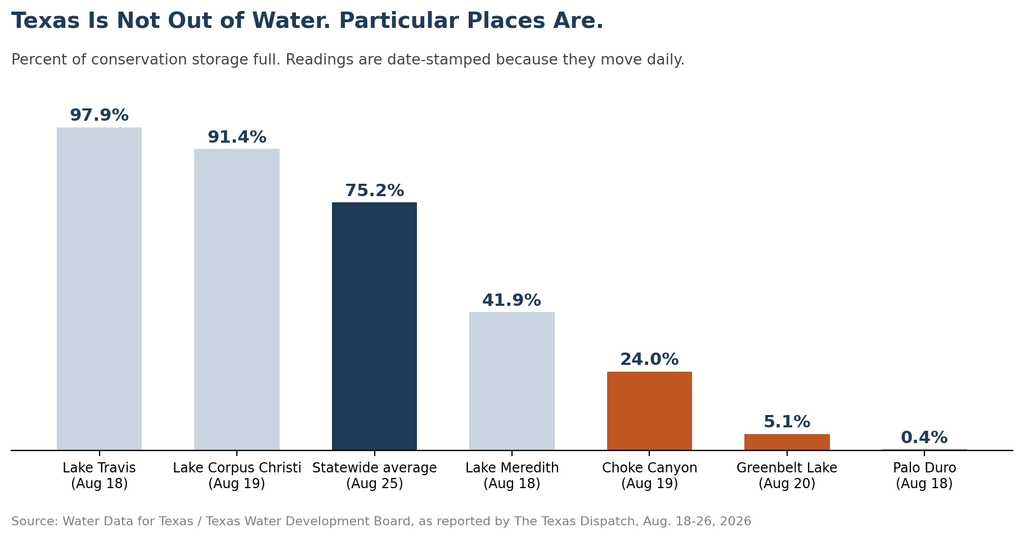
The state is not short of water. It is short of places to put it.
The statewide numbers look reassuring. Texas reservoirs were 75.2 percent full on Aug. 25, refilled by July flooding. Lake Travis was at 97.9 percent, Buchanan at 98.4.
The local numbers are a different state. Palo Duro Reservoir held 224 acre-feet against a capacity of 61,066 — four-tenths of one percent. Amarillo entered Stage 1 restrictions Aug. 17 for the first time since 2022, triggered not by demand but by reservoir level. “The City can only fill the reservoir with water purchased from CRMWA,” utilities official Shannon Tollison told NewsChannel 10. “There are no other sources feeding the reservoir.” Drought expanded across 7.91 percentage points of Texas in a single week, reaching 57.28 percent of the state, and exceptional drought returned to the Panhandle after a five-week absence.
That gap between the average and the specific place is the whole problem, and money does not close it by itself.
Voters solved the funding. The testimony was about something else.
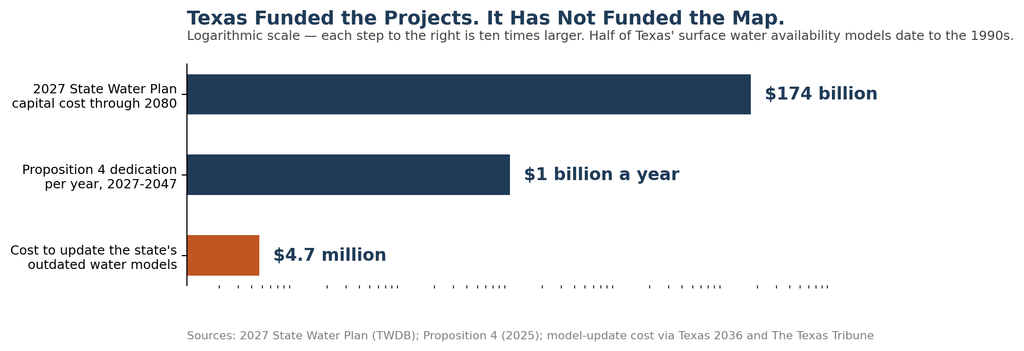
Texas has spent three years fixing what everyone agreed was the constraint. Proposition 6 created the Texas Water Fund in 2023. Proposition 4, approved last November, dedicates up to $1 billion a year in sales tax revenue to that fund from 2027 through 2047 — about $20 billion. HB 500 handed the water board another $1.038 billion in general revenue. The 2027 State Water Plan, adopted July 23, identifies about 6,700 strategies at a capital cost near $174 billion, against a projected 53 percent population increase and a 10 percent decline in drought-reliable supply.
Then the House Natural Resources Committee went to Weslaco on Aug. 24 and asked the companies eligible to build new supply what was stopping them. Money barely came up.
Seven Seas Water Group told the committee that TWDB’s own preliminary Trinity Aquifer analysis proposes well production rates of 75 to 300 gallons per minute — “well under half a million gallons a day, in a zone TWDB itself designated for high production.” Its conclusion was blunt: “No developer will invest in exploring a zone whose production ceiling is already set too low to support a viable desalination facility.” The company offered to hand the state field data at no cost so that brackish groundwater production zone limits “reflect actual aquifer performance rather than conservative, theoretical assumptions alone.”
Two atmospheric water generation firms made a parallel argument. Tsunami Products, with an application pending at TCEQ, asked for “shortened TCEQ review timelines” and “TWDB recognition of AWG as sustainable water supply, opening opportunities for grant funding.” Chief executive Stephen Peters put it as: “AWG is the bridge to expand near-term water access, and we need policy to build the road across.” SkyH2O’s Terell Jones asked for tax treatment matching what rainwater harvesting and desalination already receive.
These are companies asking to be let in, not funded. And the demand signal is not in doubt: TWDB reported 682 applications totaling $6.9 billion against a single grant solicitation.
Where the money does move, the path is not always legible
In April, the Nueces River Authority asked the water board for $140 million from the state’s main loan program and was turned down, scoring one point below the cutoff in a round where requests reached about $4.2 billion — the first rejection in the program’s eleven-year history.
Four months later the same authority wrote a $7 million TWDB grant for Harbor Island desalination engineering into its own 2027 budget on Aug. 14 — ten days before the board voted on it — along with nearly $5 million in contracts contingent on the award. Authority officials told KRIS 6 that Gov. Abbott had directed the agency to fund the planning work; a spokeswoman said she was not sure which program the money would come from. A month earlier the governor’s office had told the same station there was no formal state commitment to the project.
The grant may be entirely routine. But a state about to distribute $20 billion has an interest in the answer to a simple question the board should put on the record: which pot, and under what criteria.
Permission cuts in more than one direction
The instinct is to read all of this as a case for lighter regulation. The produced-water fight shows why that reading is too simple.
Texas oil and gas wells surface about 24 million barrels of salty water a day — more than a billion gallons. Disposal capacity is tightening as the Railroad Commission addresses seismicity and rising formation pressures, which makes treatment and reuse newly attractive. But at the Aug. 11 Senate Natural Resources hearing, RRC Chairman Jim Wright asked lawmakers for something specific: “One of the requests that I would like to make as chairman of the Railroad Commission is that this legislative session consider exactly where those authorities end and begin.” He and TCEQ Executive Director Kelly Keel, he said, “have been trying to figure out exactly where does mine stop and hers begins.”
Keel said TCEQ is evaluating seven land-application permit applications while “leveraging the existing permit process” and asking what additional framework is needed “to ensure that they’re protective of public health and the environment.”
Commission Shift policy manager Julie Range argued the proposed rules are not there yet: they “fail to establish protective surface water quality standards for numerous hazardous compounds in produced water, and they set no concrete limits to guarantee treatment meets those standards.” On the state consortium’s 2026 pilot results, she allowed “encouraging observations” but said the report “falls short of demonstrating that this technology is mature, reliable, and ready for commercial viability.”
Both sides of that exchange are asking the Legislature for the same thing: a clear line. One wants it drawn so projects can proceed; the other wants it drawn so they can be held to a standard. Neither can get it from an agency alone.
The same gap runs the other way in groundwater. The Blanco-Pedernales Groundwater Conservation District asked lawmakers in May for explicit authority to deny permits tied to data center projects — the first formal request of its kind from a Texas groundwater district. In much of rural Texas there is no groundwater district at all, and no ceiling on pumping.
Why nobody saw the Coastal Bend coming
Underneath the permitting arguments sits a quieter failure, and it is the one with the cleanest legislative fix.
Texas has updated a state water plan every five years for more than a quarter century. A Texas 2036 report released Aug. 19 found that five of those plans sent contradictory signals about the Coastal Bend, and none projected the surface-water shortage the region actually hit this year. Of 50 strategies the 2021-22 plan recommended for this decade, one had been built by 2025.
The mechanics are mundane. State rules anchor planning to historical droughts; half the state’s surface water availability models date to the 1990s; a 2023 law permitting regional groups to model worse-than-historical droughts came with no money to do it. Coastal Bend planners realized mid-cycle that the drought underway had exceeded their 2007-13 benchmark and wrote that “there was insufficient funding allocated” to re-model. The board adopted the plan in January anyway.
“Why is it so hard to update them?” former TWDB chair Carlos Rubinstein told the Tribune. “Because the state does not invest. Period. End of story.” The estimated cost of updating the models is about $4.7 million — against $1 billion a year now flowing to projects those models are supposed to justify.
Texas 2036 recommends a statutory “readiness phase” before each planning cycle, authority and funding to model droughts worse than the historical record, and longer submission timelines. Those are filable bills.
The variable nobody has sized
Into that system arrives a category of user the plans were not built to anticipate. The Houston Advanced Research Center estimates existing Texas data centers consume roughly 25 billion gallons of water a year counting cooling and power generation, and puts 2030 somewhere between 29 billion and 161 billion gallons — as much as 2.7 percent of all water used in Texas. The width of that range is the point: nobody knows.
Part of the reason is disclosure. Most data centers declined to share water-use data with lawmakers this summer, and state trade-secret law shields much of it from public records requests. The PUC ordered operators to report direct and indirect water use by May 28, with a report to the Legislature due at the end of this year.
That is the charge the Senate Committee on Water, Agriculture and Rural Affairs takes up Sept. 1 — a single question about how much these facilities use and what Texas should require them to say. Four of the panel’s seven members represent districts where irrigated agriculture is the dominant use, which is the tension in miniature: at Weslaco, the Texas Farm Bureau and Delta Lake Irrigation District argued the planning process already leaves irrigation as the residual claimant after municipal reserves are set aside.
Which returns to Childress, where a data center company is offering to become a water utility because the lake is at 5 percent and the alternative is worse. “For short term it’s going to be great,” farmer Roger Browning told the board. “It’s going to help build up a water supply, but it’s going to be a false narrative. We’re already in stage four drought restrictions.”
What to watch
Sept. 1: Two things at once. The Senate water panel hears the data-center charge in Austin, with public testimony capped at two minutes and no online comment portal. In Corpus Christi, the City Council votes on the seawater desalination plant it killed last year.
Sept. 9: TCEQ’s three commissioners decide whether to affirm, modify or set aside the Nueces Bay suspension. The order stands either way until Dec. 23.
Fall: TWDB finalizes Trinity Aquifer brackish production zone limits — the number Seven Seas says determines whether desalination there is viable. Watch whether the board takes the industry field data it was offered.
End of 2026: The PUC’s data-center water report reaches the Legislature — the first official figure to replace HARC’s 29-to-161-billion-gallon range.
Dec. 23: The Nueces Bay order expires, or extends automatically into late February if combined storage is still below 50 percent.
January 2027: The 90th Legislature convenes. The bills to watch are narrower than the $20 billion headline suggests: a produced-water jurisdiction fix, brackish production zone standards, groundwater district authority over large industrial users, data-center disclosure, and Texas 2036’s readiness-phase proposal. None of them are appropriations. All of them are about who is allowed to do what.
Sources
The Texas Dispatch:
24 million barrels a day: produced-water rollout advances (Aug. 12)
House panel takes water planning to the Valley (Aug. 17)
Reservoirs three-quarters full as drought spreads (Aug. 18)
Corpus Christi asks the state to shut off environmental releases (Aug. 19)
A data center company offers to build Childress a water supply (Aug. 20)
Water board weighs $7 million Harbor Island grant (Aug. 23)
Desalination and air-to-water firms say state rules block new supply (Aug. 25)
Senate panel to weigh data-center cooling demand (Aug. 25)
State lets Corpus Christi stop sending water to the bay (Aug. 26)
Hill Country water district asks lawmakers to curb data center permits (May)
Outside reporting and documents:
The Texas Tribune, How Corpus Christi’s water emergency exposed flaws in Texas’ water planning (Aug. 19)
Texas 2036, The Coastal Bend Water Crisis (Aug. 19)
Texas Public Radio, Most data centers won’t share water-use data with lawmakers (June 26)
KSAT, Texas law shields data center water usage from public records (July 28)
Texas Water Development Board Water Data for Texas
Texas Water Development Board 2027 State Water Plan