
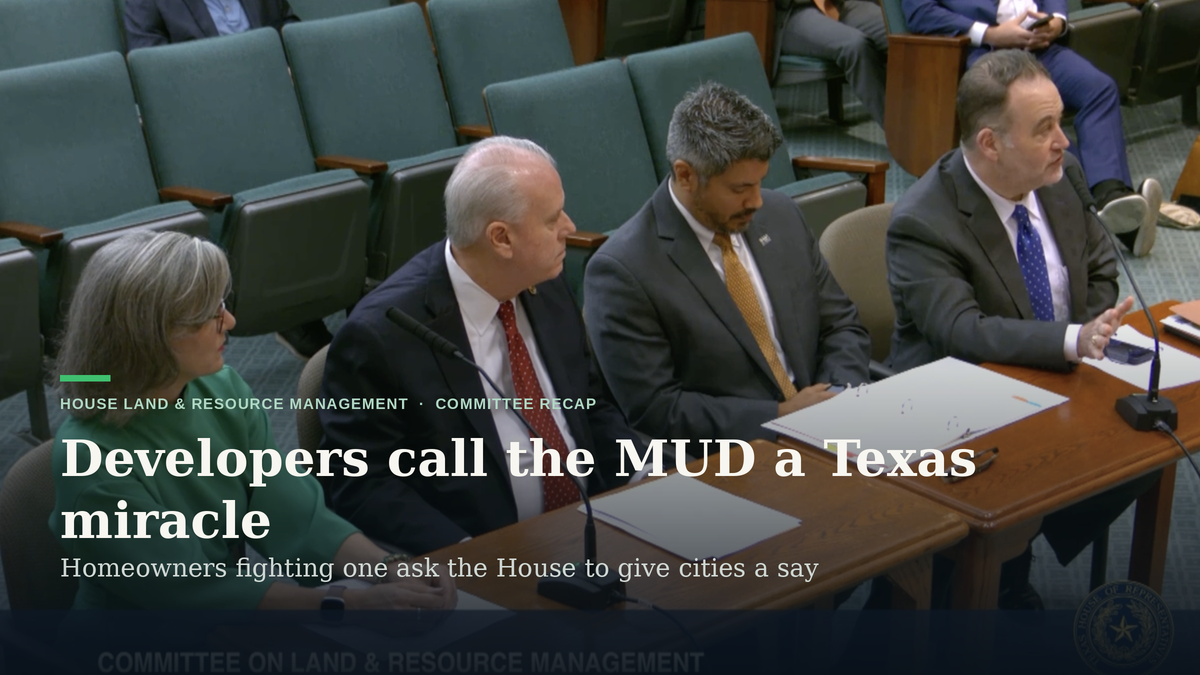
The financing engine behind much of suburban Texas got a daylong defense in the Capitol on Tuesday — and a warning from the people who live inside it. For nearly three hours, developers, engineers and municipal advisers told a Texas House committee that municipal utility districts are the reason a fast-growing state has kept new houses within reach. Then homeowners and city officials stepped to the microphone and asked the same committee to give local governments more power to say no.
The House Committee on Land & Resource Management spent the back half of a nearly four-hour hearing on municipal utility districts — the developer-created taxing districts, authorized under Chapter 54 of the Water Code, that issue bonds to build the water, sewer and drainage lines under new subdivisions and repay them through property taxes on the homes that follow. The interim charge asked members to weigh how MUDs affect housing affordability, how they are created, and whether the state’s oversight of them is enough.
The Texas Dispatch previewed the fight days earlier. On the Texas Talks podcast, host Brad Swail walked through how the districts finance suburban growth on raw land at a city’s edge — the developer fronts the infrastructure, the district issues bonds, and homebuyers repay them through property taxes over 20 or 30 years — and flagged oversight of a district’s early, developer-controlled years as the sharpest question lawmakers would bring to the hearing.
The industry’s case was that the districts are what keep the “Texas miracle” affordable. David Billings, testifying for Texas developers, told members MUDs “have become an important tool for supporting Texas’ rapid growth by finance[ing] infrastructure need[ed] for new communities.”
Because the districts front the cost of pipes and plants, he argued, that expense stays off the price tag of the house. “Affordability of home ownership is the key to explaining the continuing success of the healthy Texas housing market,” Billings said. “Texas has really avoided the volatility of other states that have experienced high growth and high population. And this is in large part because of the MUD model of financing infrastructure.”
Steven Spears, a principal with Austin-based Momark Development, put the affordability math in front of the panel. “The delivery of attainable housing has become a national crisis,” he said, citing the standard that a family can afford a home priced at about three times its income — “a household income of $100,000 per year could generally qualify for a $300,000 home.” The implication drawn by the pro-side witnesses: strip out MUD financing and that $300,000 house costs more.
Fred Balda, president of Hillwood Communities — the master-planned-community arm founded in 1988 by Ross Perot Jr. — told members his firm has built “more than 100 communities across the United States and internationally, representing more than 50,000 residential lots,” most of them served by districts like the ones under review.
Elizabeth York, senior vice president and general counsel of Johnson Development, and Rick Ramirez, director of state and federal relations for the Texas Municipal League, opened the first MUD panel alongside a Fort Bend County commissioner.
That commissioner, Vincent Morales, offered the committee a caution that opponents would seize on for the rest of the afternoon. Morales, a Fort Bend precinct one commissioner and former mayor of Rosenberg, described a county that “grew from 585,000 people in 2010 to over 975,000 today.” Growth on that scale, he said, does not look the same everywhere: “every county is different.” Supporters cited the line to argue for local flexibility. Opponents cited it to argue the state’s one-size framework is failing them.
The sharpest turn came when a homeowner group testified. Wesley Tryon, speaking for Texans for MUD Reform, opened by conceding the tool’s value. “We’re a group of taxpaying property owners who understand the need for MUDs,” he said. “But we also know there’s a right way and a wrong way to do things.” Tryon said his group, Ellis County and the city of Waxahachie have been locked in a contested case at the state’s environmental agency “since [20]21,” after the Texas Commission on Environmental Quality “issue[d] a permit for the MUD in January and then subsequently issued a permit for the open wastewater sewer treatment plant” over local objection.
His closing was aimed squarely at the members in the room. “Texans for [MUD] Reform is asking one simple thing — we the people elected y’all,” Tryon said. “I’m hearing the drumbeat about how great MUDs are, and I’m sure they are. But like Morales said, every county is different. So we’re asking y’all to come up with legislation that gives local municipalities and counties the authority” to weigh in on districts drawn at their edges.
Cities made a quieter version of the same request. Lisa Palomba, city administrator for the City of Josephine in southeastern Collin and Hunt counties, handed members a map and framed her testimony as coexistence, not opposition. “The goal today is not to criticize MUDs,” she said. “We recognize they are valuable tools that help provide infrastructure and create housing opportunities. We are simply here to share our story and offer ideas that may help cities” and districts work together.
The structural complaint underneath the day belonged to Billings, oddly enough — even the industry’s witness noted that many districts “are developed outside the city boundaries and function like communities without having the total authority of the city or capacity to provide many public services, including public safety, code enforcement, municipal courts and other local government services.”
Chairman Gary Gates, R–Richmond, ran the questioning himself and kept returning to two points: what a buyer knows, and who checks the debt. On disclosure, Gates said the system already puts the district on the closing table. “Every time somebody buys a house, I know I’m in a MUD, I know what the bonds are, I know what my tax rate is,” he said. “That’s a legal requirement. If that’s not being met, that’s a very different conversation.”
On whether districts can overload homeowners with debt, witnesses walked him through the state’s guardrails: TCEQ, one adviser said, runs “stress tests for tax rates that they apply to those bonds. And you cannot submit applications that would exceed their tax rate stress tests.” Pressed on how high a district’s levy can climb, another explained that the operating portion “could go beyond that, but the debt part of the tax rate has” a ceiling tied to what the tax base can bear.
Rick Ellis and Bill Callegari, both tied to the founding of the Association of Water Board Directors, testified on how elected district boards operate; Steven Eustis of Cedar Creek Municipal Advisors and Lawrence Dean of Community Builders Advisory Services spoke to bond capacity and housing-market economics; and Hank Smith testified as an engineer.
JD Hale of the Texas Association of Builders captured the sense that lawmakers have been here before. “It’s Groundhog Day here in the Land and Resource Management Committee,” Hale said, thanking Speaker Dustin Burrows and Gates “for making this issue a priority, because it is an issue that needs to be discussed.”
Because the committee is meeting in the interim, it took no vote. Its findings feed recommendations to the 90th Legislature, which convenes in January 2027 — and the fault line is already drawn. The building industry wants the districts protected as an affordability tool; homeowners and cities want a statutory seat at the table when a district is created next to them. Both sides asked the committee to come back in 2027 with language, just pointed in opposite directions.
Also heard: Before turning to MUDs, the committee spent its first roughly 50 minutes on oversight of its three state land agencies — the General Land Office, the School Land Board and the Board for Lease of University Lands — where officials detailed billions in revenue for public education and a $14 billion disaster-recovery portfolio. That agency-oversight charge is the subject of the companion story. Tuesday’s hearing was the second of back-to-back sessions; the committee met Monday on implementation of the 2025 housing laws.
The hearing at a glance
Issue
Municipal utility districts — impact on housing affordability, how districts are created, and whether oversight is sufficient. About 2 hours 55 minutes, or roughly three-quarters of the hearing.
What happened
Invited and public testimony. Developers, engineers, municipal advisers and the Texas Municipal League defended MUDs as an affordability tool with TCEQ guardrails; a Fort Bend commissioner urged local flexibility; Texans for MUD Reform, the City of Josephine and an aquifer group asked lawmakers to give cities and counties more authority over districts formed at their edges. Interim hearing — no vote taken.
When
9:00 AM CT, Tuesday, July 21, 2026 · ran 3 hours, 46 minutes
Where
Room E2.026, Capitol Extension, Austin
Chair
Rep. Gary Gates, R–Richmond (HD-28)
Archived video
house.texas.gov/videos/22719