
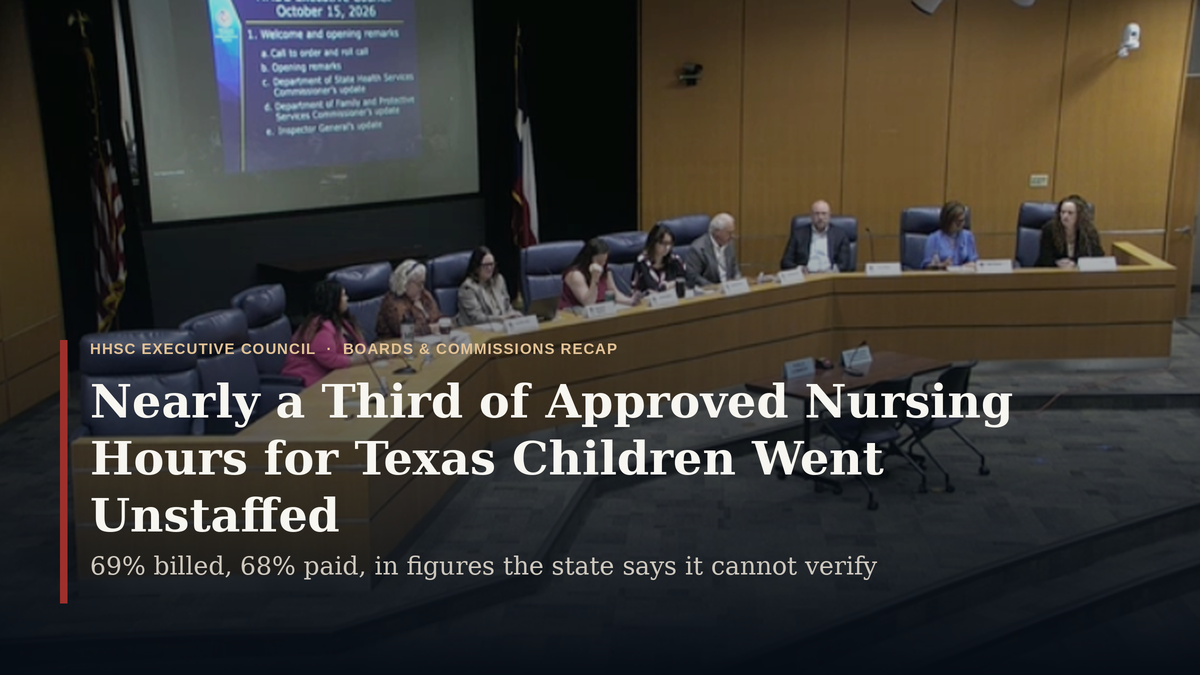
Nearly a third of the in-home nursing hours that Texas Medicaid approved for medically fragile children were never delivered, state health officials told a public meeting in Austin on Oct. 15.
The service is private duty nursing: continuous skilled nursing in a child’s own home, ordered by a physician, measured by a nurse who comes to the house, and covered only after a health plan approves it. Across state fiscal years 2023 and 2024, 69% of approved hours were billed and 68% were paid. The Health and Human Services Commission uses those two figures as “a proxy measure for hours or units that were actually staffed.” The remainder — close to a third — is care a doctor ordered, a nurse assessed and an insurer agreed to pay for, and that no nurse arrived to give.
What is at stake when the nurse does not arrive is in the commission’s own description of the benefit. Private duty nursing, Dr. Ryan Van Ramshorst, the commission’s chief medical director for Medicaid and CHIP Services, told the meeting, may “prevent prolonged or frequent hospitalization or the need for institutionalization.” Those who qualify are Texans under 21 on Medicaid whose need for round-the-clock skilled care a doctor has certified, most of them in STAR Kids, the state’s managed care program for children with medical complexity. Many depend on ventilators, feeding tubes or constant monitoring, and the hours are the difference between a bedroom and a ward.
The shortfall was not even across Texas, and Van Ramshorst was careful not to overstate the pattern:
We saw that rates seem to be lower in more rural areas of the state, but that wasn’t the case for all rural service areas.
The strongest argument against reading that as a simple staffing failure is his own. The figures were reported by the health plans themselves. “Due to system limitations, we were unable to independently validate the accuracy of the data,” he said. And the rate, he added, “does not account for situations where the caregiver declined the nursing service for whatever reason, or an instance where a child was hospitalized.” Some share of the missing third is therefore a hospital stay or a declined shift rather than a nurse who never came. How large, the commission did not say.
Nor does the public record say how many children, or how many hours, are involved. A slide behind the presentation carried the absolute totals authorized, billed and paid for each year. They were never read aloud, and the deck is not posted. The two percentages are the whole of the public arithmetic.
That the state cannot check what its health plans tell it is not a new difficulty. As The Texas Dispatch previously reported, Texas law requires the commission to publish quarterly the fines it levies against Medicaid health plans, and it has not posted a report since 2022. The commission said a prior authorization data warehouse it is building with the plans should be “operational next year” and would help it understand figures like these.
No one has publicly answered the numbers, which is less surprising than it looks: they were presented eight days before the transcript of the meeting became readable. Protect TX Fragile Kids, a grass-roots nonprofit founded and run by parents of medically fragile Texas children, holds a standing position on the program, taken before these figures surfaced and aimed at a separate rule on who qualifies for the state’s Medically Dependent Children Program. On its campaign page this month the group says: “Since the STAR Kids program was established in 2016, children with medical complexity have been experiencing significant gaps in coverage, excessive waitlist times, limited providers, and issues accessing quality care, among other problems with STAR Kids, STAR+Plus, and Texas Medicaid.” Among its asks is better Medicaid provider pay — a theory of why approved hours go unworked that the commission’s record neither confirms nor forecloses, because it said it has yet to establish the causes. The health plans, which supplied the data, have said nothing on the record about it.
The same population is already the subject of a live rulemaking the Dispatch reported on Oct. 12, when the commission held a hearing on slots meant to let the sickest children skip the nursing home. Van Ramshorst said the agency would keep working with individual plans “to improve the rate of authorized hours being staffed by identifying root causes.” No date was given for that work. The council that heard him decides nothing — state law bars it from making administrative or policy decisions, and the executive commissioner adopts rules alone. Of the business it did take up, the two radiation rules summarized the same morning open for public comment Oct. 23 and close Nov. 23.
Texas has disenrolled about 17,000 provider identification numbers from Medicaid since mid-June for failing to revalidate, the commission’s chief Medicaid and CHIP services officer, Stephanie Stephens, reported; 62% of them had not been paid by Medicaid in the previous year. Another 16,751 providers come due within 60 days, and 34% of those had not yet applied. Notices for a separate off-cycle revalidation of higher-risk providers, requested by federal regulators, begin in November.
Jennifer Sims, deputy commissioner of operations at the Department of Family and Protective Services, said a cross-agency system that screens people against state abuse, neglect and misconduct registries has run about 2.1 million checks against a projection of 1.1 million. That figure could not be reconciled with the only published counts the Dispatch could find, which are far smaller, and it is reported here as her statement rather than as fact.
Rules designating the Terrell Center for Youth, a 30-bed center for foster teenagers east of Dallas, as a residential treatment facility were summarized without a vote. The Dispatch’s preview of this meeting led on them.