
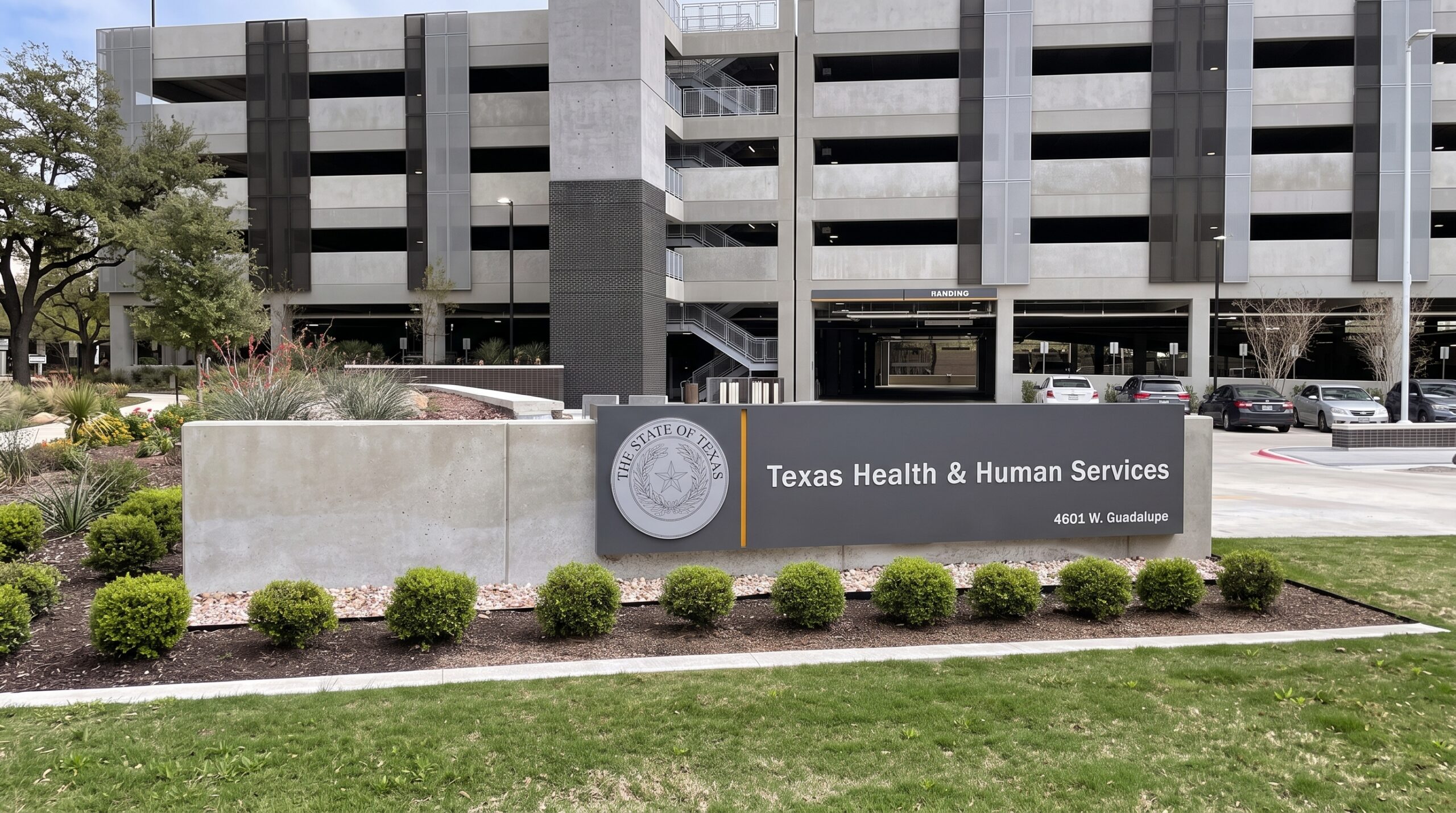
Texas health officials are proposing to delete the sentence that tells a family caring for a disabled relative at home exactly how little it may pay the worker who helps.
The Texas Health and Human Services Commission published five linked rule changes in the Aug. 28 issue of the Texas Register, the state’s official journal of agency actions. Together they repeal the rule setting a base wage for personal attendants and strike every cross-reference to it, including the line in the state’s home-care rules requiring that an attendant’s hourly rate “must be at least the base wage” the repealed section fixed.
Personal attendants are the workers who come to a home to help someone bathe, dress, eat, move around and take medication — the labor that keeps Texans on Medicaid in their own homes instead of a nursing facility. Many are hired directly by the family under an arrangement the state calls consumer directed services, in which the person receiving care, or a relative acting for them, is the legal employer and signs the paychecks.
The commission’s explanation is that the Legislature has already moved on. Budget Rider 23, it wrote, “revised the personal attendant wage by providing appropriations to support a new average attendant base wage,” and the old rule “became obsolete effective September 1, 2025.” What replaced a floor written into rule, in other words, is an average built into the formula the state uses to pay agencies — a target the state funds rather than a minimum any single worker can point to.
The commission’s fiscal note asserts there is no economic cost to anyone and no change in the number of people the rule affects. That claim is the one worth testing during the comment period, because the two arrangements do not do the same work. A wage floor in rule is a number a family employer must meet for each attendant. An average inside a payment methodology is a number the state aims at across a program.
The changes are: the repeal of 1 TAC §355.7051, “Base Wage for a Personal Attendant before September 1, 2025,” filed as TRD-202603393; the repeal of 1 TAC §354.1369, “Attendant Base Wage,” TRD-202603390; an amendment to 1 TAC §363.603, TRD-202603394; and amendments to 26 TAC §275.53 and 26 TAC §275.129, TRD-202603395 and TRD-202603396. All five were filed with the secretary of state on Aug. 11.
Comments are due Sept. 28. The commission may adopt the changes as early as Sept. 27. The commission has separately noticed all of 26 TAC Chapter 275 for the review state agencies must give their rules every four years, filed as TRD-202603453, so the surrounding home-care rules are open for comment at the same time.
The proposals land in a month when Texas Medicaid is already asking a great deal of the same families. Two health plans, Baylor Scott & White and FirstCare, leave the program Aug. 31, moving members in Lubbock and two multi-county service areas onto Wellpoint or Superior. Under a notice the state’s claims contractor issued Aug. 3, providers and the agencies that manage payroll for family employers must manually rebuild attendant authorizations under the new plan codes for any service delivered on or after Sept. 1. The same contractor is switching its electronic claims system that day, with mandatory testing for batch submitters closing Aug. 31.
The same Texas Register issue carries a separate and larger package from the commission rewriting the rules for Early Childhood Intervention, the program serving infants and toddlers with developmental delays. Eleven rulemakings, on the same Sept. 28 comment deadline, add deaf-blindness as an eligibility category and rewrite how much families are charged. The current sliding scale sets a family’s maximum charge by applying “a fixed percentage (ranging from 0.25 to 5 percent) to the mid-point income within each range.” That calculation method is struck. The scale’s existing reach — up to 1,000 percent of the federal poverty level — and the zero maximum charge for children in foster care both stay.
Anyone wanting the attendant wage rules left alone has until Sept. 28 to say so. After that, the floor comes out of the book.