
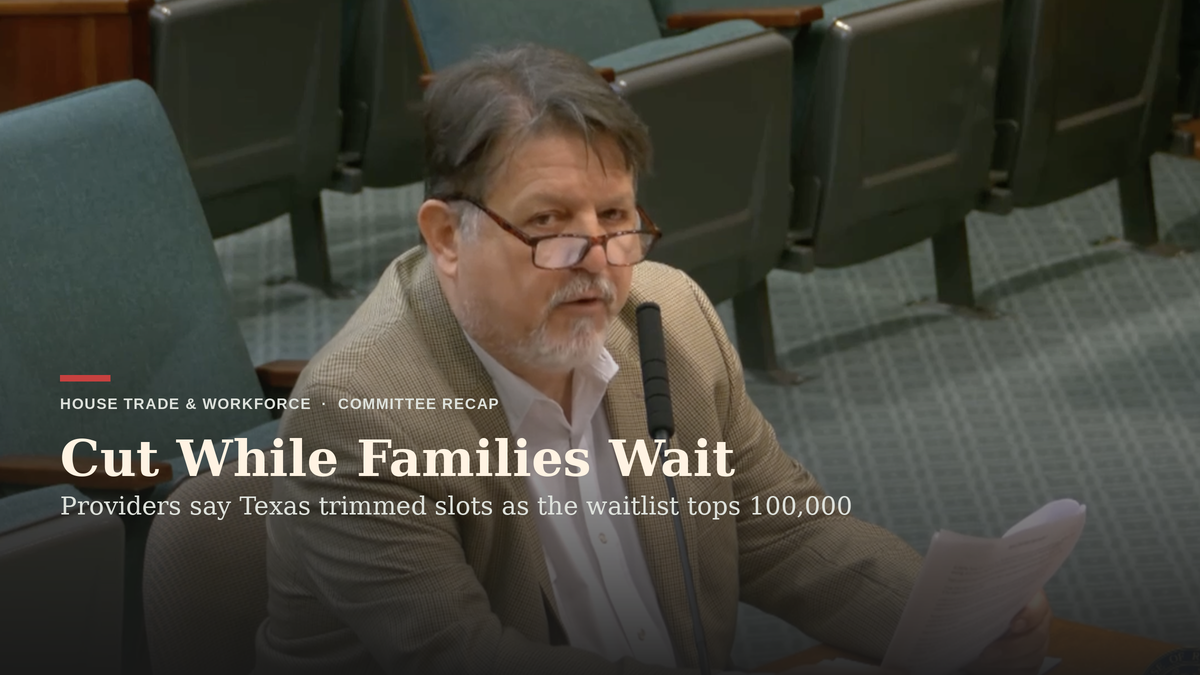
The Texas Workforce Commission spent the first hour of a House hearing Aug. 26 describing a child care program that serves 117,000 families. Two hours later, the man representing the state’s private providers told the same members the agency had just cut it.
“TWC last week announced a 9.5% reduction in the number of children served for 2020, the remainder of 2026, and all of 2027 through the Child Care Services Subsidy program,” said Tim Kaminsky, president of the Texas Licensed Child Care Association. “At a time when the waiting list already exceeds 100,000.”
No member put the reduction back to a workforce commission witness. The agency’s panel had been excused before the child care charge began.
The House Committee on Trade, Workforce & Economic Development gave child care access and workforce participation roughly 57 minutes of a three-hour, 54-minute interim hearing, the second-largest block on a five-charge agenda. Rep. Angie Chen Button, R–Garland, chaired. Testimony was invited only, and because this was an interim hearing the committee took no votes.
Kaminsky’s framing set the terms. “This child care is not simply a social service,” he said. “Child care is workforce infrastructure. We exist so parents can go to work.” He warned members against buying capacity the market already has. “Texas should not spend taxpayer dollars building government operated capacity, while existing small businesses have empty classrooms,” he said. “I actually have two empty classrooms in my building right now.”
Rep. Shelley Luther, R–Tom Bean, went after costs. “My question is about the unfunded mandates,” she said. “Can you give me an example of one that really bothers you? Number one, and does that also add to the liability insurance costs?” Kaminsky answered with his own bill. “Our liability insurance in the last two years has gone from $30,000 a year to $90,000 a year,” he said. “So overnight, $60,000 of revenue out the door without necessarily having that revenue coming in the door.” Only two carriers remain in the Texas child care liability market, he said, and no agency will own the problem: “We have looked at multiple state agencies trying to get this addressed. And everybody kind of passes the buck. It’s not a TWC issue. It’s not a t issue. It’s not health and Human services.”
He also described public schools taking private-pay children. One operator, he said, “in one week they lost 65 students to the public school system because the school system had just announced that they had additional open spaces. As a small business, you can’t recover that income.” Kaminsky traced the pressure to House Bill 3, the 2019 full-day pre-K law, layered on 2001-era authority letting districts enroll tuition-paying four-year-olds.
Wendy Uptain, executive director of Early Matters Texas, put a price on the gap for families. Texans are “paying an average of $14,000 a year for one kid, double that with two or more,” she said. “That’s more than tuition at UT.” Her diagnosis was structural: “There are eight different state agencies that are touching child care. There’s not one clear owner. So when there’s not one clear entity with accountability or responsibility, there’s therefore no visibility to understand where the resources are going.”
Employers testified that the arithmetic works when someone pays for it. Roseanne Garza of Kerbey Lane Cafe said the Austin restaurant group’s churn has collapsed since it began helping with care costs. “Our turnover, which reached approximately 300% in 2020, has fallen dramatically,” she said. “Today it is at 78%, which is roughly half of the industry norm.” Her ask was for partners: “Employers cannot solve the childcare challenge alone, but we can be partners in solving it.”
Michael Wood, vice president of education and workforce for the Dallas Regional Chamber, named a model. Michigan’s program “splits child care costs evenly between the employee, the employer and the state government,” he said, and the chamber “has previously supported legislative efforts to create a similar model in the state of Texas.”
Charles Miller of Texas 2036, whose organization published a state-of-child-care report the Dispatch covered earlier this year, argued Texas is regulating quality without admitting it. The state has “what might be regarded as quality measures that are hidden in what are termed safety licensing standards,” he said, adding that the fix is not a program. “This really is a governance issue. We need a unified governance.”
That is the question House Bill 4903 was written to answer. The 2025 law created the Quad-Agency Child Care Initiative, pulling the workforce commission, the health commission, the child protective agency and the Texas Education Agency into one forum; the Dispatch covered its first review of pre-K partnership data this month. Its commission next meets Nov. 19. A separate governor’s task force on early childhood education owes a report Dec. 1.
The sharpest exchange of the day came late, when Rep. Thresa “Terry” Meza, D–Irving, objected to how the education agency labels poor children. “The free or reduced lunch isn’t a matter of education. It’s economics,” Meza said. TEA associate commissioner Monica Martinez did not move: “That is the term that is used in the state statute.” Meza let it go. “And trying to be argumentative with you,” she said. “I just don’t see that.”
Chair Button had signaled early that she wanted the subsidy math on the record. Citing a newspaper report published the day before the hearing, she told the workforce commission that Texas is asking Dallas County to serve “1604 fewer children per day” and demanded “an official analysis.” As of the hearing’s close, the committee had not received one.
Also heard
The committee’s longest block, about 64 minutes, was agency oversight, with the Division of Workers’ Compensation reporting 335 carriers writing roughly $2.5 billion in premium and rates down about a third in five years, and the Economic Development and Tourism Office reporting $842 million in Texas Enterprise Fund grants across 225 projects since 2003. Roughly 54 minutes went to supply chain resilience and economic security. The final hour monitored three 2025 laws: House Bill 2963, the consumer right-to-repair law taking effect Sept. 1, and Senate Bill 1333, where a constables’ association told members a survey of 178 offices found 232 squatter complaints and no arrests under the criminal fraud provisions lawmakers passed alongside the removal process.
Fact box
Issue
Interim charge on child care access and workforce participation — cost, quality and coordination of early childhood systems and their effect on labor force attachment, employee retention and employer productivity (approx. 57 minutes, about 24.5 percent of the hearing; second-longest of five charges)
What happened
The state’s licensed provider association told members the Texas Workforce Commission had announced a 9.5 percent cut in children served through the child care subsidy for the rest of 2026 and all of 2027, with a waiting list above 100,000; providers described liability insurance tripling and public schools drawing away private-pay children; employers and business groups asked for a shared-cost model; three witnesses independently called Texas child care a governance problem spread across eight agencies; no vote (interim hearing)
When
Wednesday, Aug. 26, 2026, 10:00 AM CT · run time 3:53:43WhereRoom E2.014, Capitol Extension, Austin
Chair
Rep. Angie Chen Button, R–Garland (HD-112); Vice Chair Rep. James Talarico, D–Austin (HD-50)
Key witnesses
Tim Kaminsky (Texas Licensed Child Care Association); Wendy Uptain (Early Matters Texas); Roseanne Garza (Kerbey Lane Cafe); Michael Wood (Dallas Regional Chamber); Charles Miller (Texas 2036); Joe Esparza (Texas Workforce Commission); Monica Martinez (Texas Education Agency)
Archived video
house.texas.gov video 22754