
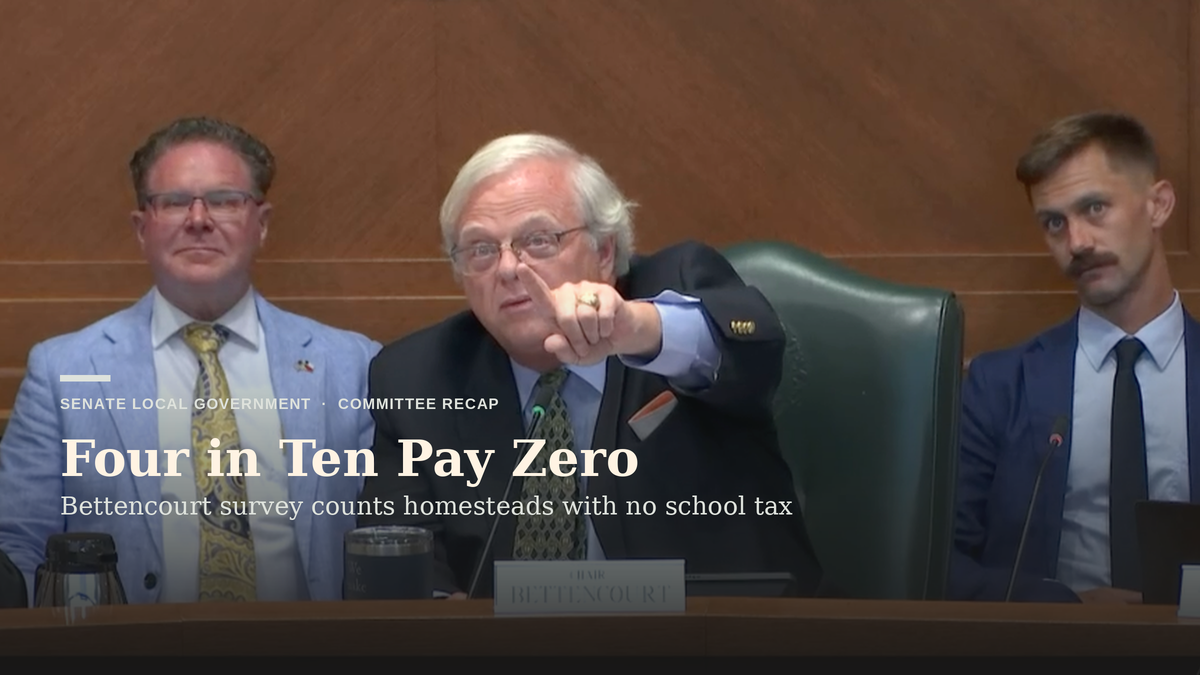
The state has never published how many Texas homeowners pay nothing in school property tax. On Sept. 1 the senator who wrote most of the exemption laws produced a number of his own: 39.23 percent of all homesteads, and 61 percent of homeowners 65 and older or disabled.
“It took us about four months to put this data together,” said Sen. Paul Bettencourt, R–Houston, chairman of the Senate Committee on Local Government. “Never has there been a comprehensive data survey of all 254 counties… I did it because I was tired of everyone having an opinion without fact.”
The hearing, the first of two the committee held this week, took invited testimony on an interim charge asking what a decade of exemption increases — from $15,000 in 2015 to $140,000 under Senate Bill 4, and to $200,000 for seniors under Senate Bill 23 — has done to school tax bills. Because this was an interim hearing, the committee took no votes. The Texas Dispatch reported in July that appraised values cooled as the larger exemptions reached tax bills.
Bettencourt’s figures came county by county. Of “2.384 million” over-65 and disabled homesteads, “almost 61% pay zero on their property tax bills,” he said, and “these 1.449 million homeowners or homesteads will never go back above zero for their lifetime.” Among general homesteads, “25% of all general homesteads don’t pay,” and combining the two, “the astonishing figure is that 39.23%, nearly four out of ten homesteads in the state pay zero.” Counties where half or more of senior homeowners pay nothing number “234. That’s 92% of all Texas counties.” Harris County’s share “went from 14% to 38%”; Ector County went from 28 percent to 85 percent “just because of that last bill.”
The average school bill for a homestead that still pays, he said, fell “from $1,037” in 2024 “all the way to $896.” Of the $51 billion the state has spent, “38 billion of it is for rate compression, only, 13 for homestead exemption.”
Sen. Molly Cook, D–Houston, the committee’s newest member, opened with the counterargument. “Texans are interested in true relief, not chasing a press release, not creating campaign soundbites,” she said. “We’ve put a shocking $51 billion behind that promise. And what do we have to show for it?” She called the exemptions “a permanent obligation to our tax rolls, funded by a temporary budget surplus,” which “is just a structural deficit on layaway.” Her district, she said, is majority renters: “Our renter majority district gets $0 from every tax cut plan.” Later she asked whether there is “not a diminishing returns… by just continuing to increase the homestead exemption.”
Vice Chair Bryan Hughes, R–Mineola, read the numbers the other way. A superintendent had told him that “if they triple the homestead exemption, nobody in my district will pay property taxes,” Hughes said. “He was kind of half joking, but who’d have thought we could be approaching that?… We are on the path to getting homeowners out of school property taxes.”
Bettencourt rejected the alternative some conservatives favor. “The last discussion we had with the comptroller testifying was 24.75% sales tax to replace… all property taxes in the state,” he said. “And that would crush the working class in the middle class.” A Rice University economist, he said, “just revised that figure up… 26% now.”
Local officials described the relief landing. Kristen Blahnik, Brazoria County tax assessor-collector, said her office fielded calls from residents “questioning the accuracy of their tax bills. And did they really actually owe zero… Seeing the relief and even sometimes tears.” In Brazoria County, 20 percent of homesteads and 61 percent of senior and disabled homesteads received a $0 school bill for 2025. Rich Sena, a Boerne ISD trustee testifying for the Texas Association of School Boards, said an 82-year-old retired educator’s school bill had “gone from a tax bill school of $2,310 to zero… saving $200 a month is a lot of money.”
Tarrant County’s 2024 reappraisal freeze, which The Texas Dispatch has reported overvalued roughly 190,000 homes, drew the sharpest exchange. Chandler Crouch, a Fort Worth broker who said he has filed 46,000 free protests, testified that homes priced from $100,000 to $199,000 were taxed at “105% of what the real world value was,” while homes over $1 million were taxed at “about 71%.” Hughes called it “a perverse result where those folks on the lower ends of the economic ladder… were the ones that suffered the most.” Crouch agreed: “That’s the definition of a regressive situation.” Bettencourt said the episode was “proof positive that freezes don’t work… Somebody pays the bill. The bill always comes due.”
Shannon Halbrook of Every Texan urged restraint. “We’ve had $33 billion worth of cake sitting in the fridge,” she said. “We know now that that’s pretty much gone.” She said a flat homestead exemption “has the flattest incidence and it’s the most equitable,” while “50% of the benefits of an appraisal cap go to the highest quintile.” James Quintero of the Texas Public Policy Foundation cited a June poll in which 84 percent called property taxes a major burden, “the highest that we’ve ever received.”
Sen. Royce West, D–Dallas, closed the charge by directing TPPF and Every Texan to produce a joint proposal for renters. Bettencourt said the committee would test TPPF’s tax model against the 2025 bills. The 90th Legislature convenes in January 2027.
The committee gave its final 100 minutes to appraisal district budgets, where chief appraisers from Harris and Travis counties reported that protests have nearly doubled, lawsuits removed $90 billion from the 2024 rolls and the new board elections cost Harris County’s district $7.5 million. Realtors and homebuilders also testified on homeownership costs, and the committee recessed until 9 a.m. the following morning for a second hearing on 2025 housing laws.
Fact box
- Issue
- Interim charge 1 — examining the effect of increasing the homestead exemption (approx. 2 hours 39 minutes, about 60 percent of the hearing; longest charge)
- What happened
- Chair Bettencourt released a 254-county survey finding 39.23 percent of all homesteads and 61 percent of senior and disabled homesteads pay no school property tax; Sen. Cook called the $51 billion program a structural deficit that leaves renters with nothing; Vice Chair Hughes said the state is on a path to remove homeowners from school taxes; witnesses testified the Tarrant reappraisal freeze taxed low-value homes at 105 percent of market value; Every Texan urged the committee to stop raising the exemption; no vote (interim hearing)
- When
- Tuesday, Sept. 1, 2026, 1:00 PM CT · run time approx. 4:24:28, no recess
- Where
- Room E1.016 (Hearing Room), Capitol Extension, Austin
- Chair
- Sen. Paul Bettencourt, R–Houston (SD-7); Vice Chair Sen. Bryan Hughes, R–Mineola (SD-1)
- Key witnesses
- Kristen Blahnik (Brazoria County tax assessor-collector); Rich Sena (Boerne ISD / TASB); Chandler Crouch (Tarrant County broker); Shannon Halbrook (Every Texan); James Quintero (Texas Public Policy Foundation); John Crow (Texas Realtors); J.D. Hale (Texas Association of Builders)
- Archived video
- senate.texas.gov video 22697