
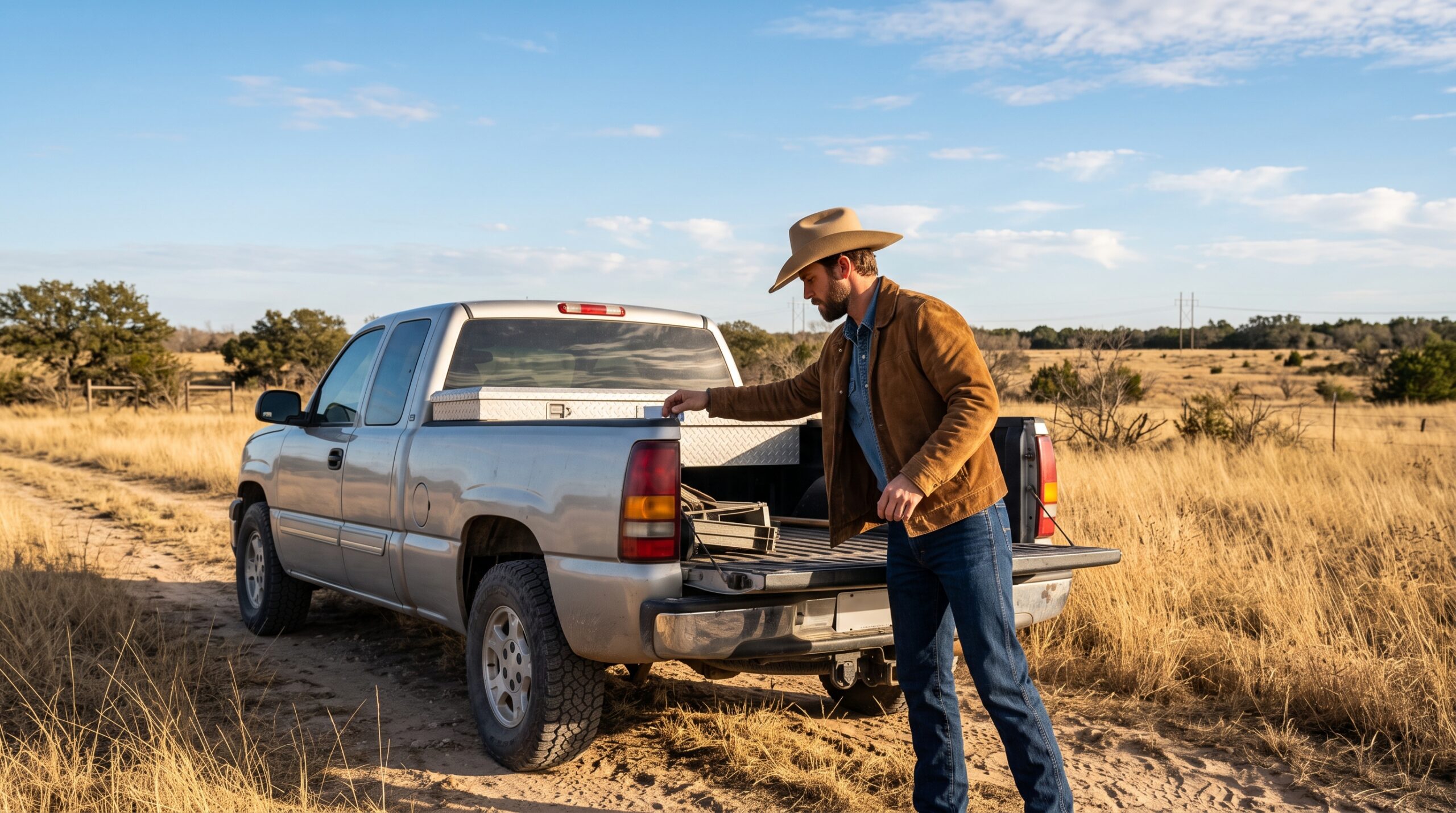
Every Texan pays the same 20 cents a gallon in state gas tax, but a ranch family running two pickups can pay more than twice what a city household does, a long-distance commuter nearly three times, and a home health aide driving between clients gives up a larger slice of a small paycheck, a Texas Dispatch analysis of federal travel, fuel-economy and wage data shows.
The tax looks perfectly even. It is 20 cents on every gallon, whoever buys it and wherever they buy it, and it has not changed since 1991. For the average Texas household, the Dispatch calculated that comes to about $242 a year. But few households are average. How much a family pays depends on how far it drives, what it drives and how much it earns, and on all three counts the tax lands hardest on Texans with the fewest alternatives.
Rural Texans drive farther. About 16 percent of Texans live in rural areas, according to 2020 Census figures compiled by the comptroller, yet 27 percent of all vehicle miles driven in the state are on rural roads, according to Federal Highway Administration data for 2024. Nationally, rural households drive about 24,500 miles a year, roughly 50 percent more than urban households, and spend 20 percent of their budgets on transportation against 13 percent for urban households, according to the highway administration’s analysis of the 2017 National Household Travel Survey, the most recent survey with a comparable rural figure. Almost 90 percent of rural trips are by car, and fewer than 3 percent of rural households use public transit.
At the average fuel economy of the light-duty fleet, those extra miles mean a rural household pays about $209 a year in state gas tax, compared with about $139 for an urban household. Rural Texans also tend to drive pickups, and at pickup fuel economy the rural household’s bill is closer to $264.
Location changes the pump price, too. On Oct. 15, regular gasoline averaged $4.33 a gallon in El Paso and $3.93 or more in Lubbock, Amarillo, San Antonio and Killeen-Temple, compared with $3.69 in Corpus Christi and $3.71 in Dallas and Fort Worth, according to AAA Texas. The tax is the same 20 cents everywhere. The bill around it is not.
Some Texans drive for a living. Texas has about 330,000 home health and personal care aides, and their median pay is $11.65 an hour, or about $24,230 a year, according to the Bureau of Labor Statistics’ May 2025 state estimates. Many drive their own cars from one client’s home to the next. Nationally, 59 percent of home care workers rely on some form of public assistance, according to PHI, a research and advocacy group for the direct-care workforce.
Consider an aide who drives 15,000 miles a year in a sedan, an illustration built from federal averages rather than a real person. That is about 586 gallons. The state gas tax on that fuel is about $117, roughly half a percent of her pay. But her whole gas bill at the Oct. 15 price is about $2,250, or about 9 percent of her income, and about $690 more than a year ago. The federal government acknowledged the squeeze in July, when the IRS raised its standard business mileage rate in the middle of the year, from 72.5 cents to 76 cents a mile, citing higher fuel prices. Whether an aide is reimbursed at anything like that rate depends on her employer.
Lower-income families give up a bigger share. A flat per-gallon tax takes the same dollars from a $30,000 household and a $300,000 household that buy the same gas; as a share of income, it is 10 times heavier on the first. Bank of America Institute data from March 2026, drawn from its own customers’ accounts, show lower-income households spent 4.2 percent of their income on gasoline, up from 3.9 percent a year earlier, while higher-income households spent 2.7 percent. About one in 10 lower-income households spent more than 10 percent of income on gas.
That fits a broader pattern. The Institute on Taxation and Economic Policy, a research group that favors progressive taxation, ranks the Texas tax system the seventh most regressive in the country. By its figures, the lowest-earning fifth of Texans pay 12.8 percent of their income in state and local taxes, and 8.1 percent in sales and excise taxes alone, the category that includes the gas tax. The top 1 percent pay 4.6 percent overall and 1.5 percent in sales and excise taxes.
Even Texans who do not drive pay. The state taxes diesel at the same 20 cents, and diesel moves groceries, building materials and retail goods. Spread across households, the diesel tax works out to about $112 a year, built into prices, by the Dispatch’s calculation from federal fuel and Census household data. Diesel averaged $5.80 a gallon in Texas on Oct. 15, up $2.64 from a year earlier, according to AAA.
The averages hide how widely the same tax can land. Using federal fuel-economy figures and the Oct. 15 AAA price, the Dispatch built five illustrations. An urban household driving about 16,300 miles pays about $139 in state gas tax and about $2,670 for gas, up about $820 from a year ago. The home health aide pays $117 in tax on a $2,250 bill. A rural household driving 24,500 miles in pickups pays about $264 in tax on a bill of about $5,070, up about $1,560. A ranch family putting 30,000 miles on two pickups pays about $324 in tax on about $6,220 in gas, up about $1,910. A long-distance commuter driving 60 miles each way in a pickup, about 35,000 miles a year, pays about $378 in tax on roughly $7,250 in fuel, up about $2,230. These are illustrations built from averages, not real households.
The 20-cent rate was set in 1991. Only the Legislature can change or pause it, and lawmakers return in January 2027. The tax pays for state roads and public schools, so any change raises the question of how to replace that money, roughly $300 million a month by the Dispatch’s earlier estimate. This year’s prices raise a second question: whether a flat tax that lands hardest on rural, working and lower-income Texans should work the same way in every kind of year.