
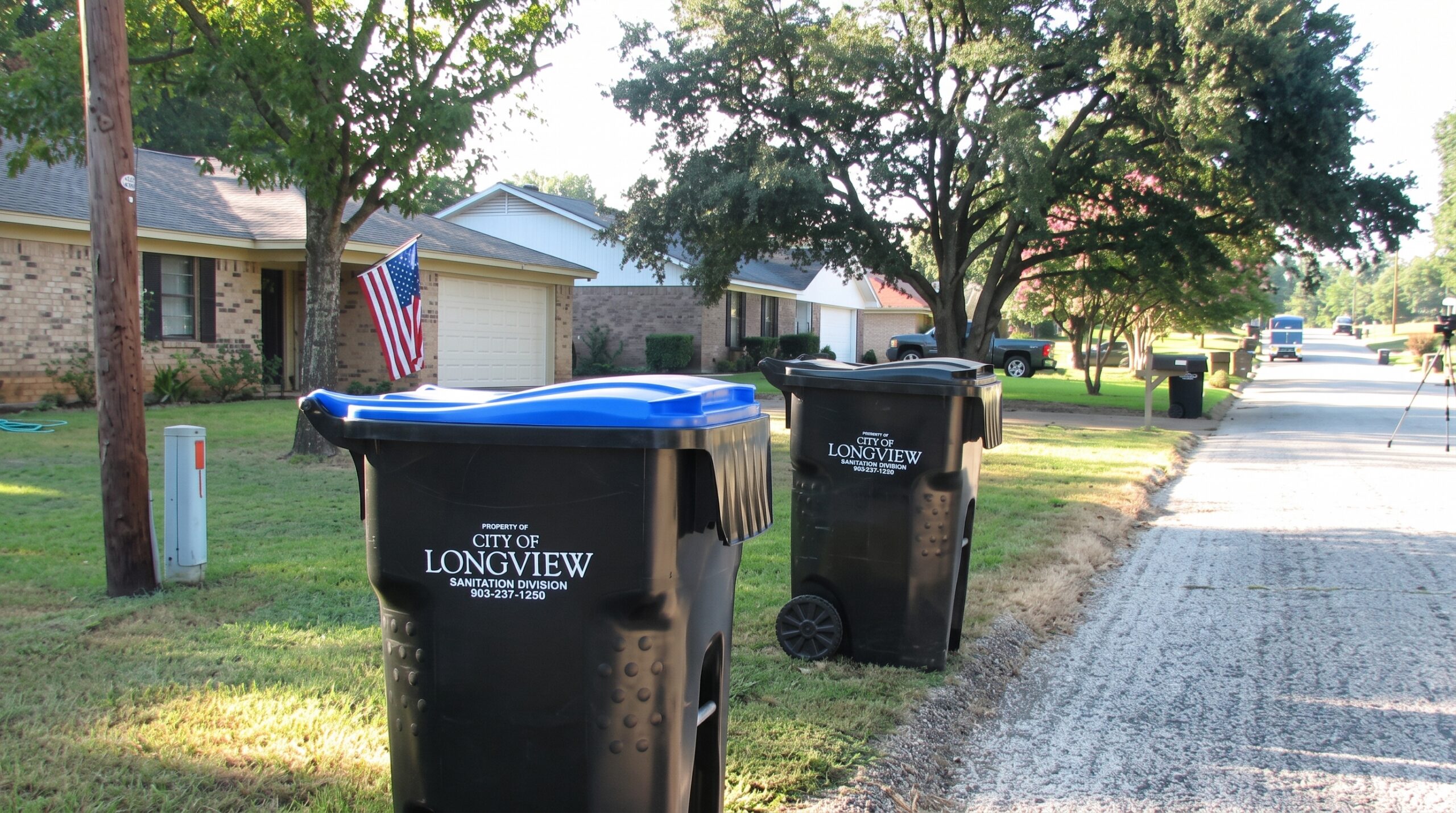
Longview picked up recycling from half its households before a 2024 fire destroyed the plant that took the material. It now picks up from about one in eight. On Aug. 27 the city council took up whether to keep picking up at all, and its own proposed budget for the coming year points in two directions at once.
The council put the question on its agenda as Discussion Item B, “Discussion of the City of Longview’s curbside recycling program,” raised by Mayor Kristen Ishihara. ]
“Fifty percent of the people were participating; now we’re probably at about 12 percent,” Assistant Public Works Director Dwayne Archer told KETK after the meeting, adding: “There’s room to improve. There’s room for us to get back to those numbers we were seeing before.” City Manager Rolin McPhee had told the council in an earlier briefing that the city collected 300 tons of recycling a month at the program’s peak, and that the material coming in now, though far less of it, is “very clean,” according to an account published Aug. 7 by the Longview News-Journal.
What the program costs depends on which document is open. McPhee gave the council a figure of about $193,000 a year. District 5 Councilmember Jody Berryhill described it publicly as “a quarter million dollars that we’re spending, and people are not taking advantage of it.” The city’s own line-item budget for the coming year shows a recycling request of $248,900, plus $1,100 for a glass fuel surcharge, reduced by a $90,000 adjustment to a net line of $160,000. Landfill costs in the same sanitation fund run $1,050,000 — more than six times the recycling line.
The same budget also proposes spending more on recycling, not less. Of the $20,000 the sanitation department has budgeted for advertising, $12,000 is a new line labeled “Increased public engagement on recycling.” The city is proposing to pay to talk residents back into a program some council members want to end.
Longview used to send its recyclables to Rivers Recycling near Kilgore for more than a decade until the plant burned in 2024 and its owners chose not to rebuild. The city suspended collection for about a year, then restarted in the spring of 2025 with the material going to the new Northeast Texas Regional Materials Recovery Facility in Kilgore. The restart came with a narrower list: the new plant accepts plastics numbered 1, 2 and 5 rather than 1 through 7, though McPhee told the council that 90 percent of household recyclables fall into those three categories. “Restarting the program created a disposal mindset,” he said.
Todd Lucas, who owns the Kilgore plant, argued against cancellation. “I think what is important to know is that Longview used to be the largest single city of curbside recycling in this market,” he said. McPhee has told the council that Longview remains the facility’s largest customer. District 6 Councilman Sidney Allen said Lucas “has spent money on new equipment and has investors he has to consider,” and added: “We need to pick up the recycling volume.”
The market has not helped. Baled beverage bottles made of the clear plastic known as PET averaged 2.63 cents a pound nationally in August, down from 3.20 cents a month earlier and 5.75 cents a year ago, according to the monthly index published by the trade journal Resource Recycling — figures the Dispatch reported in August. Aluminum beverage cans held steady at 93.75 cents a pound. The most valuable thing in a Longview blue cart is worth roughly 36 times, by weight, the thing there is most of.
Residents pay for trash and recycling as a single charge. The city’s proposed fee schedule raises the residential rate 46 cents a month, from $19.36 to $19.82, and lists no separate recycling fee at all.
The decision returns in September, on a calendar that is tighter than it looks. The council meets Sept. 10 and Sept. 24; a special meeting on Sept. 17 adopts the budget, and a second special meeting the morning of Sept. 18 sets the tax rate. As of Sept. 1 the city had posted no September agenda carrying the recycling item, and had posted no minutes for the Aug. 27 meeting. “I feel like the public’s response we’re getting now is they don’t care enough about the recycling program to continue it,” Ishihara said. “That’s the message we’re receiving.”