
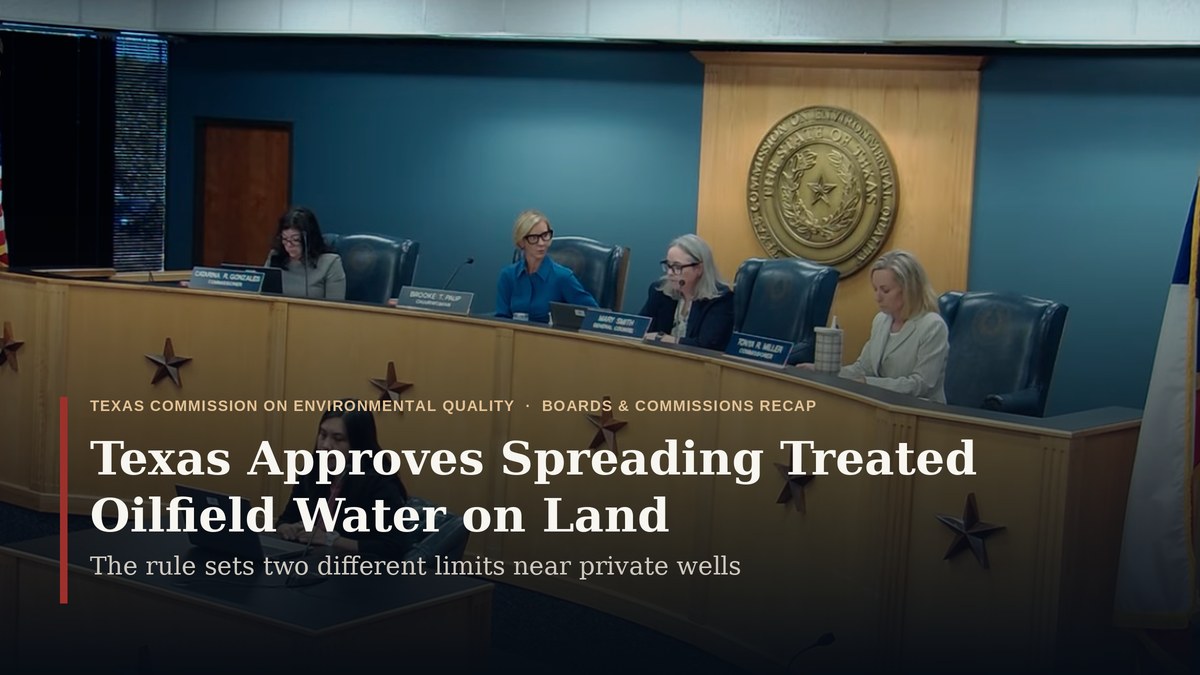
Treated oilfield wastewater can be spread across Texas farmland under rules the state’s environmental regulators adopted Nov. 4 — and on the question a neighbor is most likely to ask, how close it may come to a drinking water well, the rule gives two answers that do not match.
Produced water is what comes back up an oil or gas well along with the hydrocarbons: brine, drilling chemicals and, depending on the formation, metals and naturally occurring radioactive material. The Permian Basin makes it faster than the industry can inject it back underground, and the Sierra Club’s Lone Star Chapter puts the volume there at 20 to 25 million barrels a day, up to a billion gallons. Disposal by injection has been tied to earthquakes in the basin, and a state desperate for new supply has spent two legislative sessions looking for somewhere else to put the water.
The Texas Commission on Environmental Quality now decides where it may go. One paragraph of the siting section it adopted requires that land irrigated with treated wastewater sit “a minimum horizontal distance of 150 feet from a private water well.” The lead-in to the same subsection, a few lines above, sets the distance at “nor 250 feet from a private water well”. Staff asked the commissioners to adopt that section “without changes to the proposed text”, and they did, unanimously. The discrepancy was in the May draft, as The Texas Dispatch reported when the rules were proposed, and it survived the vote intact.
Most of what a permit holder must do is not new. The commission took the chapter it had written for sewage plants and industrial wastewater and extended it to oilfield water: map the wells within half a mile, sample the groundwater before operating, test the soil at least once a year, keep nitrogen within what the crop can take up. The one genuinely new requirement is a buffer of “a minimum horizontal distance of 100 feet from a water in the state” — a term that reaches creeks, rivers, lakes and the groundwater beneath them.
That is the part landowners will feel. A rancher who leases acreage to a disposal operator, a neighbor downhill on a private well, a farmer whose hay goes to cattle: none of them gets a say under this rule beyond a comment period that closed in June. The agency logged 617 written and oral comments and staff told the commissioners the response was mixed, with some offering general support and others raising “potential impacts to water quality including groundwater, human health and the environment”.
Among those objections was one the adopted text does not answer. Writing during the comment period, the Sierra Club’s Lone Star Chapter noted that the proposal “would also allow treated produced water to be applied as close as 100 feet from surface waters and 150 feet from private water wells” and asked the agency to explain how it had arrived at those distances and why they were enough. On the rulemaking as a whole the chapter was blunter:
“Until those gaps are addressed and safety can be demonstrated, TCEQ should not move forward with these rules.”
That was June, and it was comment on the proposal rather than a response to what passed. Nothing has been said on the record about the rule as adopted; the vote is a day old.
The commissioners made their own case for moving. Chairwoman Brooke T. Paup called the rulemaking “an essential step to putting this important program in effect”. Commissioner Tonya R. Miller said the program is “being watched closely by the entire country” and framed it as supply rather than disposal:
“It’s an opportunity for Texas to utilize a new water resource that’s much needed.”
She is describing a real problem. The state created a research consortium in 2021 to work out whether treatment can make produced water safe to use outside the oilfield, and its most recent report, published in April, did not find that it can yet. What the commissioners did not settle Nov. 4 is where their authority stops and the oil and gas regulator’s begins. The two agencies are still drawing that line in a separate rulemaking staff described as “currently in progress”, with no completion date offered — the same boundary they asked senators to help clarify in August.
The amendments take effect once they are filed with the secretary of state, a date nobody stated at the meeting. Before that happens, the agency has one question left to answer for anyone living near a field that may soon be irrigated with this water: 150 feet, or 250.
A senator and a representative denied a hearing. On a petition to create a municipal utility district across Kaufman and Van Zandt counties, the commissioners denied hearing requests from Sen. Bob Hall and Rep. Keith Bell, finding that neither had identified a personal justiciable interest — a stake of their own, distinct from the public’s. Van Zandt County’s request was denied too, and the district was created with road powers. Then the opposite result, 2-1. Minutes later, on a Williamson County district, the commissioners granted that county a contested-case hearing. Commissioner Catarina R. Gonzales dissented and was asked to confirm her vote for the record, arguing that delay drives up the price of a house: a $1,000 increase, she said, prices an additional 14,365 Texas households out of new housing. Penalties. The commissioners approved 47 enforcement orders carrying $3,292,288 in assessed administrative penalties, with $311,169 deferred.