
The Texas Legislature last overrode a governor’s veto in 1979, which makes the veto the most durable power a governor holds alone. Most of Governor-elect Gina Hinojosa’s stated agenda runs the other way: it needs bills. Three items need two-thirds votes that no party will hold in either chamber in January: a $1,500 payment to every household from the Rainy Day Fund, confirmation of a new education commissioner and an end to residential property taxes.
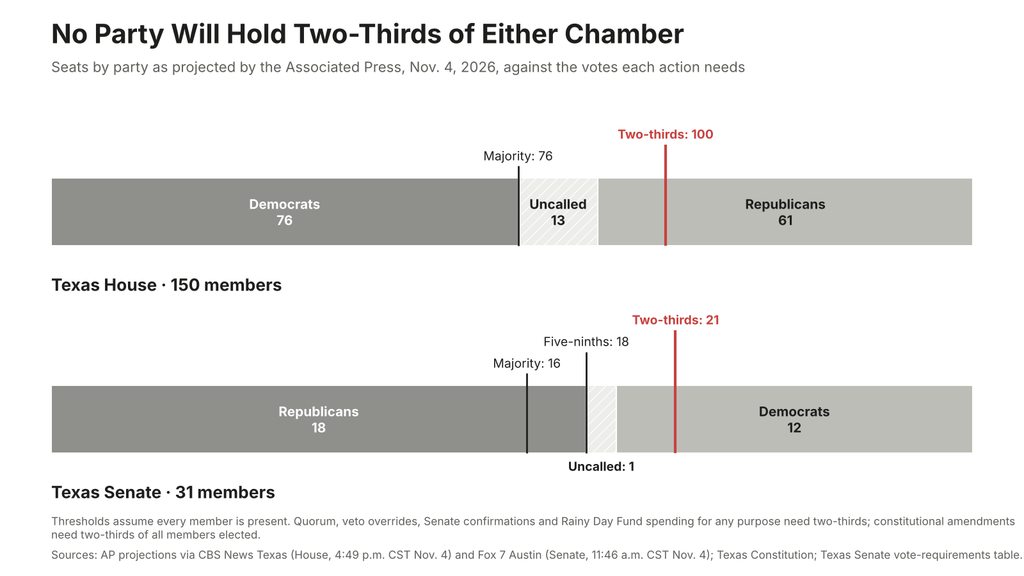
Results below are unofficial, as reported through the morning of Nov. 5. The Associated Press called control of the Texas House for Democrats; AP projections showed 76 Democratic seats, 61 Republican and 13 uncalled, CBS News Texas reported, with Democrats leading in seven of the uncalled races, which the Texas Tribune said could produce an 83–67 majority pending recounts and late ballots. The AP called the Senate’s last open race, District 2, for Republican incumbent Bob Hall on Wednesday afternoon, fixing the Republican majority at 19 to 12. The 90th Legislature convenes Jan. 12, according to the Texas Legislative Council, and the governor is installed the first Tuesday after it organizes, under Article IV, Section 4, which Fox 4 reported will be Jan. 19.
Neither chamber will be at full strength that day. Two senators, Nathan Johnson and Sarah Eckhardt, and three House members, Hinojosa, Lt. Gov.-elect Vikki Goodwin and U.S. Sen.-elect James Talarico, all Democrats, leave for other offices, and their seats stay empty until special elections. A Senate of 29 would put two-thirds of those present at 20, one more than Republicans hold. The arithmetic below assumes full chambers; the vacancies change the margins, not the thresholds.
What the governor does alone
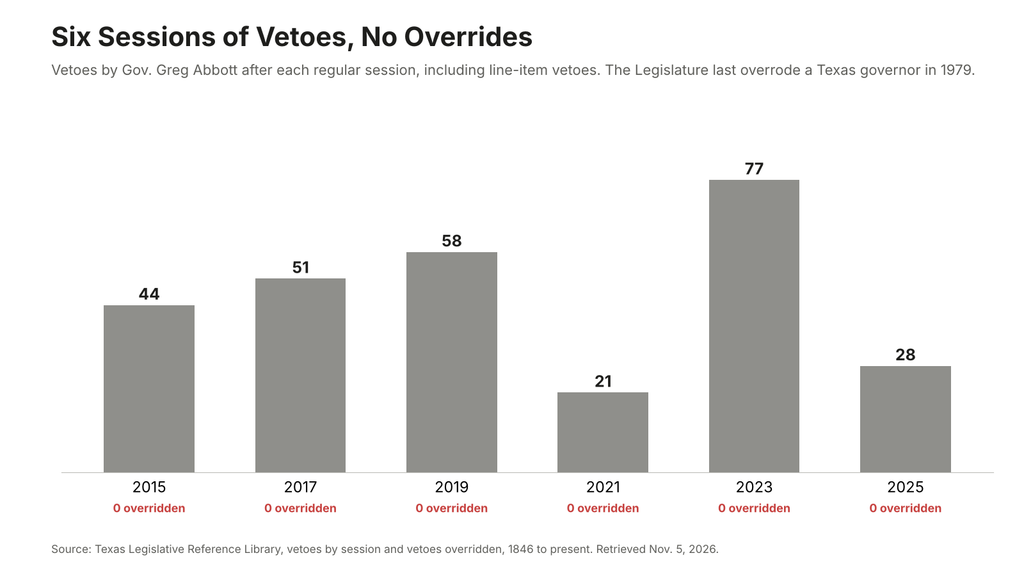
Vetoes. The governor has 10 days, Sundays excepted, to act on a bill while lawmakers are in session. For bills that arrive at the end, the governor has 20 days after adjournment to file a veto with the secretary of state, under Article IV, Section 14. An override takes two-thirds of each house, and a veto issued after lawmakers go home cannot be overridden because no session exists to vote, the Texas Tribune has reported. A 2025 amendment to create a veto session passed the Senate 31-0 but never reached voters, according to Ballotpedia. On spending bills the governor can strike individual items. Gov. Greg Abbott issued 28 vetoes after the 2025 regular session and 77 after 2023, counting line items, according to the Legislative Reference Library. The last override, in 1979, reversed Gov. Bill Clements’ veto of a bill on Comal County’s approval of hunting and fishing rules.
Special sessions. Only the governor can call one. Lawmakers may pass laws only on subjects the governor designates, and a session lasts no more than 30 days, under Article IV, Section 8 and Article III, Section 40.
Emergency items. The first 30 days of a regular session are for introducing bills. “Emergency matters” the governor submits by message are the main exception, under Article III, Section 5.
Directives and disaster powers. Abbott’s Aug. 3 letter told the Public Utility Commission and ERCOT, the grid operator, to audit data centers in the connection queue “before any additional data centers are approved to move forward.” A Sept. 21 letter told the state environmental agency to pause data-center permits. Neither letter names a statute granting the power to order the pause, and lawyers at DLA Piper have noted open questions about its scope and duration. A successor can keep, widen or withdraw such directives on the same footing. Senate and House leaders have assigned committees to study data centers before the session, the Dispatch reported Oct. 27.
Disaster declarations lapse after 30 days unless the governor renews them, under Government Code Section 418.014. During one, the governor may suspend procedural statutes that would delay disaster response, under Section 418.016. Emergency powers let Abbott “award no-bid contracts at times of emergency,” the Texas Tribune reported. Letting declarations lapse takes no one else’s vote.
What a simple majority decides
The House elects its speaker by majority. In 2025 that took 76 votes, the Tribune reported. Under the 2025 House rules, the speaker names every committee chair, fills at least half of each policy committee’s remaining seats (seniority fills the rest) and refers every bill to committee, subject to correction by a House majority. A rule added in 2025 requires the speaker to name every chair from the majority party and bars naming vice chairs from it.
The lieutenant governor presides over the Senate and votes only to break ties, under Article IV, Section 16. The office’s other powers come from Senate rules, which each chamber writes for itself under Article III, Section 11. Those rules let the lieutenant governor appoint the standing committees. The Senate readopted its rules 31-0 in January 2025 through Senate Resolution 2. The Senate’s own vote table lists a majority of the membership, 16 senators, to amend a rule. Bringing a bill up out of calendar order, the usual route to the floor, takes five-ninths of senators present: 18 if all 31 attend. It was three-fifths before 2021.
Ordinary laws also need only majorities in each house plus the governor’s signature. That covers repealing the data-center sales tax exemption in Tax Code Section 151.359, which will cost an estimated $3.2 billion over two years, the Tribune reported from comptroller figures. It covers rewriting the education savings account program the comptroller runs under Senate Bill 2, which had made 101,600 awards by Aug. 13. And it covers appropriating the state share of Medicaid expansion; no money leaves the treasury without an appropriation, under Article VIII, Section 6.
What takes two-thirds or more
Quorum: two-thirds of each house, or 100 House members and 21 senators, under Article III, Section 10. After House members broke quorum in 2025, the House adopted daily fines for such absences in House Resolution 128.
Confirmations: two-thirds of senators present, under Article IV, Section 12.
Immediate effect: laws take effect 90 days after adjournment unless two-thirds of all members elected vote otherwise, under Article III, Section 39.
Constitutional amendments: two-thirds of all members elected to each house, then a majority of voters, under Article XVII, Section 1. The governor has no veto over them.
Rainy Day Fund: three-fifths of members present to cover a certified shortfall, and two-thirds “at any time and for any purpose,” under Article III, Section 49-g.
S
pending beyond the revenue estimate: an emergency and four-fifths of each chamber’s total membership, under Article III, Section 49a.
The priorities, by path
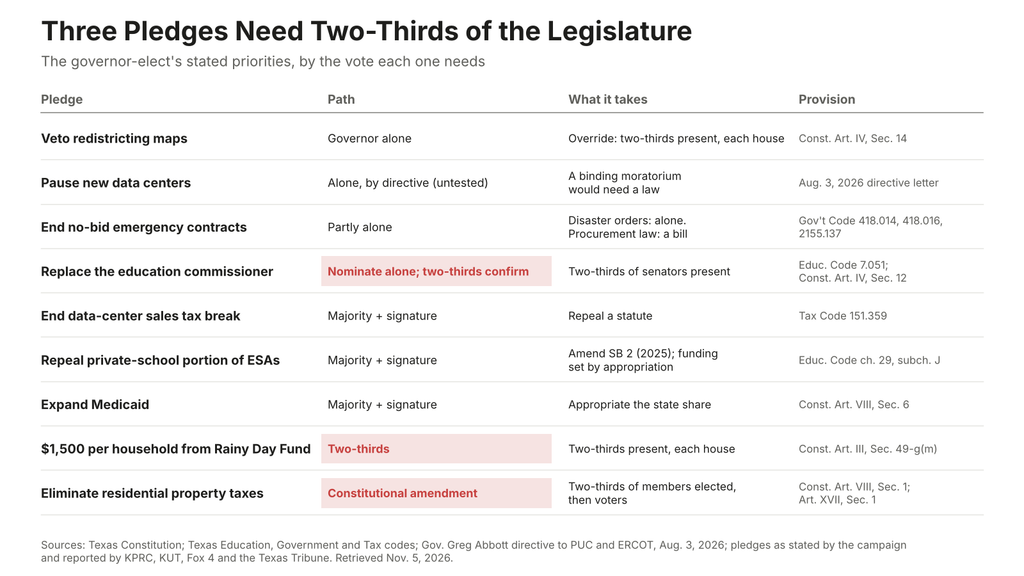
The $1,500 payment. The campaign put the cost at $17 billion, leaving about $10 billion in reserve, the Tribune reported. The comptroller projects the fund at $28.48 billion by August 2027, and the fund is above its cap, as the Dispatch reported in September. The comptroller’s October 2025 estimate projected a $4.66 billion ending balance for the current budget, not a shortfall. Unless the January estimate shows a shortfall, the payment needs the two-thirds vote.
Property taxes. The campaign’s stated goal is “eliminating residential property taxes,” paid for by ending corporate subsidies. The constitution requires property to be taxed in proportion to its value unless exempt “as required or permitted by this Constitution,” under Article VIII, Section 1. It sets the school homestead exemption itself, now $140,000. By that text, a full exemption for homes would need an amendment.
The education commissioner. Hinojosa told supporters in her election-night victory speech, “on day one, I will fire Mike Morath,” repeating a pledge she made at an Odessa rally in October. The governor appoints the commissioner with the Senate’s consent, under Education Code Section 7.051, to a four-year term “commensurate with the term of the governor,” under Section 7.052. The constitution’s removal clause applies to “the governor who appoints an officer,” with two-thirds Senate consent, under Article XV, Section 9. Abbott appointed Commissioner Mike Morath, whose term expires Jan. 10, nine days before the inauguration, the Houston Chronicle reported. The new governor can then nominate a successor, who needs two-thirds of senators present under Article IV, Section 12. Officers keep serving until a successor qualifies, under Article XVI, Section 17.
Redistricting. A veto of any map passed as a bill is the governor’s alone. Legislative maps go to the Legislative Redistricting Board only if lawmakers fail to draw them in the first regular session after a census.
Two officers who answer to voters
The attorney general and comptroller are elected separately to four-year terms, under Article IV, Section 23. The attorney general represents the state in court and issues legal opinions on request. Courts treat those opinions as “highly persuasive,” but courts decide, according to the attorney general’s office. The comptroller writes the revenue estimate that caps the budget and must certify every appropriations bill before it reaches the governor, under Article III, Section 49a. The AP projected Sarah Eckhardt the winner of that office, The Daily Texan reported.
What to watch
Nov. 9, 2026: Bill prefiling opens for the 90th Legislature (Texas Legislative Council).
Jan. 10, 2027: Morath’s term expires, as reported by the Houston Chronicle.
Jan. 12, 2027: The Legislature convenes; the House elects a speaker and both chambers adopt rules (Article III, Section 9).
January 2027: The comptroller’s revenue estimate for 2028-29, due before the session under Article III, Section 49a, sets how much lawmakers can spend.
Jan. 19, 2027: Inauguration; any emergency items must be submitted by message under Article III, Section 5.
Sources
Primary documents – Texas Constitution: Art. III (Secs. 5, 9, 10, 11, 28, 39, 40, 49a, 49-g); Art. IV (Secs. 4, 8, 12, 14, 16, 23); Art. VIII (Secs. 1, 1-b, 6); Art. XV, Sec. 9; Art. XVI, Sec. 17; Art. XVII, Sec. 1 – Education Code Secs. 7.051–7.052; Government Code Secs. 418.014, 418.016; Tax Code Sec. 151.359 – S.B. 2, 89th Legislature (enrolled); H.R. 4, 89th Legislature (House rules); S.R. 2, 89th Legislature (Senate rules); S.R. 2, 87th Legislature; H.R. 128, 89th Legislature, 2nd C.S.– Texas Senate, vote requirements – Office of the Governor, Aug. 3, 2026 directive to PUC and ERCOT; Sept. 21, 2026 letter to TCEQ – Texas Legislative Council, Dates of Interest – Office of the Attorney General, About Attorney General Opinions
Data – Legislative Reference Library, vetoes by session and vetoes overridden, 1846 to present – Texas Comptroller, Certification Revenue Estimate 2026-27 (Oct. 14, 2025); fiscal 2026 revenue release (Sept. 11, 2026); Education Freedom Accounts release (Aug. 13, 2026)
Research and interest groups – Ballotpedia (nonpartisan reference), Texas Authorize State Legislature to Override Veto After Session Amendment (2025) – DLA Piper (law firm), Governor Abbott expands data center permitting pause (Sept. 2026) – Gina Hinojosa for Texas (campaign), An Affordable Texas That Works for Everyone
News reporting – PBS NewsHour/AP, Democrats win full control of more state governments and the Texas House (Nov. 4, 2026) – CBS News Texas, Texas Democrats flip state House (Nov. 4, 2026) – Fox 7 Austin, Texas election results: state Legislature (Nov. 4, 2026) – Fox 4, Constitutional timeline for when Hinojosa takes office (Nov. 4, 2026) – The Daily Texan, Eckhardt unseats Huffines (Nov. 4, 2026) – Houston Chronicle via Yahoo, Key appointments for Gina Hinojosa (Nov. 4, 2026) – KUT/Austin Current, Hinojosa’s victory could change Austin ISD’s fate (Nov. 5, 2026) – Texas Tribune: Hinojosa wins (Nov. 4, 2026); $1,500 proposal (July 7, 2026); data-center tax break (Apr. 8, 2026); veto override amendment (May 24, 2025); speaker vote (Jan. 14, 2025)