
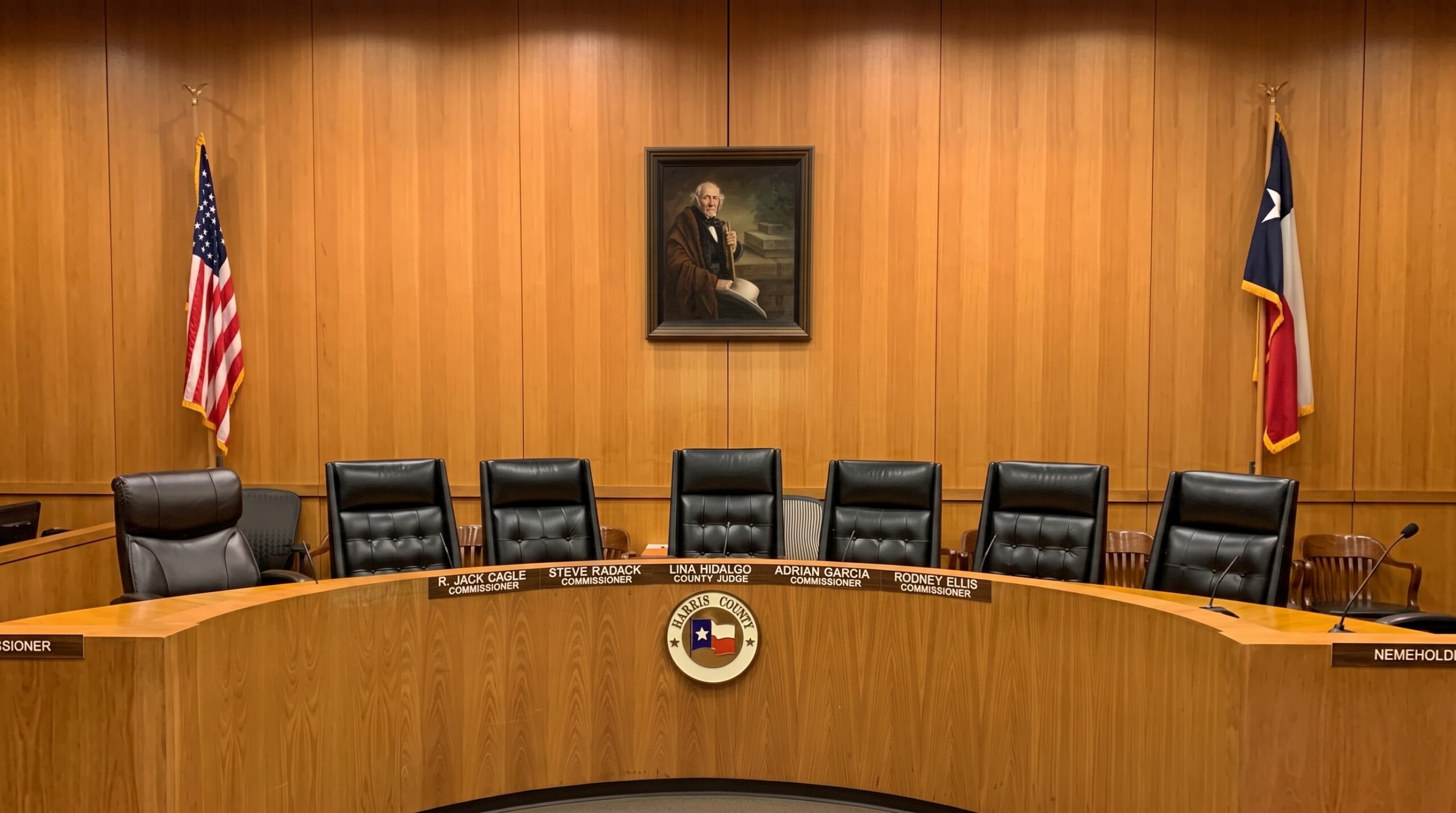
Harris County commissioners meet in special session at 9 a.m. Aug. 17 to take up proposed budgets and tax rates that one member has already called the largest increase in the county’s history — four days after Tarrant County commissioners were handed a recommendation to cut their rate for a fourth straight year.
The two proposals come out of nearly identical conditions. Both counties are working with appraisals that have flattened or fallen, both face rising payroll and public safety costs, and both must adopt a rate by the end of September. They are arriving at opposite answers.
For Harris County homeowners, the practical question is whether the county’s share of their bill rises this fall and whether they get a vote on it. Under the state’s truth-in-taxation rules, a taxing unit that collects more from existing property than a 3.5 percent threshold allows must put the increase before voters in November rather than simply adopting it.
Budget Director Daniel Ramos has been planning to propose a three-cent increase in the county’s general fund rate to close a deficit of about $130 million, ABC13 reporter Nick Natario reported Aug. 6. Precinct 3 Commissioner Tom Ramsey, the court’s only Republican, said the county’s flood control district and its public hospital system are each weighing three-cent increases of their own, which he said could push the combined rate from 62 cents to 71 cents per $100 of taxable value.
“Please understand the tax rate that we will be considering in just a few short weeks is probably the greatest tax rate increase in the history of Harris County,” Ramsey said, according to ABC13. He added: “In this time of affordability, where you can’t turn on the TV. That’s what people want to talk about. For us to be considering a significant tax increase this year would be not listening to the folks that are out there.”
Precinct 1 Commissioner Rodney Ellis disputed that characterization, telling the station, “There won’t be a change with the rate we have.”
The county’s own deficit estimates have moved considerably and do not reconcile. Community Impact reporter Kennedy Thomason put the projected 2026-27 shortfall at $178 million as of Aug. 14, down from a May estimate of as much as $257 million, while the figure Ramos has been working from is $130 million. Those are almost certainly different scenarios rather than corrections, but the county has published no reconciliation — nor what any of this would cost a typical homeowner. ABC13 asked the budget office for an average dollar impact and reported that it could not provide one.
The court is scheduled to propose rates Sept. 8 and hold a public hearing and final adoption Sept. 17, with the fiscal year beginning Oct. 1. The Aug. 17 meeting covers the county, the flood control district, the toll road authority and Harris Health.
In Tarrant County, staff recommended a rate of 18.6 cents per $100, down from 18.62 cents, KERA reporter Penelope Rivera reported Aug. 13. On an average taxable value of nearly $278,000, that produces a county bill of roughly $516. The proposed budget runs about $834 million, an increase of nearly $10.6 million, and adds 46 positions while raising public safety spending about $14 million and cutting community services by $3.6 million.
County Judge Tim O’Hare described the timing problem every Texas county faces this month: “You work all year essentially on putting together a budget and you don’t know what the tax revenue will be until basically the end of July.”
Two commissioners argued the lower rate obscures what is happening underneath it. “The public should not be fooled or confused by a lower tax rate or cuts to selected programs when overall county spending has increased, not decreased,” Commissioner Alisa Simmons said. Commissioner Roderick Miles Jr. added that if “the average taxpayer is saving five or $10, but we are cutting services, reducing hours, leaving positions unfilled and pushing expenses into next year, then we need to be honest about whether that is really a savings.” Tarrant is raising most employee pay 3 percent, with a maximum of 4 percent for law enforcement.
Elsewhere, El Paso County commissioners set a rate of $0.504717 as a budget guidepost — the maximum available without a November election — against a preliminary general fund of about $542 million, KTSM reported, an increase of roughly $164 a year on an average home. Travis County has told taxpayers on its own budget page that its 2027 rate will be adjusted downward to remove a one-time increase tied to the July 2025 flooding disaster.
The county numbers arrive two weeks into the city rate-setting season the Dispatch surveyed on Aug. 14, when Austin adopted the highest rate it could without an election and Dallas cut its rate for an eleventh straight year. Tarrant County will set its proposed rate Sept. 1 and vote Sept. 15.