
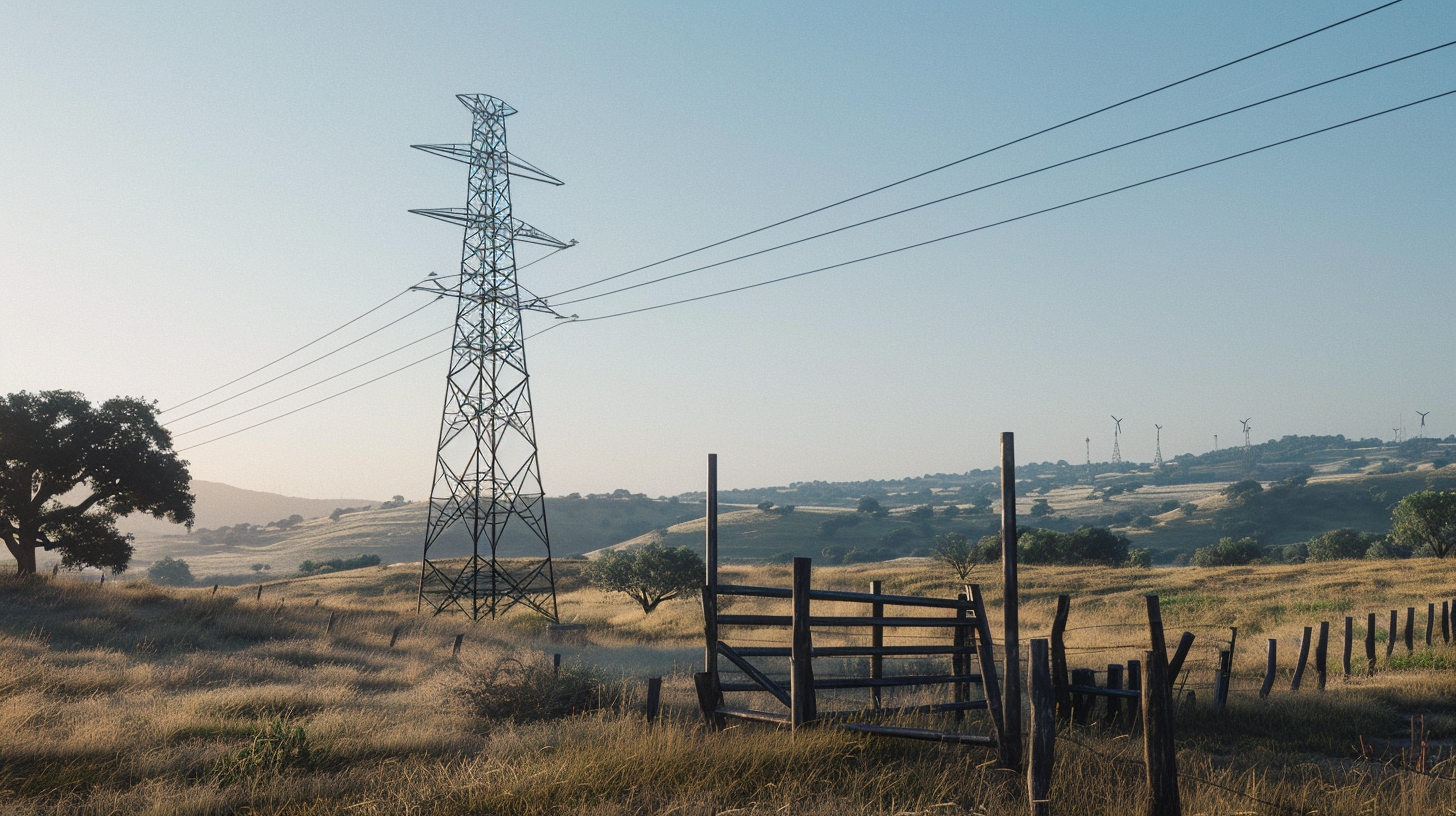
Three state administrative law judges recommended on Aug. 20 that Texas regulators refuse to let Oncor Electric Delivery Company and LCRA Transmission Services Corporation build the Bell County East-to-Big Hill 765,000-volt transmission line, and recommended the same result for the companion line from Big Hill to Sand Lake. Together the two make up Import Path 2, one of three corridors meant to carry power into the Permian Basin.
Their recommendation is blunt. “The Commission does not approve the Applications for the Bell County East-to-Big Hill and Big Hill-to-Sand Lake Projects,” reads the order the judges propose the Public Utility Commission of Texas sign. The document is a proposal for decision — the judges’ written recommendation, which the commissioners may accept, reject or rewrite — filed in Docket No. 59475 and signed by Presiding Administrative Law Judges Linda Brite, Linda J. Burgess and Dee Marlo Chico.
The judges gave two independent reasons, and summarized both in a single paragraph. “Applicants have not established that the amendment of Applicants’ CCNs is necessary for the service, accommodation, convenience, or safety of the public,” they wrote. “Further, the Application should be denied for Applicants’ failure to comply with the process due to approximately 1,400 landowners under Rule 22.52(a)(4) for public meeting.” A CCN, or certificate of convenience and necessity, is the state permission a utility must hold before it builds.
The notice problem runs deeper than one rule. The judges found the companies failed two separate duties. Oncor and LCRA held three public meetings in June 2025, then added and modified route segments afterward, drawing roughly 1,400 landowners into the project’s path who were never invited to a meeting. Separately, the judges found the companies did not mail notice of the application itself to every affected owner on the tax rolls current as of the March 26, 2026 filing date — “a pattern affecting over three dozen landowners” that the rule’s safe-harbor provision could not excuse.
An Oncor witness, Casey Petty, testified that “it is not standard practice to host another public meeting for the landowners newly affected by the additional or modified routes.”
On need, the judges made a legal finding that reaches well past this line: “ERCOT’s PBRP recommendation is not entitled to great weight in the determination of need for this reliability project.” The Permian Basin Reliability Plan is the Electric Reliability Council of Texas blueprint the commission approved in 2024, and the utilities had argued it settles the question.
The judges concluded it does not, because they found too much of the demand behind it unverified. Of the projected Permian load that is not oil and gas, the companies had submitted 6,167 megawatts to the grid operator backed only by a corporate officer’s letter or by nothing at all — 61 percent of that category. ERCOT itself adopted a discount in 2025 for exactly that kind of load, counting officer-letter demand at 55.4 percent and data-center demand at 49.8 percent. Applying the grid operator’s own discount would cut the forecast by at least 3,571 megawatts. Import Path 2 can safely carry 5,270 megawatts, so the disputed load is most of what the corridor could deliver.
They also found 59 percent of that forecast — about 6,900 megawatts — was cryptocurrency mining, and that the 2022 study behind the oil and gas projection had not held up. It forecast 10.3 gigawatts of new oil and gas demand by 2030; ERCOT now projects about 3.1. Its premise was that producers had to electrify to cut emissions, but S&P Global’s own October 2025 analysis found Permian emissions fell nearly 20 percent between 2022 and 2025 while production rose.
Barry Smitherman, who chaired the commission and testified for a landowner, questioned whether the line can deliver what it promises. “There are real questions as to whether this particular project will allow new power to be brought to that load,” he said, adding that he was “not aware of any similar announcement for generation capacity at or near the Bell County East proposed substation.”
Oncor and LCRA argued the lines are required by House Bill 5066 and the approved plan, and pointed to newly announced Far West import constraints that ERCOT says the 765-kV paths are “expected to help exit” by 2030. On notice, they and commission staff argued the objections confuse two different duties and that under the landowners’ reading a utility would have to hold meetings continuously until the day it filed. The judges rejected both. No ERCOT witness testified, and the Oncor engineer who introduced the constraint evidence conceded it “ha[s] not resulted in any load shed to date.”
The judges did pick a route, in case they are overruled. “Should a route be selected for construction, the ALJs recommend selection of Route 894,” they wrote — a 223.17-mile central-corridor line estimated at $1.681 billion, with 85 habitable structures within 500 feet of its center. That is the fewest homes of the four routes the parties fought over; the others ranged to 136.
The case was vast. The application, filed March 26 across 15 counties, produced a five-day hearing, 1,398 exhibits and 40 witnesses cross-examined, with more than 200 parties at one prehearing conference where the judges allotted 2.8 minutes of questioning apiece. ERCOT valued the five-line program at $13.77 billion in 2024; the judges noted the per-mile estimate has since climbed 21 percent, to roughly $7.5 million.
Nothing is settled. The commission will set an open-meeting date and deadlines for exceptions, replies and any request for oral argument before the commissioners vote.