
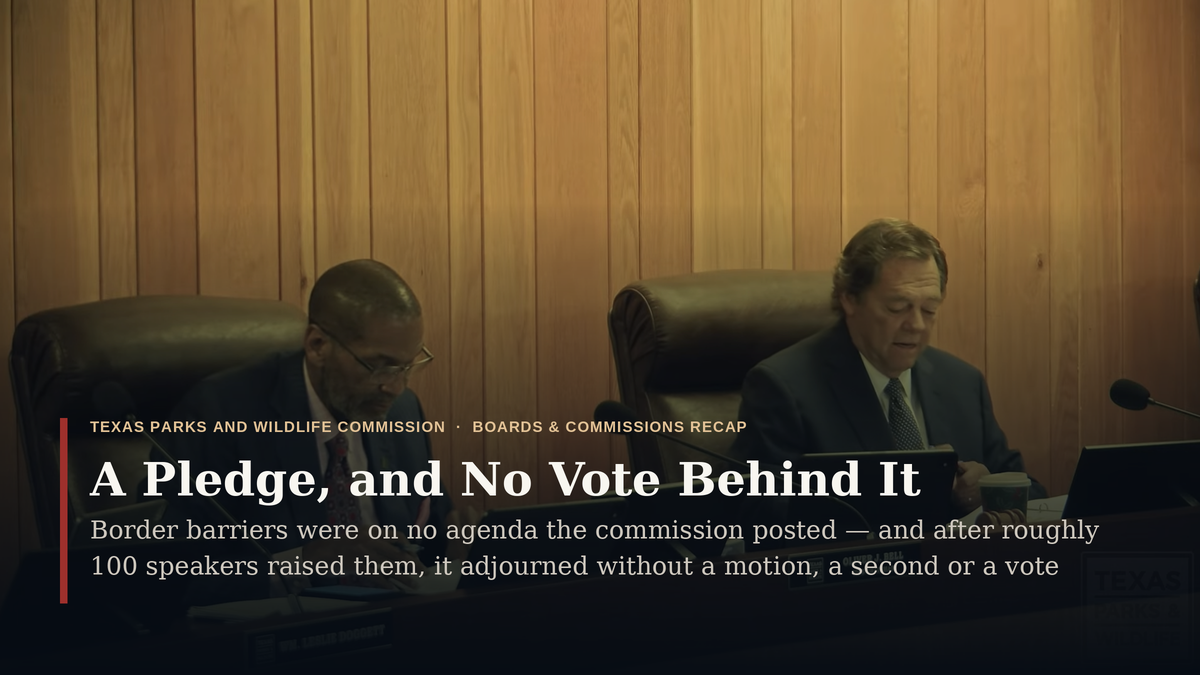
The Texas Parks and Wildlife Commission finished its August business Aug. 20 with a briefing on alligator gar, and then its chairman said something that was not on the agenda.
“Before we adjourn, I want to make a brief comment,” Chairman Paul L. Foster said. He then addressed the crowd that had filled the same room the day before: “Yesterday, we had 101 speakers who signed up to discuss various issues, most of whom raised concerns about border barriers in our state parks and state natural areas.”
“I don’t think there was anybody in the room who wants to see bigger barriers and walls and lighting and other obstructions in our state parks, in our pristine areas,” Foster said. He went on to say that he wanted to go on record “by saying that we heard you all and we agree with your concerns.”
Then he made a commitment, and it is the most specific thing any Texas parks official has said on the record about the federal barrier program running through the Big Bend:
“I’m personally committed to doing anything I can do to make sure we maintain the beauty and integrity of our parks,” Foster said. “I recognize the need for border security and would never do anything to compromise border security, but I also recognize the value of our parks and wide open spaces and I’ll vigorously oppose any unnecessary or ill-advised incursions.”
Seconds later he adjourned the meeting: “Dr. Yoskowitz, this commission has completed its buiness and we’re adjourned at 11:06 a.m.”
That is the whole of it. There was no motion, no second and no vote, and there could not have been one. Border barriers appear nowhere on the Aug. 20 commission agenda, nowhere on the Aug. 19 work session agenda and nowhere on the executive session agenda. Under the Texas Open Meetings Act a governmental body may not act on a subject it has not posted. A chairman’s statement of personal intent, delivered after the last item, is not commission action.
What makes it worth reporting anyway is the distance between it and what the commission has said before. Speakers at the Aug. 19 annual public hearing — the Dispatch recapped that hearing separately — asked the commission to run the Chapter 26 parkland process for the barrier, the same notice-and-findings process it ran May 28 for a pipeline easement crossing six-tenths of an acre. Foster’s statement answers the sentiment and not the request. He says he agrees; he does not say the department will run Chapter 26, will refuse a right of entry, or will do any particular thing at all.
On the “101 speakers.” The Texas Tribune, reporting from the room the day before, counted 99 people signed up to speak. TPWD has not posted a speaker list or an official transcript for either day, so neither number can be checked against a primary record yet. The substance of the chairman’s characterization — that most speakers came to raise border barriers — is corroborated by every outlet that covered the hearing.
The distinction that governs whether the commission can do anything is the one most easily lost. This is a federal project. The barrier work in the Big Bend is being contracted and built by U.S. Customs and Border Protection under the Department of Homeland Security. The state’s own border wall program, run by the Texas Facilities Commission, finished at 82.2 miles and more than $3 billion, and the Legislature stopped appropriating new money for it in the 2025 budget. TPWD is not a party to the federal construction. It is a landowner being approached for access.
That is also why Chapter 26 does not reach CBP. The statute opens by binding “a department, agency, political subdivision, county, or municipality of this state” — and no part of the chapter mentions the federal government. The trigger is a state entity’s approval, not a federal builder’s construction. So the strongest version of the speakers’ argument is narrower and sharper than it sounds: if TPWD itself must grant an easement or a right of entry across protected state land, that TPWD approval would be the Chapter 26 event. Whether the department has granted, refused or is still negotiating access at Big Bend Ranch State Park could not be established; TPWD has declined to say.
Fact box
What
Texas Parks and Wildlife Commission meeting
When
Commission meeting: Thursday, Aug. 20, 2026, adjourned 11:06 a.m. CT. Annual public hearing and work session: Wednesday, Aug. 19. Next regular commission meeting not set in the captured record.
Archived video
TPW Commission Meeting, Aug. 20, 2026