
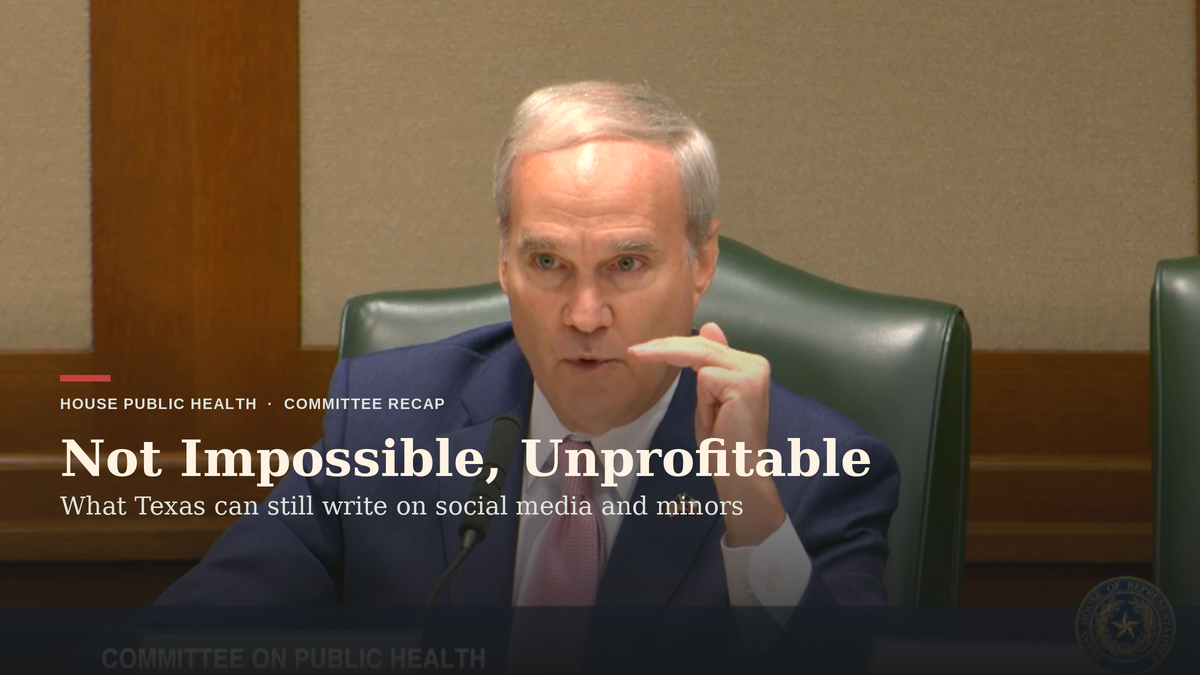
The Texas House passed a social media ban for minors by 116 votes to 25 and watched it die anyway. When the House Committee on Public Health reopened the subject Aug. 20, members spent two hours pushing three witnesses on a single question: what can Texas write that will actually survive a court and a Senate calendar?
David Dunmoyer of the Texas Public Policy Foundation gave them the industry’s defenses and then knocked one down. Platforms “hide behind the veneer of the First Amendment or Section 230 of the Communications Decency Act,” he said. “Or they’ll say that we want reforms, but they’re technically impossible to implement. They’re not impossible. They’re unprofitable. And that’s the major difference here.”
Dr. Daniel Flint, a pediatric psychologist at Texas Children’s Hospital and assistant professor of pediatrics at Baylor College of Medicine, supplied the clinical case. He asked a teenage patient to guess her daily screen time; she said 10 hours, and her phone said 14. “That leaves her two hours per day left of real life,” Flint said. She later told him “she has absolutely nothing to be proud of in her life, and how could she?”
Therapy cannot close that gap, he told members. “Even if I was the best therapist in the world, my two hours per month with a child simply won’t compete with hundreds of hours of algorithmically targeted social media content.” What arrives in his clinic, he said, “is not a failure of Texas parenting. It’s the predictable result of exposing developing brains to an unregulated digital environment designed to elicit views, clicks, likes and shareholder value.” His line — “you simply cannot out-parent an algorithm” — was quoted back to him by two members later in the hearing.
Maurine Molak, co-founder of the David’s Legacy Foundation and ParentsSOS, testified as the parent whose loss produced current Texas law. “Ten years ago, my 16-year-old son, David, died by suicide after a yearlong battle with social media and online gaming addiction, with months of threatening cyberbullying,” she said. “His death spurred the passage of the Cyberbullying Prevention law in 2017 called David’s Law.”
Her recommendation set the agenda for the 90th Legislature. Texas should “build on the last four years by regulating content-neutral product design features that encourage compulsive use, turn off dangerous algorithms for minors, require stronger safeguards by default, require more parental tools, and pass a robust chatbot bill,” she said, pointing members to the age-appropriate design codes moving in a dozen states.
Chairman Gary VanDeaver, R–New Boston, cut to it after the opening statements. “All three of you have certainly, I think, presented some compelling evidence that there is a problem, and I don’t think that’s news to anyone on this dais,” he said. “What can we as a legislature do to protect our children online?”
Rep. Mike Olcott, R–Aledo, took the newest piece of Texas law, asking whether app stores are complying with Senate Bill 2420, the App Store Accountability Act, now that the U.S. Supreme Court has declined to block it, and whether the attorney general has brought any case. “There are companies who are already applying this law. It is the law of the land,” Dunmoyer said. “For the major app [stores], it is in effect, and I haven’t seen any actions brought just yet.”
That law is the model Dunmoyer urged members to copy. “Content-based restrictions are the ones that tend to get thrown out by the courts on account of Section 230 or the First Amendment,” he said. “So what the App Store Accountability Act says is we’re going to address the conduct.”
Rep. John Bucy III, D–Austin, described changing his mind about the bill that died. “When this bill came up, the full-on ban for minors by Representative Patterson two sessions ago, I was against it. It should be parent rights,” Bucy said. “I then spent a lot of time learning about the true health side effects of social media on our children, and I’ve really become a convert.” House Bill 186 cleared the House, he said, but “the governor and the Senate have decided this isn’t the same crisis that the House believes it is.”
Rep. Ann Johnson, D–Houston, told witnesses the committee has heard all of it before. “This is not new information for the state of Texas. We do this in the interim, we go through a session. We don’t actually put any teeth in any of the regulation,” she said. “So the majority that has been running this state for 30 years has had the opportunity to make these decisions and hadn’t done it. So I appreciate that we’re now here in August before another election.”
Johnson also walked witnesses through New Mexico’s suit against Meta, in which the attorney general’s office had investigators pose as children and drew flagged predators before a jury returned the verdict. Vice Chair Liz Campos, D–San Antonio, opened that thread.
Rep. Lauren Simmons, D–Houston, drew the generational line. “I’m a millennial. I feel like we were kind of like the first internet kids, and which was the wild Wild West,” she said. “But I’m guessing what is different here is you watch one beheading video and then that was it. But now there’s like an algorithm that’s like, hey, you like gore? Well, here’s more of that.” Like Bucy, she said the ban no longer sounds extreme.
Rep. Joanne Shofner, R–Nacogdoches, asked who is actually suing the states. NetChoice, mostly, Dunmoyer said — the trade group behind the pending challenge to the 2023 SCOPE Act, House Bill 18, whose content-monitoring provision remains enjoined.
Asked whether compulsive platform use meets a clinical threshold, Flint would not overstate it. “I don’t want to testify to the nature of the degree of dopamine that’s involved,” he said, “but I’m comfortable saying it’s a behavioral addiction.” No vote was taken; the record feeds the interim report and bills filed in the 90th Legislature, which convenes in January 2027.
Also heard
This charge opened a nine-hour sitting that covered four interim charges and closed the committee’s interim work. The longest block, roughly three hours, went to infant mortality prevention, where a Texas Children’s Hospital researcher asked the Legislature to build a CPRIT-style research fund for sudden unexpected infant death and members split along party lines over the state’s record. Two more hours went to artificial intelligence in health care, with the Texas Medical Association, the Texas Association of Health Plans, the Texas Hospital Association, Texas 2036 and the Cicero Institute testifying on prior authorization and physician review. The closing 90 minutes went to public health trends, including kratom and 7-hydroxymitragynine, recent infectious disease responses and chronic disease data. Chairman VanDeaver also created a new Subcommittee on Maternal Health, Menopause and Access to Evidence-Based Medicine, chaired by Rep. Katrina Pierson.
Fact box
Issue
Interim charge on the impact of social media platforms and artificial intelligence technologies on the mental health, cognitive development and behavioral well-being of minors (~123 minutes, roughly 23% of the hearing — third of four charges by time, first by member questioning)
What happened
Three invited witnesses urged Texas to regulate platform design rather than content, arguing that conduct-based rules like the App Store Accountability Act survive First Amendment challenge where content rules do not; members were told SB 2420 is now enforceable after the U.S. Supreme Court declined to block it, with no attorney general enforcement yet; House Democrats used the charge to fault the governor and Senate for killing HB 186 and to press the majority on 30 years of inaction; no vote (interim hearing)
When
Thursday, Aug. 20, 2026, 9:00 AM CT · run time 9:06:03 · this charge ran from about 9:06 a.m. to about 11:09 a.m.
Where
Room E2.030, Capitol Extension, Austin
Chair
Rep. Gary VanDeaver, R–New Boston (HD-1)
Archived video
house.texas.gov, video 22753