

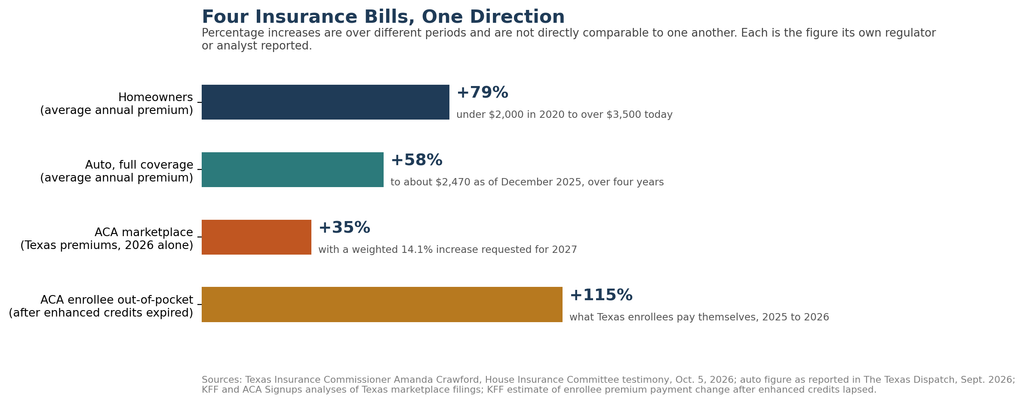
The number came from the regulator herself. “The average annual homeowner insurance premium in Texas has increased from under $2,000 in 2020 to over $3,500 today,” Insurance Commissioner Amanda Crawford told the House Insurance Committee on Oct. 5. “That is a 79% increase in six years.”
The second number came under questioning, and it explains why the first one landed the way it did. In the two decades Texas has regulated homeowners insurance under a file-and-use system, the Texas Department of Insurance has formally disapproved exactly zero rates.
Those two facts frame the problem the 90th Legislature will inherit in January. The cost of insuring a home in Texas has nearly doubled. The cost of insuring a car has risen by more than half in four years. The cost of buying health coverage on the individual market rose by a third this year and is set to rise double digits again. And the instrument Texas built in 2003 to keep rates competitive has, by the state’s own account, never been used to stop one.
Chair Jay Dean, R-Longview, put it in the terms his colleagues hear at the door: “None of us have not knocked on doors in our districts and not heard people talk about — my insurance is just, I can’t afford to stay in my house. That’s not rhetoric. That’s the truth.”
Housing: the premium became a housing cost
Homeowners insurance is the market where Texas is most clearly an outlier. The state has ranked among the most expensive for home coverage since the Insurance Information Institute began comparing states in the 1990s, and 2026 surveys put it fifth to seventh nationally, with modeled premiums between $4,500 and $4,900 a year against a national average under $3,000. TDI’s own data, which measures actual premiums paid rather than quotes, show the average policy rising from $1,961 in 2019 to $3,291 in 2024 — 68 percent in five years, roughly double the national pace by the Dallas Fed’s reckoning.
The cost has migrated from a line item into a housing-affordability variable. The Dallas Fed found that Texas owners without a mortgage devoted 14.9 percent of housing costs to insurance in 2024. The Texas Mortgage Bankers Association told the House committee that Ginnie Mae delinquency in Texas is “exceeding 12%,” the highest in the nation, with serious delinquencies up roughly 58 percent in a year. Builders described carriers “declining to quote a home, literally just right across the street from one another,” in the words of Hogan Homes’ Trey Summers.
Three explanations compete for why, and the hearing aired all of them.
Losses. Crawford attributed the rise to “increases in home values and increases in claim costs.” Annual homeowner losses averaged $5.5 billion from 2015 to 2020 and $9.1 billion from 2021 to 2025. Coverage amounts are up 51 percent since 2020; roofs account for 70 to 90 percent of residential catastrophe losses. The Insurance Council of Texas told members flatly that “Texas cannot sustainably reduce the cost of insurance by changing how the price is regulated.”
Profits. In 2025, a light weather year, Texas home insurers earned about 22 cents of profit per premium dollar — the best result in two decades — on nearly $20 billion collected. Crawford said in July that companies should “strongly consider whether or not a rate decrease might be in order.” None has materialized. The industry’s answer, from Beaman Floyd of the Texas Coalition for Affordable Insurance Solutions: “Part of what you’re looking at in 2025 is a really good weather year. And that is not a thing that is reliable in the long term in Texas.”
Claims practices. Policyholder advocates pointed at the other end of the transaction. Weiss Ratings found 30.45 percent of closed Texas homeowner claims in 2025 paid nothing. Adam Brenner of the Texas Association of Public Insurance Adjusters: “We have created a pay-to-play system, one in which resolving an otherwise straightforward property claim can require both sides to spend thousands of dollars simply to establish what should be covered and how much is owed.” Dean cited the Oklahoma attorney general’s case against State Farm and said, “I understand and share the concerns that similar practices could be occurring in Texas.”
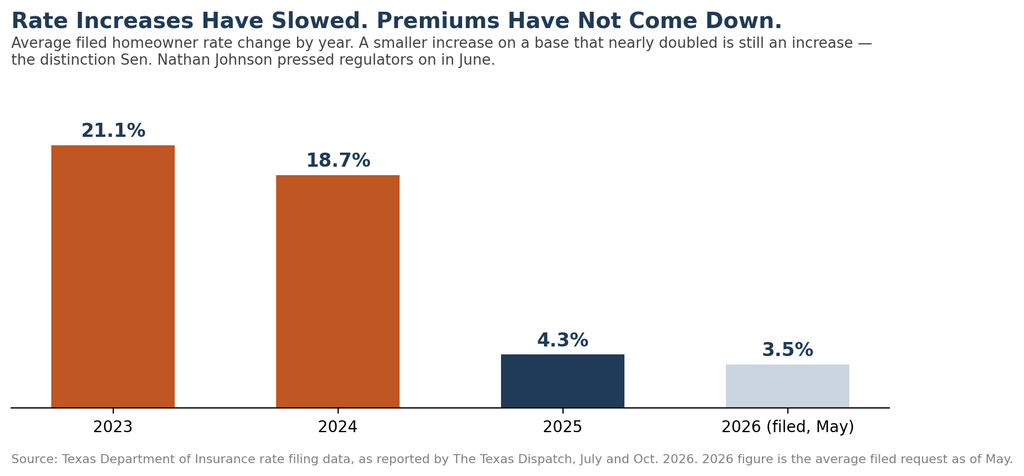
The distinction that matters most is the one the industry leans on and legislators keep flagging. Filed rate increases have slowed sharply — 21.1 percent in 2023, 18.7 percent in 2024, 4.3 percent in 2025. Industry voices call that stabilization. But a 4.3 percent increase on a base that nearly doubled is still an increase, and Sen. Nathan Johnson pressed regulators in June on exactly that point. Crawford conceded: “We’re certainly seeing a leveling off. We haven’t quite seen a decrease yet.”
Cars: the quieter 58 percent
Auto insurance has drawn less legislative attention and comparable pain. The average full-coverage premium in Texas reached about $2,470 a year as of December 2025, up nearly 58 percent from four years earlier. Independent 2026 surveys put Texas full-coverage rates 19 to 21 percent above the national average.
The drivers overlap with housing — repair-parts costs up 44 percent and labor up 28 percent since 2020, by industry figures — with one addition the industry has made its central argument: litigation. Ryan Patrick, chief executive of Texans for Lawsuit Reform, has built TLR’s 2027 agenda around the claim that verdicts in a handful of counties are priced into every Texan’s premium. “Whether you’re in El Paso or you’re in Texarkana or you’re in Lubbock or Amarillo, you’re paying for these nuclear verdicts,” he told the Dispatch. “That’s how the risk pool is spread.”
The causal link is contested, and the Dispatch’s reporting said so. Academic estimates put the premium effect of individual tort reforms at 1 to 2 percent each. The industry’s own trade association has said it “never promised that tort reform would achieve specific premium savings.” And the three “lawsuit tax” figures in circulation — Patrick’s $3,200 to $4,000 per person, Perryman’s $1,725, and a separate Perryman-attributed $5,000 per family — do not agree with one another.
What is not contested is that auto is the market where the state’s proposals are most specific. Abbott’s agenda includes letting all auto insurers rate on driving records. TLR’s includes medical-damages disclosure, a staged-collision offense and funding for TDI-deputized fraud prosecutors.
Health: the market where Texas has the least say
The individual health market is the one where the biggest cost driver was a federal decision. Enhanced Affordable Care Act premium credits expired at the end of 2025. KFF estimates the lapse raised what Texas enrollees pay out of pocket by about 115 percent — roughly $456 a year for a typical subsidized enrollee — and that a benchmark 40-year-old Texan’s premium rose from $489 a month in 2025 to about $661 in 2026.
Texas premiums rose about 35 percent for 2026. For 2027, insurers in all 50 states have proposed a median 15 percent increase; the weighted Texas request is 14.1 percent. The mechanism is circular: healthier enrollees drop coverage when subsidies shrink, the remaining pool is sicker, and insurers price the next year for the pool that stayed. One Texas filer, Antidote Health, wrote that it expects “the remaining risk pool in 2027 to have higher healthcare needs, on average, as healthier consumers are more likely to lapse coverage.”
Enrollment has already turned. Effectuated Texas marketplace enrollment fell from 3.42 million to 3.28 million this year, the first decline since 2019.
The state’s levers here are narrower. TDI gained authority to review individual-market rates in 2021 and was sitting on 17 undecided 2027 filings in September, the largest seeking about a one-third increase. Its Sept. 2 bulletin banning price optimization — charging loyal customers more because they are unlikely to shop — was addressed to all insurers, which reaches health plans. Beyond that, the fix is in Washington: Congress restoring the credits before November open enrollment is, as KFF put it, “the single largest variable.”
How the costs are borne
The common thread across all three markets is who absorbs the increase.
A homeowner with a mortgage cannot decline coverage. A driver cannot legally decline liability coverage. A marketplace enrollee can decline, and increasingly does — which is how a cost shift becomes a coverage loss. In each market the policyholder has no vote on the price and limited ability to exit, which is the condition that justifies regulation in the first place.
That is why Crawford’s description of TDI’s position carries weight. “There are limited levers that we can pull as a regulator based on statute,” she told the House. The statutory profit test in rate review has no numeric definition. Disapproving a rate requires a State Office of Administrative Hearings process she called “complex and lengthy and a time-consuming process.” Only about a third of filings even take effect on day one. And as one committee member observed, “There is nothing on affordability in the rate review process.”
The 2003 system was built to end a crisis of availability, not price. Before Senate Bill 14, 99 percent of Texas homeowners premium was written by companies exempt from rate regulation; the reform’s goal was to pull them into a competitive, lightly regulated market. By the industry’s own account it succeeded — 17 new insurers entered the state, and Texas has not had an availability crisis since. What it did not do, and was not designed to do, was give the state a tool to say a rate is too high.
What is already on the table
The proposals divide by who is making them, and by which of the three explanations they accept.
The governor’s track. Abbott’s Aug. 24 directive ordered TDI to recognize FORTIFIED roof status in rate-setting, propose a rule barring refusals based on a roof’s age alone, enforce the price-optimization ban, create an Insurance Fraud Task Force, and produce a claim-cost study across auto and homeowners by year’s end. For 2027 he has proposed a Texas Roof Fortification Program and the driving-record rating change. “I will work with the Legislature next session to further curb premium increases,” he said. Dean’s response: “I’ve asked him to bring me the legislation, and we’re happy to run with it.”
The fortification track. This is where the hearing found its only consensus. Lars Powell of the University of Alabama testified that a FORTIFIED roof cuts premiums “by about 21%.” Alabama’s Strengthen Alabama Homes program has retrofitted more than 8,600 homes with $10,000 grants; Louisiana expanded its equivalent by 60 percent this year to $80 million and expects to reach 13,000 homes. Asked whether Texas should license roofers — it currently does not — the National Association of Mutual Insurance Companies’ answer was “Mr. Chairman, our position is yes,” and nearly every witness agreed. Builders accept incentives and oppose a mandate; a fortified roof can add “four, five, six, maybe up to $20,000” to a new home, Scott Norman of the Texas Association of Builders said.
The litigation track. TLR will re-file the medical-damages disclosure bill that died as SB 30 last session, alongside the criminal-actor responsibility rule, a staged-collision offense, negligent-entrustment limits and fraud-prosecutor funding. Patrick says the bills will be narrower than 2025’s. The industry’s op-ed voice, David Sampson, makes the same case and points to Florida, Georgia and Louisiana as precedents.
The rate-review track. The least developed and most consequential. The hearing surfaced three ideas without a sponsor: writing affordability into the rate-review standard, defining the profit test numerically, and streamlining disapproval so it does not require a SOAH contested case. Any of them would be the first substantive change to the 2003 framework. The industry’s position is that none of them would lower costs; the policyholder advocates’ position is that without them nothing else will.
The claims track. Last session’s SB 458 created a new appraisal process for disputed claims, with insurer compliance due Sept. 1. HB 2067 now requires insurers to report declination and nonrenewal reasons by ZIP code; TDI is extending it to commercial and farm lines. TAPIA and the American Policyholder Association want the state to go further on what happens after a claim is filed, not just before a policy is priced.
What to watch
End of 2026: TDI’s claim-cost study across commercial auto, personal auto and homeowners, and its ZIP-code availability report. Together they are the first state-produced evidence on which of the three explanations — losses, profits, claims practices — carries the most weight. The interim reports from House Insurance and Senate Business and Commerce follow.
Nov. 1: ACA open enrollment. Whether Congress restores enhanced credits before then determines whether 2027 individual-market increases land on consumers at 14 percent or at double that after subsidies.
Nov. 30: Hurricane season ends. A second quiet year makes the 2025 profit margins harder to describe as a one-off and strengthens the rate-decrease argument. An active one does the opposite.
Jan. 12, 2027: The 90th Legislature convenes. The near-certain bills are fortification grants, roofer licensing, the driving-record rating change and some version of SB 30. The open question is whether anyone files a rate-review bill. Twenty-three years after Texas chose file-and-use, the state has a regulator who says her levers are limited, a committee chair who says his constituents cannot afford to stay in their homes, and a system that has never disapproved a rate. Whether the Legislature treats that as a design feature or a design flaw is the decision the session will turn on.
Sources
The Texas Dispatch
- Texas Homeowner Premiums Up 79% in Six Years as Lawmakers Press Regulators on Rate Review (Oct. 6, 2026)
- House Insurance Committee to Weigh Rising Premiums, Windstorm Funding and Cancellation Law (Sept. 28, 2026)
- TDI Outlines Steps to Curb Rising Property Insurance Costs for Texans (Sept. 17, 2026)
- The Bumper, the Verdict and Your Premium: Ryan Patrick’s Case That Texas Courtrooms Are Driving Up Insurance Rates (Sept. 10, 2026)
- The State’s New Ban on Charging Loyal Customers More Reaches Health Insurers, Not Just Home Insurers (Sept. 7, 2026)
- Governor Abbott Reminds Insurers That Price Optimization Is Banned Under Texas Law (Sept. 3, 2026)
- Governor Abbott Directs TDI to Curb Rising Property Insurance Costs for Texans (Aug. 25, 2026)
- Health Insurers in All 50 States Propose a Second Straight Double-Digit Premium Jump for 2027 (Aug. 7, 2026)
- Texas Home Insurers Post Best Profits in Two Decades as Premiums Stay 80% Above 2020 (July 14, 2026)
- Texas Marketplace Shoppers Brace for a Second Straight Double-Digit Premium Jump (July 9, 2026)
- Texas Insurance Regulator Puts County-Level Premium and Rate-Hike Data Online (July 8, 2026)
- Texas Insurers File 2027 ACA Rates as Higher Costs Continue for Consumers (July 2, 2026)
- Texas’s Senate Committee Pressed Insurance Commissioner on the One Number Homeowners Feel Most: the Premium (June 25, 2026)
- Analysis: Texans Have Told the Legislature to Fix Health Care Costs (Sept. 2026)
- Opinion: Finally, Insurance Rates Are Stabilizing in Texas, David Sampson (March 17, 2026)
State law and regulators
- Texas Department of Insurance — Texas Homeowners Insurance Market Overview
- Texas Department of Insurance — Commissioner’s Bulletin B-0028-03 on SB 14 implementation
- House Research Organization — Focus report on TDI Sunset, 81st Legislature
- Texas Coalition for Affordable Insurance Solutions — 20 Years of File and Use in Texas
Outside data and reporting
- Federal Reserve Bank of Dallas — Southwest Economy, homeowners insurance
- NerdWallet — Average home insurance cost in the U.S. for 2026
- MoneyGeek — Why is car insurance so expensive in Texas
- Peterson-KFF Health System Tracker — How much and why ACA Marketplace premiums are going up in 2027
- ACA Signups — 2027 rate changes, Texas
- Alabama Department of Insurance — Strengthen Alabama Homes
- Louisiana Illuminator — Louisiana adds money to expand its fortified roof program by 60% (May 2026)
- Brookings — What incentives are states offering to make houses less vulnerable to extreme weather damage