
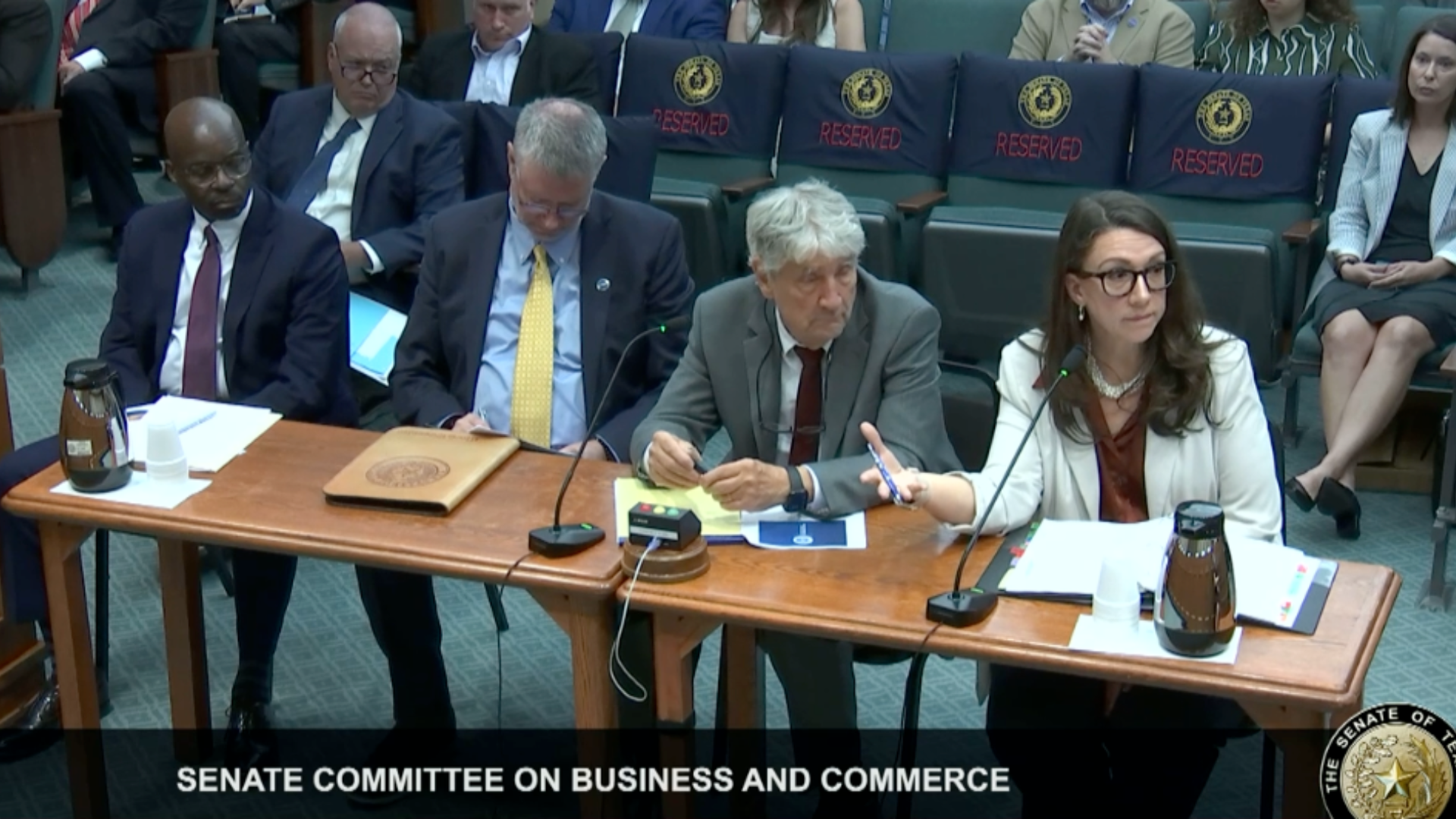
Four months into the job, Texas Insurance Commissioner Amanda Crawford spent Wednesday morning answering for the price of keeping a roof insured. “It has been a fast four months since Governor Abbott appointed me insurance commissioner in February,” Crawford told the Senate Committee on Business and Commerce, before turning to “the cost of property and casualty, or P&C, insurance” — the charge that consumed half of a nearly seven-hour interim hearing as senators pressed regulators, academics and industry on why Texans keep paying more.
Chair Charles Schwertner, R-Georgetown, opened with a “robust agenda” and put affordability first. The committee is working through interim charges ahead of the 90th Legislature in 2027, and the insurance charge directs members to weigh the stability and competitiveness of the Texas market against the squeeze on household budgets. Witnesses described a market shaped by catastrophe risk — hail, wind and storm losses — that keeps pushing rates up even as regulators say competition remains healthy.
Senators repeatedly steered the abstractions back to their own constituents. Sen. Kevin Sparks, R-Midland, pushed on the weather that drives West Texas premiums. “My district gets a lot of hailstorms,” he said, describing the all-too-familiar pattern of “a storm [that] drops pea-sized hail” and the claims that follow, and asking regulators whether the practices he was seeing were still common.
Sen. José Menéndez, D-San Antonio, arriving mid-hearing, said he had been “listening on the way up” and pressed witnesses on issues the committee had begun working through a day earlier.
Schwertner’s panel called Dr. Lars Powell, executive director of the Center for Risk and Insurance Research at the University of Alabama, and Sen. Donna Campbell, R-New Braunfels, put the central question to him directly. “Dr. Powell, based on your research in Alabama, what you now know about Texas, if you could make one recommendation for us to accept in terms of legislation or policy or rulemaking” — she asked him to name the single most effective lever. Campbell also pressed industry witnesses on a related driver of household costs, asking whether “the increase in auto insurance” was feeding the broader affordability problem.
Sen. Nathan Johnson, D-Dallas, drilled into the data. Crediting “an excellent presentation,” he turned to a witness’s written special report and the claim that “rate increases declined” in a recent year, probing whether a slowing rate of increase actually translates into relief for policyholders still paying more than before.
Sen. Phil King, R-Weatherford, the vice chair, asked regulators to confirm the reach of prior legislation, recalling that the Legislature “passed some kind of liability protection” tied to insurer disclosures.
The state’s insurer-of-last-resort drew its own scrutiny. David Durden, general manager of the Texas FAIR Plan Association — “FAIR stands for Fair Access to Insurance Requirements” — reminded members the plan was created in 1995 through House Bill 1367 to cover property the private market would not, and walked through how it functions as a backstop in high-risk areas.
David Bolduc, the state’s public insurance counsel, appeared for consumers, while industry was represented by Beaman Floyd of the Texas Coalition for Affordable Insurance Solutions, Scot Kibbe of the American Property Casualty Insurance Association, and Billy Crocker of Alliant Insurance Services, appearing for the Independent Insurance Agents of Texas.
Housing-cost witnesses connected premiums to the broader affordability debate. Trey Summers, chief operations officer of Hogan Homes and a representative of the Texas Association of Builders, and Scott Norman, CEO of the Texas Mortgage Bankers Association, testified to how rising insurance costs ripple into the price of buying and financing a home — a point that gives the charge reach well beyond the insurance line on a household budget.
The committee took no vote; the hearing was an interim fact-finding session. Schwertner’s panel is assembling findings on affordability and consumer protections that would shape bills filed in 2027, when lawmakers reconvene. The recurring tension on display Wednesday — regulators describing a competitive, functioning market, and senators describing constituents who can barely afford it — is the gap any new legislation will have to close.
Also at the hearing
The committee took up two other charges Wednesday. It spent roughly two hours on the Broadband Development Office’s management of more than $5 billion in state and federal funds, where members pressed the office on duplicate spending and pole-replacement money. A third block examined the future of cryptocurrency and financial technology, including the implementation of Senate Bill 21’s Texas Strategic Bitcoin Reserve and the state’s lack of authority over crypto kiosks tied to consumer scams.
Archived video: senate.texas.gov/videoplayer.php?vid=22666