
A single blood test will not reliably predict menopause, a physician told a House subcommittee Oct. 5, and a panelist said no medical society recommends routine AMH checks. A string of witnesses still urged Texas to study baseline hormone testing, the idea at the center of one of the panel’s two charges.
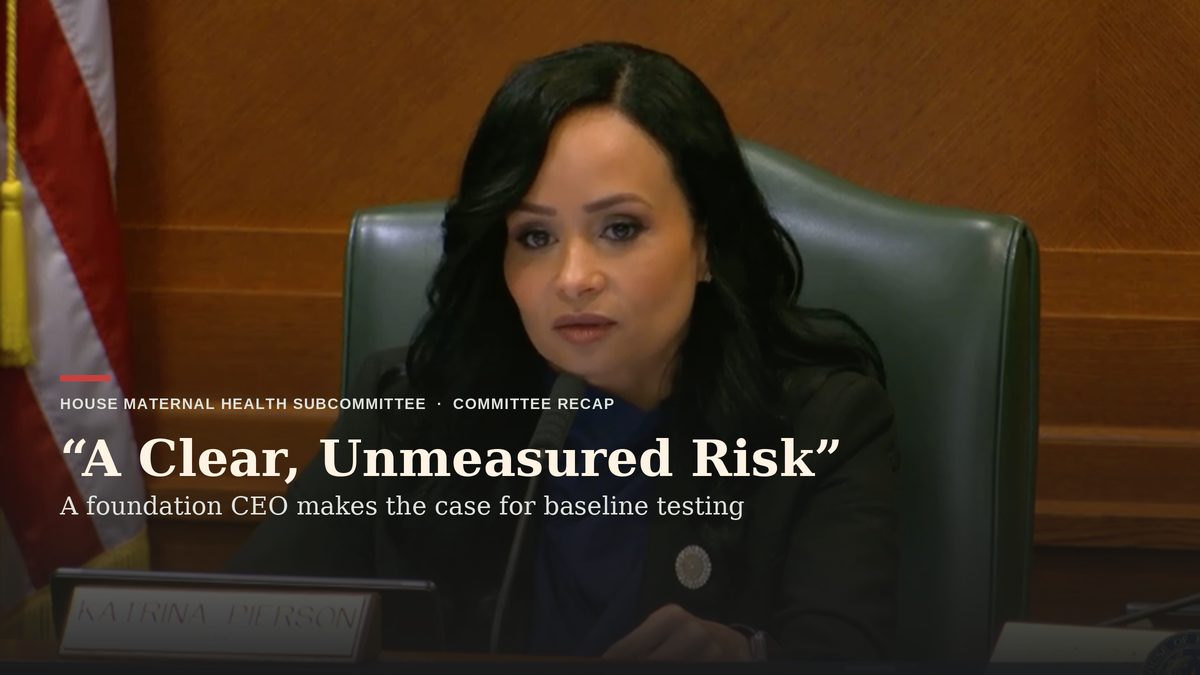
Chair Katrina Pierson, R-Rockwall, set the question in her opening: “Today’s charges direct us to study opportunities to increase preventative efforts and early detection of hormone imbalances, including baseline hormone testing.” Pierson has proposed such a test in her women’s health initiative, The Texas Dispatch previously reported.
Dr. Mary Claire Haver, an ob-gyn and certified menopause specialist, laid out the problem. “Testing for hormones in perimenopause is tricky because we don’t have a baseline in premenopause, right? Our hormones fluctuate day to day,” she said. “I call it pinning the tail on a moving donkey,” she said, adding that a one-time blood, urine or saliva test “is not really going to be helpful.” Perimenopause, she said, “is a diagnosis of exclusion.”
A panelist answering a question that Rep. Liz Campos, D-San Antonio, relayed from Rep. Claudia Ordaz said “there is not a single society that is currently recommending checking routine AMH levels.” The test, which gauges ovarian reserve, costs under $60, another witness said. Campos said Ordaz is working on legislation to make reproductive health evaluations part of early care. Jamie Dutton Singh of the Texas Association of Health Plans said: “Hormone testing prior to menopause has not really been seen to be effective for deciding on treatment.”
Others argued the real question is what a baseline adds. Steve Hoffert, who owns Magnolia Pharmacy and said about 7,000 women use compounded hormone therapy there, asked the committee to “study the value of obtaining reproductive health baselines earlier in a woman’s life, so that we later know more about what that was normal for that individual later.” He added: “The better question isn’t do we test or not test? The better question is what information helps us provide the best care for that woman?”
Dr. Heidi van den Brink, an assistant professor of nutrition at Texas A&M, supplied the caution. “A simple baseline hormone test captures one moment in a moving picture,” she said. She cited research showing estrogen surged unexpectedly in more than a third of cycles in women nearing menopause. “I would gently suggest that we ask when we think about this question, balanced compared to what measured when,” she said.
Testing advocates made the case for early data. Millicent Key, a nurse practitioner with Quest Diagnostics, said Quest asks lawmakers to start with “the establishment of baseline hormone and metabolic testing.” She said labs “inform about 70% of all clinical decision making, yet they account for less than 3% of total health care spending.” Key said polycystic ovary syndrome, now being renamed PMOS, affects 10% to 13% of women of reproductive age, and an estimated 70% of cases go undiagnosed.
Anna Halpine, CEO of the Femm Foundation, went furthest. “An unmeasured hormone is a clear, unmeasured risk. Every year, a woman’s hormones go unmeasured and untreated is a year. Her body and her mind quietly absorb the cost and pay for it,” she said. Halpin put the cost of PCOS at more than $15 billion a year. She told members that testing should begin at puberty, “13 and maybe 11 for some populations.”
Members probed the logistics. Rep. Joanne Shofner, R-Nacogdoches, said timing is the weak point. “The problem is when women are going to get their estrogen or testosterone or progesterone checked, it’s hardly ever during that optimal time,” she said. “If you’re not going at the same time, you’re just you’re just not going to know and they’re just throwing darts.” Shofner asked Halpine about a university pilot of baseline testing, and Halpin said she welcomed it.
Campos asked about eligibility in any bill. “When crafting legislation around menstrual and hormone health for young women, would you recommend using a specific starting age or should eligibility for testing and treatment begin once a girl starts her menstrual cycle and has symptoms of irregularities?” she asked. Halpin said testing should begin at puberty.
No vote was taken, and the captions cite no bill number. The 90th Legislature convenes in January 2027, and the open design questions are the starting age, who pays and whether a pilot should come first. The Dispatch previewed the hearing before it began.
Most of the hearing, about 185 minutes, went to hormone replacement therapy, prior authorization and Medicaid coverage gaps; see the companion recap, “Doctors Say Insurers Block Menopause Care as Health Plans Point to Surge in Claims.”
Fact box
- Issue
- Baseline reproductive hormone testing and early detection (approx. 75 minutes, about 29 percent of the hearing)
- What happened
- Witnesses disagreed on whether a single early hormone test is useful; lab, foundation and pharmacy witnesses urged a baseline study while physicians and a nutrition researcher cautioned. Members asked about timing and eligibility. No vote — interim hearing.
- When
- Monday, Oct. 5, 2026 · run time 4:22:43
- Where
- Room E2.030, Capitol Extension, Austin
- Chair
- Rep. Katrina Pierson, R–Rockwall (HD-33); members Rep. Liz Campos, D–San Antonio (HD-119) and Rep. Joanne Shofner, R–Nacogdoches (HD-11)
- Key witnesses
- Dr. Mary Claire Haver; Steve Hoffert, Magnolia Pharmacy; Dr. Heidi van den Brink, Texas A&M; Millicent Key, Quest Diagnostics; Anna Halpin, Femm Foundation; Jamie Dutton Singh, Texas Association of Health Plans
- Archived video
- house.texas.gov video 22877