
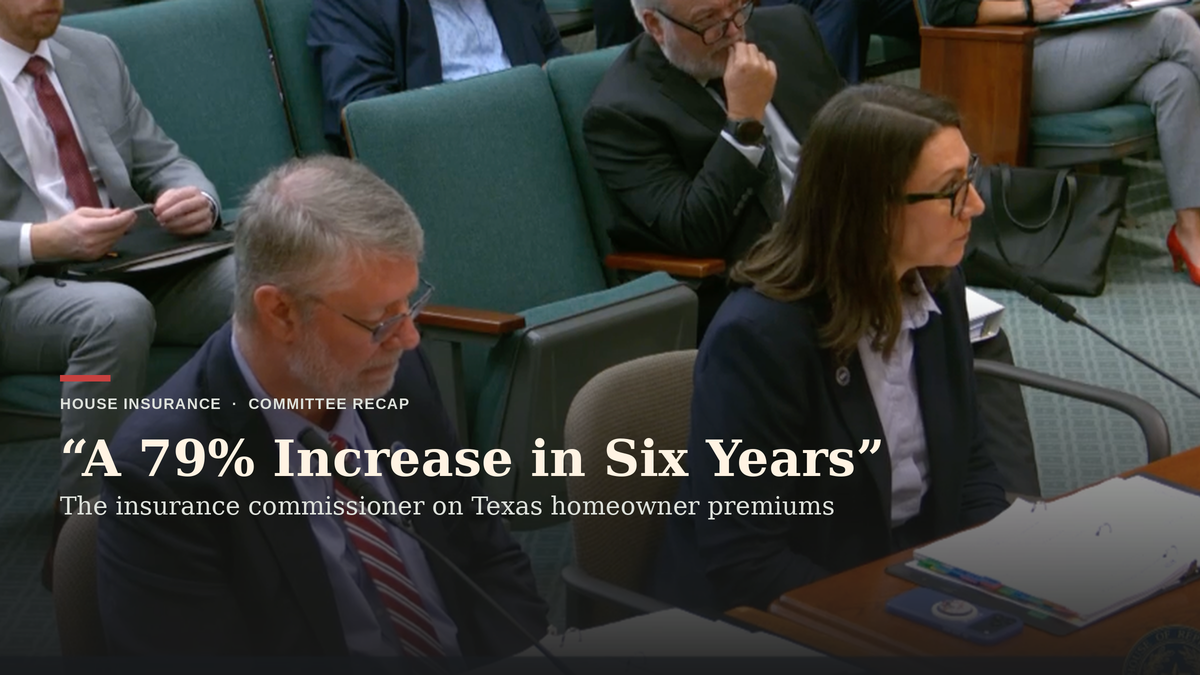
The average Texas homeowner now pays more than $3,500 a year for insurance, up from under $2,000 in 2020. Insurance Commissioner Amanda Crawford gave that figure to lawmakers Oct. 5. Then the committee spent hours asking why regulators have never turned back a rate.
“The average annual homeowner insurance premium in Texas has increased from under $2,000 in 2020 to over $3,500 today. That is a 79% increase in six years,” Crawford told the House Committee on Insurance. She named two causes: “increases in home values and increases in claim costs.” Average coverage amounts are up 51% since 2020, she said. Annual homeowner losses averaged $5.5 billion from 2015 to 2020 and $9.1 billion from 2021 to 2025.
Chair Jay Dean, R-Longview, opened the day by pointing the committee at consumer protection. Referring to the Oklahoma attorney general’s case against State Farm, he said: “I understand and share the concerns that similar practices could be occurring in Texas.” Texas cannot join another state’s lawsuit, he said, and any local complaints belong with the enforcement division of the Texas Department of Insurance, whose investigations are confidential.
Crawford told members she sees “signs of healthy moderation” and said TDI has limited tools. “There are limited levers that we can pull as a regulator based on statute,” she said. What the agency can do, she said, is “drive as much sunshine into what goes behind the decisions of the insurers and make it as transparent as possible.” Texas lets insurers file rates and use them, and Crawford said only about a third of filings take effect on day one.
Members pressed on the gap. Under questioning, Crawford said TDI has formally disapproved no rate. To do so, she said, the agency must go through the State Office of Administrative Hearings, a process she called “complex and lengthy and a time consuming process.” One member noted that the law’s stated purpose for rate review says nothing about affordability: “There is nothing on affordability in the rate review process.” Crawford said the profit test in statute is undefined and carries no numeric cap.
Industry witnesses said regulation is not the problem. A representative of the Insurance Council of Texas said “the efforts to address affordability here have to be focused on losses and risk. Texas cannot sustainably reduce, we don’t believe the cost of insurance by changing how the price is regulated.” He said Texas ranks about 37th in 10-year return on net worth for homeowners coverage and 44th for private passenger auto, and that average filed homeowner rates rose 4.3% in 2025 after double-digit increases from 2022 to 2024.
The roof was the focus of the policy debate. Chelsea Stallings of the National Association of Mutual Insurance Companies said roofs account for 70% to 90% of residential catastrophe losses. “A 30 year roof has a 30 year warranty against manufacturing defects. It is not a warranty against wind, hail, ice, heat or cold,” she said.
Dean asked her: “Roof damages account for 70, 90% of residential catastrophic loss. Should we be licensing roofers?” Stallings answered: “Mr. Chairman, our position is. Yes.” Michael Atkinson, who owns Guardian Roof Systems in Pearland, said Texas has no state roofer license.
Lars Powell, who directs a risk and insurance research center at the University of Alabama, described that state’s fortified-roof program. After a fortified roof is installed, he said, “the premium goes down by about 21%.” Scott Norman Jr. of the Texas Association of Builders said his members are open to incentives but oppose a mandate beyond the building code. A fortified roof, he said, can add “four, five, six, maybe up to $20,000.”
Builders and lenders described the cost to buyers. Trey Summers of Hogan Homes in Corpus Christi said he has seen carriers quote one house and “declining to quote a home, literally just right across the street from one another. So that’s how fickle the market is.” Scott Norman of the Texas Mortgage Bankers Association said Texas has the highest delinquency rate in Ginnie Mae lending, “exceeding 12%,” and serious delinquencies are up about 58% in a year.
Policyholder advocates took aim at claims handling. Adam Brenner, president of the Texas Association of Public Insurance Adjusters, said: “Plainly stated, we have created a pay to play system, one in which resolving an otherwise straightforward property claim can require both sides to spend thousands of dollars simply to establish what should be covered and how much is owed.” Doug Quinn of the American Policyholder Association cited a Weiss Ratings finding that 30.45% of closed Texas homeowner claims in 2025 paid nothing.
Dean closed with a signal for the 90th Legislature. “None of us have not knocked on doors in our districts and, and, not heard people talk about … my insurance is just I can’t afford to stay in my house. That’s not rhetoric, that that’s the truth,” he said. Gov. Greg Abbott wants costs down, Dean said, adding: “I’ve asked him to bring me the legislation, and we’re happy to run with it.” The Texas Dispatch previously reported that Abbott directed TDI to curb rising property insurance costs and that TDI outlined its steps. No vote was taken; the Dispatch previewed the hearing.
The committee also spent about 45 minutes on the Texas Windstorm Insurance Association’s new funding structure and a flap over second-home coverage. Witnesses also reviewed the House Bill 138 cost-analysis program, the appraisal process under Senate Bill 458, and the first reason-code data under House Bill 2067, which showed about 50,000 non-renewals in a quarter against roughly 11.5 million policies, by one industry estimate.
Fact box
- Issue
- Cost drivers, consumer protection and roofing: why Texas homeowner premiums keep climbing (approx. 206 minutes, about 67 percent of the hearing)
- What happened
- Commissioner Amanda Crawford reported a 79 percent premium increase since 2020 and defended file-and-use rate review; industry blamed losses and costs, advocates blamed claims practices, and nearly every witness backed roofer licensing. No vote — interim hearing.
- When
- Monday, Oct. 5, 2026 · run time 5:07:12
- Where
- Room E2.026, Capitol Extension, Austin
- Chair
- Rep. Jay Dean, R–Longview (HD-7); Vice Chair Rep. Hubert Vo, D–Houston (HD-149)
- Key witnesses
- Amanda Crawford, Texas Department of Insurance; Chelsea Stallings, NAMIC; Lars Powell, University of Alabama; Trey Summers, Hogan Homes; Scott Norman, Texas Mortgage Bankers Association; Scott Norman Jr., Texas Association of Builders; Adam Brenner, Texas Association of Public Insurance Adjusters; Doug Quinn, American Policyholder Association
- Archived video
- house.texas.gov video 22757