
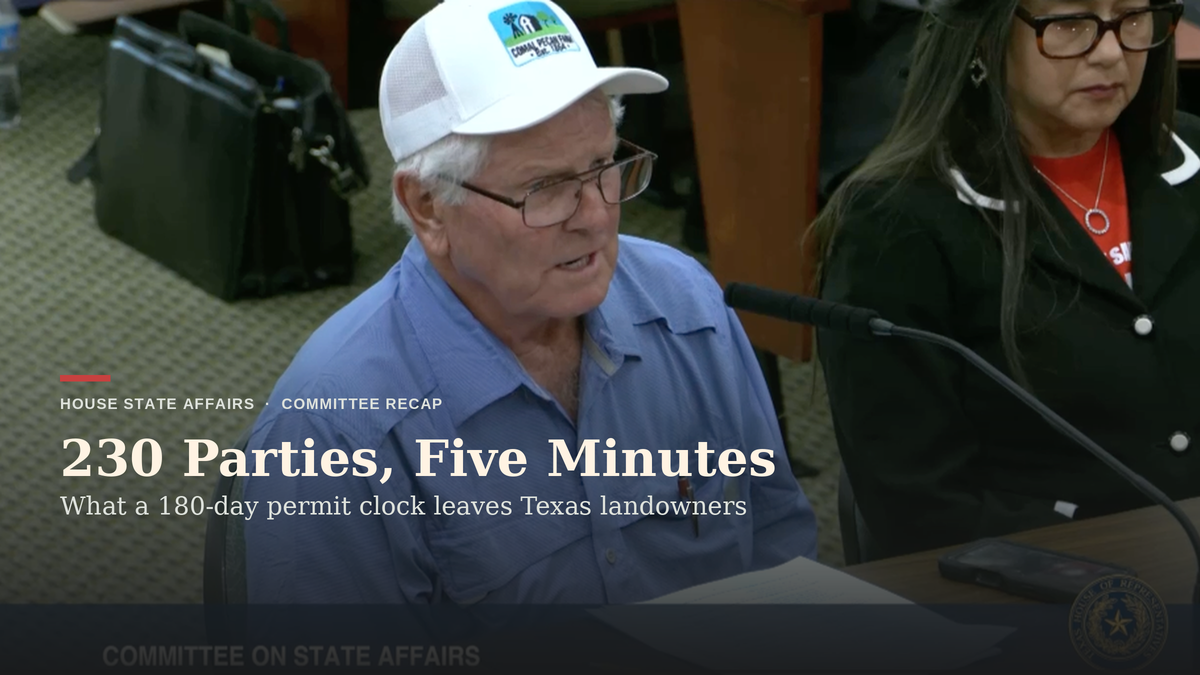
In order to speed up the development of grid infrastructure, the Legislature cut the clock on transmission permits from a year to 180 days. The state’s public counsel told the House Committee on State Affairs on Aug. 19 what that arithmetic leaves for the people whose land is in the way.
Sixty days go to the administrative law judges, Ben Barclay said, and another 30 to 35 to the Public Utility Commission. “That still leaves residential consumers and everyone else, all these landowners, 90 days to litigate this case. And in some instances, that results in a four day hearing where there were 230 parties, who had in some instances, roughly five minutes to conduct cross-examination.”
“And when your land is at stake,” said Barclay, chief executive and public counsel at the Office of Public Utility Counsel, “that’s not an ideal situation for you to be able to fully litigate your case.”
The charge on the state’s first 765-kilovolt lines ran roughly six hours, closing out a twelve-hour sitting. It put four officials at the table at once — the PUC chairman, ERCOT’s chief operating officer, the state’s chief administrative law judge and the public counsel — and the questions kept returning to process rather than voltage.
PUC Chairman Thomas Gleeson opened by trying to move one thing off the committee’s ledger and onto his own. Lawmakers keep hearing that they mandated the extra-high-voltage build, and he said that is not what happened. “When we talk about 5066 and what it did, the one thing I always want to make completely clear, and that is: it did shorten the timeline for CCNs from a year to 180 days,” Gleeson said. “It did not require this build out to be at 765 kV. That was determined by the commission, after a lot of analysis by ERCOT and others about what the most efficient and effective way to build out this transmission plan is going to be. So I just want to always make sure I get that out there on the record.”
House Bill 5066 passed in 2023 and was authored by Rep. Charlie Geren, R–Fort Worth, who sits on the committee and who put the framing question back to the panel: “So this is the plan that 5066 authorized.”
Gleeson traced the decision. The commission approved the Permian Basin Reliability Plan in October 2024; a study weighed “options for 345 kV, 500 kV and 765 kV”; workshops with PUC staff, ERCOT, manufacturers and landowners ran from January through April 2025. “Ultimately, then, in April of 2025, the PUC unanimously approved the 765 kV option,” he said. “There are three import paths, and those are broken up into five distinct projects.” Lower-voltage work rides along underneath, “but obviously the 765 lines are the ones getting the most attention.”
He also told members he is granting every request for oral argument. “When we get asked to do oral argument in these cases, I was going to grant it. We’ve had our first case before us and heard oral argument a few weeks ago.”
Christopher Munson, chief administrative law judge at the State Office of Administrative Hearings, drew the sharpest picture of what the compressed schedule costs. He opened by fencing off what he could not discuss: “I’m ethically barred from discussing the substance of the programs in question. I’m here to just answer your questions about the procedural and logistical impact of the 180 day deadline on these cases.”
Then he explained the step that normally saves everyone time and did not happen here. Ordinarily, after the prehearing conference, “folks have been able to see what everybody’s arguing and align themselves. And often we’ll see, you know, 500 competing routes down to six.” Under the 180-day clock, “that’s an efficiency, for example, that we were not able to realize in this case.”
His agency, he reminded members, is “about 60 lawyers, 60 judges” running a process with “all kinds of procedural requirements, as you would have in a court of law.” He offered to take questions “about the process and the pressure put on us to provide due process.” The docket is moving regardless: “we’re already done with two out of five, and we expect the rest to be out before the end of the month.”
Representative Senfronia Thompson opened a line no one else had raised, asking whether the certificate application process “identified tribal nations whose natural resources, including burials, will be impacted.” Munson said he could not speak directly to it. Pressed on what recourse tribes have “relative to those burial sites and their cultural resources,” the answer from the table was that “the statute provides the amount of notice and participation in these processes.”
Woody Richardson, chief operating officer at ERCOT, took the load-growth questions. Members and witnesses agreed landowners learned too late. Much of the problem “is around education,” one witness said — “that we could have all done a better job of letting the landowners know that if you have a ranch right now that’s been in your family for generations, and a line is currently routed to bisect it.”
Carolyn Quinlan, who came from a ranch southeast of San Angelo that she said her family has held since the 1870s, put the cost in her own terms. “It is grievous what is happening to our beautiful, bountiful land,” she told members. “It is most frustrating to have spent money to defend our properties, and only recently to have our governor call for guidelines and guardrails on transmission line expansion. It behooved him to have done this so many months ago.”
Chairman Ken King, R–Canadian, kept one landowner claim alive rather than dismissing it. Told that the lines may affect livestock, he asked for evidence and set a deadline that points at the next session. “I don’t discount it,” King said. “I don’t know that it has any more effect on cattle than the drought we’re in. But if you do get some concrete evidence or whatever, especially between now and January, contact me, I’d like to know.”
No vote was taken; this was an interim hearing. The 90th Legislature convenes in January 2027.
Also heard
The committee took only two interim charges and split the day almost evenly, sitting just over twelve hours. The morning and early afternoon — roughly six hours — went to data center development and implementation of Senate Bill 6, where the PUC chairman disclosed that the governor has ordered the commission and ERCOT to run a verification audit of ERCOT’s Batch Zero interconnection process, ERCOT put the interconnection queue at nearly 500 gigawatts, and the public counsel pressed for exit obligations on large loads that walk away from twenty-year commitments.
Fact box
Issue
Interim charge reviewing the regulatory and planning process for the proposed 765-kilovolt transmission lines (~361 minutes, roughly 49% of the hearing)
What happened
The public counsel told members the 180-day permitting clock leaves landowners about 90 days to litigate, producing a four-day hearing with 230 parties and roughly five minutes of cross-examination each; the chief administrative law judge said the compressed schedule cost the process its usual route-consolidation step; the PUC chairman said HB 5066 shortened the timeline but did not mandate 765 kV, which the commission chose in April 2025; no vote (interim hearing)
When
Wednesday, Aug. 19, 2026, 8:00 AM CT · run time 12:08:30 · this charge ran from about 2:08 p.m. to adjournment
Where
Room JHR 140, John H. Reagan Building, Austin
Chair
Rep. Ken King, R–Canadian (HD-88)
Archived video
house.texas.gov, video 22746