
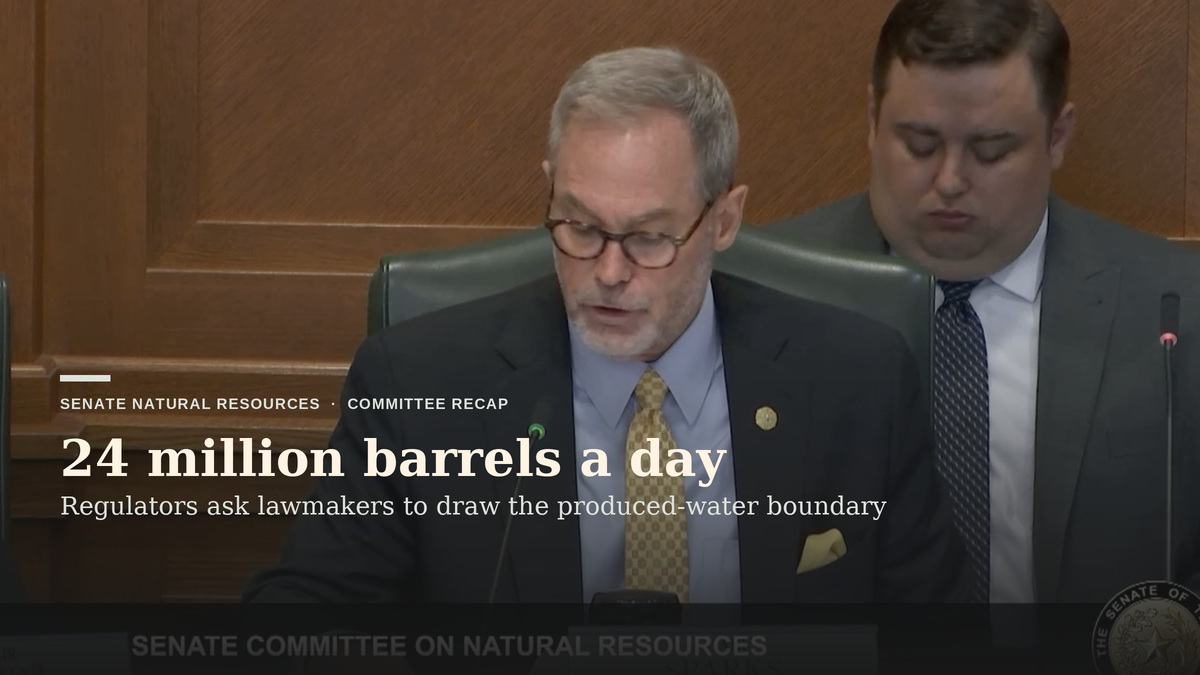
Texas oil and gas wells surface roughly 24 million barrels of salty water every day — more than a billion gallons — and the state’s plan to turn that waste stream into a water supply now hinges on rules still being written and a jurisdictional boundary two agencies admit they cannot locate.
That was the picture that emerged Tuesday as the Senate Committee on Natural Resources spent about an hour and a half on its charge to monitor Senate Bill 1145 and House Bill 49, the 2025 laws meant to move produced water from disposal wells toward treatment and reuse.
Railroad Commission Chairman Jim Wright told the panel the pressure behind the policy is geological as much as economic. Most produced water has historically gone down injection wells, he said, “but disposal capacity is becoming increasingly constrained as the Railroad Commission takes necessary steps to address seismicity, rising formation pressures and the risk of surface breakouts.”
His headline request was aimed at the dais, not the industry: “One of the requests that I would like to make as chairman of the Railroad Commission is that this legislative session consider exactly where those authorities end and begin,” Wright said of his agency’s boundary with the Texas Commission on Environmental Quality.
He and TCEQ Executive Director Kelly Keel “have been trying to figure out exactly where does mine stop and hers begins,” he said. Keel agreed the questions are getting sharper as permits become real: “We’re getting these site-specific questions from applicants and from other interested parties,” she said, pledging to “implement any legislation and work with our partner agencies” if lawmakers redraw the line.
Keel walked members through the machinery The Texas Dispatch has previously reported on: TCEQ holds federally delegated authority, granted by the EPA in January 2021, to permit discharges of treated produced water into surface waters, and it has reissued two discharge permits inherited from the Railroad Commission. Under SB 1145’s new land-application program, she said, the agency is “currently evaluating seven TLAP permit applications,” each site-specific and subject to technical review, two public notices, public meetings and a potential contested-case hearing.
Pressed from the dais on whether the agency has a working definition of treated produced water and a plan to monitor contaminants that set produced water apart from other wastewater, Keel said TCEQ is “leveraging the existing permit process” while drawing on consortium science to decide “what additional framework pieces do we need… to ensure that they’re protective of public health and the environment.”
The scale argument came from industry. Trace Finley, president of the Texas Independent Produced Water Association, converted the daily volumes into water-supply terms: “Texas wells don’t just produce enough water to fill Lake Travis every year. They produce roughly double what lakes Buchanan and Travis combined reliably supply to every city and industry.”
Shane Walker, the Texas Tech professor who directs the Texas Produced Water Consortium created by Senate Bill 601 in 2021, said the consortium’s 27 faculty and more than 50 members have “performed a rigorous water quality analysis of pilot treatment systems in the Permian Basin.”
Michael Lozano of the Permian Basin Petroleum Association rounded out the industry panel. Chairman Kevin Sparks, R-Midland, opening the charge, framed the stakes in supply terms: treatment and reuse “offers a practical path forward by reducing dependence on injection wells, supporting continued energy production, and provides an opportunity to create a new source of usable water” — so long as the state provides “regulatory certainty.”
The caution came late in the charge, and it was specific. Julie Range, policy manager for Commission Shift, said her organization was “cautiously optimistic” when SB 1145 moved land-application oversight to TCEQ. “However, we are highly concerned that the rules proposed fail to establish protective surface water quality standards for numerous hazardous compounds in produced water, and they set no concrete limits to guarantee treatment meets those standards,” she testified, referencing the draft rules the Dispatch has covered.
The consortium’s 2026 report shows “encouraging observations” across five pilot tests, Range said, “but the report falls short of demonstrating that this technology is mature, reliable, and ready for commercial viability.” Her warning to the committee doubled as political advice: “You need to bring the public along on this.”
The exchange that may matter most in January 2027 came when Wright was asked directly whether the Railroad Commission has all the tools it needs to facilitate discharges. His answer — that the Legislature should settle where TCEQ’s authority begins — points to a produced-water cleanup bill in the 90th session, alongside whatever emerges from TCEQ’s still-pending land-application rules.
Because the committee met in the interim, it took no votes; members’ questions and the agencies’ answers will feed the recommendations the panel sends to the next Legislature.
Also heard
The committee opened with roughly 53 minutes of agency oversight testimony from TCEQ, the Railroad Commission and the General Land Office — including Sen. Bryan Hughes’ questions about groundwater and surface water policy and a GLO explanation of how it manages oil and gas leases across 13 million acres for the Permanent School Fund. The bulk of the day, about 210 minutes, went to the wildfire-preparedness charge, covered in the companion recap, “‘Fire almost doubles in size every 60 seconds’: Texas takes stock of its wildfire defenses before the next Smokehouse Creek.”
Hearing at a glance
Issue
Monitoring charge — implementation of SB 1145 and HB 49, produced water and oilfield waste (~85 minutes, ~25% of hearing)
What happened
RRC and TCEQ reported rulemaking and permitting progress and asked the Legislature to clarify the jurisdictional line between them; industry urged regulatory certainty; Commission Shift said proposed rules lack concrete protective limits; no vote (interim hearing)
When
Tuesday, August 11, 2026, 9:00 AM CT · run time ~5:48
Where
Room E1.012, Capitol Extension, AustinChairSen. Kevin Sparks, R-Midland (SD-31)
Key witnesses
Jim Wright (RRC chairman); Kelly Keel (TCEQ executive director); Trace Finley (Texas Independent Produced Water Association); Shane Walker (Texas Produced Water Consortium); Michael Lozano (PBPA); Julie Range (Commission Shift)
Archived video
senate.texas.gov, vid 22698