
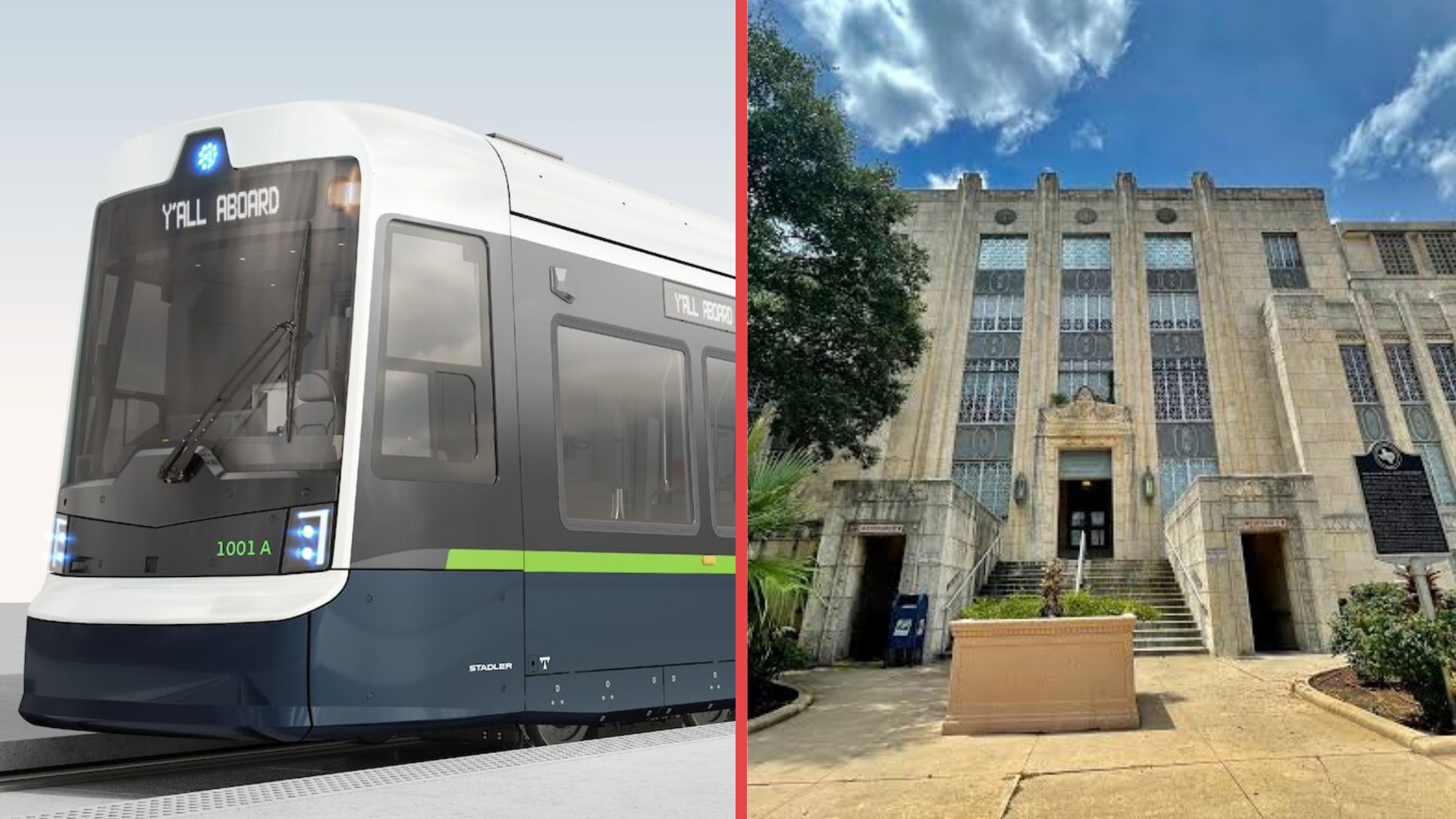
A Travis County district court is scheduled to take up Austin’s long-running Project Connect tax fight Thursday morning, in a hearing that will determine whether a court finally rules on the legality of the property tax increase voters approved in 2020 — or whether the case detours into another round of procedural appeals.
The 53rd District Court has three matters before it at the 9 a.m. hearing, according to a press packet distributed by Bill Aleshire, the former Travis County judge representing five taxpayers suing the city. No witnesses will testify; the hearing is legal argument only.
At issue is a financing structure that has been contested almost since the day it was approved. In November 2020, Austin voters raised the city’s property tax rate by 20% to fund Project Connect, a $7.1 billion transit program. Roughly 242,000 voters said yes, carrying the measure, according to the Texas Tribune. What that money bought — and whether the city may lawfully spend it the way it now plans to — has been in dispute ever since.
The 2020 plan promised a roughly 27-mile rail system with a downtown tunnel and a direct connection to Austin-Bergstrom International Airport, with the rail component budgeted at $5.8 billion. Costs escalated sharply, and in summer 2023 city officials adopted a scaled-back plan: a single 9.8-mile line, no tunnel, no airport connection, and 15 stations instead of 26.
The Texas Tribune reported in May that the light rail component alone now carries an $8.2 billion price tag and that the project works out to roughly $840 million per mile — a calculation the Austin Transit Partnership disputes, arguing it should exclude one-time costs such as vehicles, a maintenance facility, financing and professional services.
ATP has secured a federal environmental clearance, received a medium-high rating from the Federal Transit Administration and approved a $60 million initial design-build contract, but it has not received any of the $4.1 billion in federal funding it is seeking and was promised to voters. The agency says it will break ground in 2027 with or without federal dollars; passenger service is not expected before 2033.
The legal fight traces to 2023, when state Sen. Paul Bettencourt, R-Houston, asked the attorney general’s office whether the financing mechanism was lawful. In May 2023, the office issued Opinion KP-0444, a nonbinding opinion concluding that the Tax Code does not authorize a city to earmark maintenance-and-operations tax revenue for debt service.
Mayor Kirk Watson read the opinion differently. “The advisory opinion issued by the Attorney General today upholds the will of Austin voters and reinforces that the City of Austin’s tax ratification election in 2020 was conducted in full compliance with state law,” he said in a statement at the time, according to the Austin Monitor.
Taxpayers sued in late 2023. In February 2024, ATP authorized $150 million in 40-year bonds, and the city and ATP filed a separate suit under Chapter 1205 of the Government Code — the Expedited Declaratory Judgment Act — asking a court to validate the bonds. The city council also amended the funding agreement with ATP that month to specify that the revenue transfer is subject to annual appropriation, a change ATP’s audited financial statements reflect.
The attorney general’s office challenged the city and ATP’s right to bring that suit at all, arguing neither qualifies as an “issuer” under the statute. That challenge went undecided for two years. The trial court took the plea under advisement and proceeded to a bench trial in June 2024 without ruling on it; the 15th Court of Appeals dismissed the state’s interlocutory appeal that October.
On May 22, 2026, the Texas Supreme Court intervened. In Paxton v. City of Austin, Chief Justice Jimmy Blacklock wrote that proceeding to trial without resolving the jurisdictional challenge “was an abuse of the district court’s otherwise broad discretion,” adding: “Nothing about this scenario is as it should be. A court may not decline to rule on challenges to its jurisdiction, which should always be addressed before proceeding to the merits.” The court construed the state’s petition as a mandamus request and directed the trial court to rule on the plea — while stating plainly, “We express no view on the State’s jurisdictional arguments.”
The taxpayers — Dirty Martin’s Place, former state Sen. Gonzalo Barrientos, former Travis County Commissioner Margaret Gómez, former Council Member Ora Houston and East Austin community leader Susana Almanza — argue the maintenance-and-operations tax cannot lawfully be spent on bond debt, that routing it through a city-created corporation does not cure the problem, and that the 2020 ballot’s open-ended dedication of the tax created a perpetual obligation the Texas Constitution forbids without a bond election.
Their packet says that by the end of 2026, Austin taxpayers will have paid approximately $1 billion under the tax without any court ruling on its legality. ATP’s audited financial reports show the agency received $159.8 million from the city in fiscal 2023 and $166.4 million in fiscal 2024; KUT has reported the tax is projected to generate $185.8 million in fiscal 2026.
The plaintiffs say they are not asking the court to stop transit, and that a lawful, voter-approved bond proposition would moot the case.
The city and ATP have argued that the council reserved discretion to refine the project as designs advanced, that the scaled-back plan is consistent with the city’s commitments to voters, and that the attorney general’s office has approved similar financing arrangements elsewhere. After the Supreme Court ruling, ATP said in a statement that “the procedural ruling means that the case can now move forward,” adding that it remains “confident in our case” and on schedule to begin construction in 2027.
The two sides now disagree about how much the court should decide Thursday. Aleshire says that on Aug. 7, ATP’s counsel wrote the court that ATP and the city are “opposed to having the Cross-Motion for Partial Summary Judgment… heard at next Thursday’s hearing,” leaving the jurisdictional question as the day’s main event. Neither the city nor ATP has issued a public statement specific to Thursday’s hearing; their most recent public comments on the litigation came in June.
If the court rules only on jurisdiction, the tax continues to be collected while the underlying question goes unanswered — as it has for two and a half years. A ruling either way could trigger another interlocutory appeal. Each previous one has taken roughly a year.